The greatest threat to your collection isn’t a single catastrophic event, but the slow, invisible damage from minor environmental shifts that standard building systems are not designed to prevent.
- Standard HVAC systems create cyclical fluctuations that induce “material fatigue” in organic artifacts, leading to cracking and delamination.
- A multi-layered defense system, combining macro-environmental controls with passive microclimates, provides far greater protection than a single, fallible solution.
Recommendation: Shift focus from achieving a single “perfect” humidity number to implementing strategies that ensure long-term stability at every level of your facility, starting with an audit of your storage materials and microclimates.
For a newly appointed curator inheriting an older building, the environmental control panel often represents a source of constant anxiety. The conventional wisdom suggests that preserving priceless artifacts requires a multi-million dollar, state-of-the-art HVAC system—an impossible-to-obtain luxury for many institutions. This leads to a reliance on standard commercial systems that, while adequate for human comfort, are actively detrimental to the long-term health of a collection. These systems are designed with setbacks and wide operating tolerances that introduce the very enemy of preservation: fluctuation.
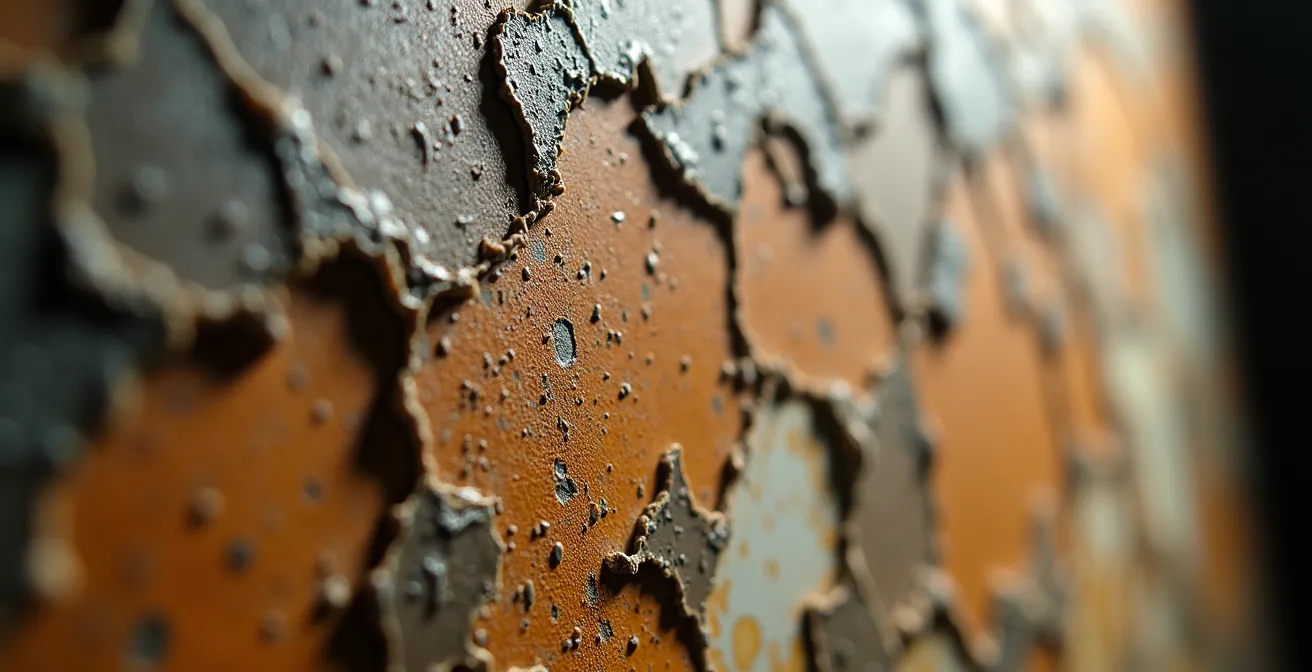
The core problem lies in a misunderstanding of the physics of decay. Hygroscopic materials like wood, canvas, and paper are in a constant state of exchange with the moisture in the air. They absorb and release water vapor, causing them to swell and shrink. While a stable environment allows them to reach equilibrium, even a minor 5% swing in relative humidity (RH) forces a dimensional change. When this happens day after day, the object experiences a form of material fatigue. The bonds between layers—such as a gesso ground, a paint layer, and a varnish on a wooden panel—are stressed to their breaking point. This is how a seemingly insignificant fluctuation becomes the root cause of cracks, flaking paint, and irreversible warping.
This article moves beyond the simplistic advice to “control the climate.” It adopts a “defensive layers” approach, demonstrating how to protect a collection by understanding the science of decay and implementing a hierarchy of controls. We will explore why standard systems fail, how to build effective low-tech microclimates, how to identify hidden threats in your storage, and how to create a strategic plan for both emergency response and long-term reorganization. The goal is to empower curators to make significant improvements to preservation outcomes, even within the constraints of a tight budget and aging infrastructure.
This guide provides a structured approach to building a robust preservation environment. The following sections break down the critical components, from large-scale systems to micro-level interventions, to help you establish institutional-grade standards of care.
Summary: Why a 5% Humidity Fluctuation Can Wreck Your Collection
- Why standard HVAC systems fail to protect artworks older than 100 years?
- How to build a silica gel micro-climate for a display case without a power source?
- Active climate control vs. passive buffering: Which is safer for organic materials?
- The invisible pollutant source in your storage room that destroys varnish
- What to do within the first 60 minutes of a climate control failure in the gallery?
- When to stop hoping for humidity to fix a warp and intervene surgically?
- The weight calculation mistake that cracks the slab under your sculpture rack
- How to Reorganize a Museum Storage Facility to Gain 30% More Space?
Why standard HVAC systems fail to protect artworks older than 100 years?
Standard commercial HVAC (Heating, Ventilation, and Air Conditioning) systems are fundamentally designed for human comfort and energy efficiency, two goals that are often at odds with artifact preservation. Their primary failure lies in their inability to maintain the strict environmental stability required by delicate, aged materials. A typical office HVAC system may allow relative humidity to swing by ±10-15%, a range that is catastrophic for hygroscopic objects. Furthermore, these systems often incorporate energy-saving setbacks for nights or weekends, during which temperature and humidity are allowed to drift, introducing damaging cyclical stress.
The chemistry of decay is unforgiving and accelerates with environmental instability. Research from the Image Permanence Institute demonstrates that for every 9°F (5°C) increase in temperature, the rate of chemical decay doubles. This process—which includes the yellowing of paper and the embrittlement of varnishes—is exacerbated by humidity fluctuations. Museum-grade systems, by contrast, are engineered for 24/7 stable operation with no setbacks. They are designed with the capacity to maintain humidity within a much tighter tolerance, often ±3% to ±5% RH, and use superior filtration (MERV-13 or higher) to remove not just particulates but also gaseous pollutants like ozone and sulfur dioxide that attack surfaces.
The difference is not merely incremental; it’s a completely different engineering philosophy. A museum HVAC must account for the unique challenges of a historic building, such as high air infiltration, which may require 30-50% more capacity than standard calculations suggest. It also requires dual-redundant components, like chillers and humidifiers, to ensure that a single point of failure doesn’t lead to a complete loss of control. For a curator in an older facility, recognizing these inherent shortcomings is the first step toward building compensatory defensive layers.
How to build a silica gel micro-climate for a display case without a power source?
When macro-environmental control is unreliable, the most effective strategy is to create a stable microclimate within a sealed enclosure, such as a display or storage case. This is a core principle of the “defensive layers” approach. The most powerful tool for this task is silica gel, a desiccant that can be “conditioned” to buffer a small volume of air at a specific relative humidity (RH) level. This passive method requires no power and can provide exceptional stability for the most sensitive objects. The scale of this practice is significant; for example, the Penn Museum currently maintains approximately 300 kg (661 lbs) of silica gel across its galleries to stabilize environments.
The process involves selecting the right type of silica gel, calculating the required amount, and placing it within the case. Not all silica gel is the same. Its buffering capacity varies depending on its type and the target RH, making the right choice critical for success. The key is to create a well-sealed enclosure to minimize the “load” on the silica gel from the surrounding ambient air.
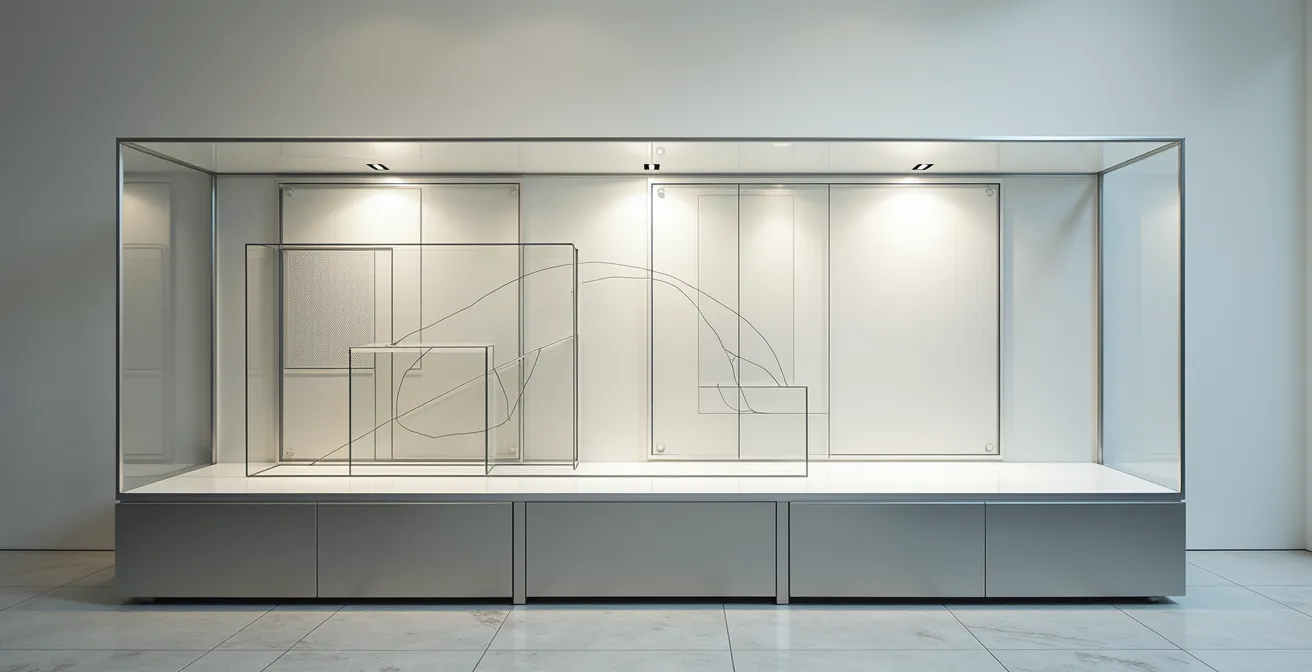
As the illustration shows, a professionally designed case incorporates hidden compartments, often in the base, to hold the silica gel. Perforated panels allow air to circulate between the artifact chamber and the desiccant, creating a stable RH buffer. The amount of gel needed depends on the case’s air exchange rate, the volume of the case, and the ambient environmental conditions. As a rule of thumb, more is better, as it increases the buffering capacity and extends the time between reconditioning cycles.
The following table provides a guide to choosing the correct silica gel for your collection’s needs.
| Silica Gel Type | Optimal RH Range | Buffering Capacity | Application |
|---|---|---|---|
| Regular Density | 30-45% RH | High below 45%, Low above 50% | Dry storage for metals |
| Art-Sorb | 45-60% RH | Lower below 45%, High above 60% | Mixed collections |
| ProSorb | 40-60% RH | Consistent across range | General museum use |
Active climate control vs. passive buffering: Which is safer for organic materials?
The debate between active and passive climate control centers on a trade-off between precision and risk. Active microclimate systems use small, powered devices (heaters, coolers, humidifiers, dehumidifiers) within an enclosure to maintain a precise setpoint. These systems can be remarkably effective, with some commercial units able to maintain ±1.5% RH precision within a 35-75% range. This level of control is ideal for extremely sensitive objects, such as ivories or certain manuscripts, that require a very specific environment different from the rest of the gallery. The Louvre’s sophisticated zoning, with 24 separate climate zones, is an example of this philosophy on a macro scale, targeting different conditions for Islamic arts versus paintings.
However, this precision comes with risks. Active systems are complex machines with potential points of failure. A malfunction could rapidly drive the environment to dangerous extremes—for example, a stuck humidifier could raise the RH to 100%, promoting mold growth in hours. They are also dependent on a continuous power supply, making them vulnerable during outages unless connected to a reliable backup generator. This complexity and failure risk can make them a nerve-wracking choice for a facility without 24/7 engineering support.
Passive buffering, using materials like silica gel or acid-free paper products, offers a “safer” alternative in terms of failure mode. A passive system cannot fail catastrophically; its worst-case scenario is that it becomes exhausted and simply stops buffering, allowing the microclimate to slowly drift toward the ambient conditions. While it cannot achieve the pinpoint precision of an active system, it excels at dampening the rapid fluctuations that cause the most material fatigue. For most organic materials, the goal is stability above all else. A passively buffered case that holds RH steady within a ±5% band is often a safer and more practical choice than a high-tech active system with inherent failure risks, especially in an institution with limited resources.
The invisible pollutant source in your storage room that destroys varnish
While humidity and temperature are the most discussed environmental factors, gaseous pollutants represent an insidious and often overlooked threat to collections. These airborne chemicals can cause irreversible damage, from the yellowing and embrittlement of varnishes to the corrosion of metals. One of the most significant dangers is that the source of these pollutants is often the storage furniture and building materials themselves. This internal “pollutant load” can create a toxic microenvironment, even in a room with otherwise stable climate control.
Materials like medium-density fiberboard (MDF), particleboard, and certain paints and adhesives release a cocktail of volatile organic compounds (VOCs), the most notorious of which is formaldehyde. This chemical actively cross-links with the molecules in paint, varnish, and textiles, causing them to become brittle and discolored. Other culprits include acetic acid off-gassed from wood products and sulfurous compounds from rubber-based materials.
MDF or particleboard shelving releases formaldehyde, certain powder coatings and plastics can off-gas, requiring specification of conservation-grade materials like sealed steel or anodized aluminum.
– Museum Conservation Guidelines, HVAC Control Requirements for Museum Storage
Eliminating these sources is a critical preservation activity. It requires a systematic audit of all materials within the storage and exhibition spaces. This includes shelving, cabinets, object mounts, and even cleaning products, many of which contain harmful agents like ammonia or citrus oils. The ideal is to use inert materials such as powder-coated steel, anodized aluminum, and archival-quality polymers for all collection contact and storage applications.
Your Action Plan: Eliminating Storage Room Pollutants
- Audit storage furniture: Systematically identify and inventory all storage furniture. Prioritize the replacement of any MDF or particleboard units with sealed metal or anodized aluminum shelving.
- Establish quarantine protocols: Designate a separate, well-ventilated space for new acquisitions and materials (e.g., crate wood, mounts) to off-gas for several weeks before they are integrated into main collection areas.
- Review cleaning supplies: Remove all cleaning products containing ammonia, bleach, or citrus oils. Replace them with conservation-safe, neutral pH detergents and deionized water.
- Install gas-phase filtration: If VOCs are a known issue, add activated carbon filters to your HVAC system or use standalone air purifiers with carbon media in storage rooms to actively capture gaseous pollutants.
- Monitor air quality: Deploy specialized sensors or passive sampling tubes to periodically test for key pollutants like formaldehyde and acetic acid to verify that your mitigation efforts are effective.
What to do within the first 60 minutes of a climate control failure in the gallery?
A sudden HVAC failure is one of a curator’s worst nightmares. The moments immediately following the failure are critical, as the gallery environment can begin to change rapidly, exposing artworks to thermal shock and humidity swings. A well-rehearsed emergency response plan is the only way to mitigate damage. The primary goal within the first hour is not to fix the HVAC, but to slow the rate of environmental change and protect the most vulnerable objects through a process of “environmental triage.”
The first action is to assess the situation. Is the failure system-wide or isolated to one zone? What is the outdoor weather, and how will it influence the indoor drift? The response team should immediately begin monitoring temperature and RH in critical locations with handheld data loggers. The second step is to seal the affected area as much as possible by closing doors, windows, and vents to create a temporary vapor barrier and slow air exchange with uncontrolled spaces. This simple action can buy precious time.
The response then shifts to active stabilization, often using low-tech tools. For instance, teams can deploy portable fans to prevent air stratification and the formation of damp microclimates where mold could grow. In a scenario where humidity is dropping, they might unroll large sheets of polyethylene plastic over vitrines or open-shelf storage to trap existing moisture. In a rising humidity crisis, the priority is to increase air circulation to prevent condensation on cool surfaces.

As this image conveys, a coordinated response is key. Comprehensive disaster plans include pre-set emergency HVAC settings and protocols for activating backup power systems to maintain at least minimal control. Every staff member should know their role, where the emergency supplies are stored, and which objects in the collection are on the “platinum list”—those most susceptible to damage and requiring immediate attention. This first hour is about calm, decisive action to buffer the collection from the shock of a sudden environmental shift.
When to stop hoping for humidity to fix a warp and intervene surgically?
When a wooden panel or canvas begins to warp, the first instinct is often to adjust the environmental humidity in the hope that the object will relax back into shape. This can be effective for minor, recent distortions. However, there is a critical point where this passive approach becomes futile, or even dangerous, and a “surgical” intervention by a trained conservator is required. Knowing when to make that call is a crucial collections care decision, balancing the desire to avoid invasive treatment with the risk of allowing damage to become permanent.
The decision should be based on objective data, not just hope. The first factor is the stability of the environment. General conservation standards indicate that relative humidity below 30% causes embrittlement, while levels above 70% can trigger mold growth. If a warp occurred because of an excursion outside this safe range, returning the object to a stable 45-55% RH is a logical first step. However, if the warp persists for weeks or months within a stable environment, the material has likely undergone a permanent “set” or deformation. At this point, humidity alone will not correct it.
The second factor is the condition of the paint and ground layers. If the warping is accompanied by active flaking, cracking, or lifting of the paint, immediate intervention is necessary. Continued dimensional changes, even minor ones, will lead to further paint loss. A conservator may need to perform a structural treatment, such as applying a reinforcing cradle to the back of a panel or performing a strip-lining on a canvas, to stabilize the support before any further damage occurs.
The following decision matrix, based on conservation principles, can help guide the process from monitoring to intervention.
| Damage Indicator | Wait & Monitor | Passive Intervention | Surgical Intervention |
|---|---|---|---|
| Dimensional Change Rate | <0.5mm/month | 0.5-2mm/month | >2mm/month |
| Paint Layer Condition | Stable adhesion | Minor lifting | Active flaking/loss |
| Support Significance | Reproduction | Period replacement | Original historic |
| Exhibition Priority | Storage only | Study collection | Major exhibition |
The weight calculation mistake that cracks the slab under your sculpture rack
The focus on environmental control can sometimes overshadow an equally critical and dangerous aspect of collections storage: structural integrity. The sheer weight of collection objects, particularly when concentrated in high-density storage systems, can exert immense pressure on a building’s structure. A common and catastrophic mistake is to miscalculate the load, leading to deflection, cracking, or even the failure of the concrete floor slab.
This error often stems from a misunderstanding of different types of structural loads. Engineers distinguish between “live loads” (temporary, dynamic forces like people or movable carts) and “dead loads” (permanent, static forces like the building’s own structure and permanently installed fixtures). High-density storage racks, once filled, are considered dead loads and are subject to stricter safety factors. However, the most critical concept is the “point load.” While a floor may be rated for a certain number of pounds per square foot (PSF) as a distributed load, a storage rack concentrates its entire weight onto a few small feet, each creating a point load with an extremely high pounds per square inch (PSI) value.
Imagine a 10,000-pound sculpture rack resting on four feet, each with a 2×2 inch surface area. The total weight is distributed over just 16 square inches. Each foot exerts a pressure of 2,500 pounds, creating a point load of 625 PSI. This concentrated force can easily exceed the compressive strength of an older concrete slab, causing it to punch through or crack, even if the overall PSF rating for the room seems adequate. For this reason, commissioning a new structural engineering survey is non-negotiable before installing or reorganizing heavy storage systems, especially in historic buildings not originally designed for such loads. The survey will identify the location of beams and columns, determine the true capacity of the slab, and may recommend the use of steel plates under rack feet to distribute the point loads over a wider area.
Key Takeaways
- Environmental stability, not a specific number, is the primary goal for preserving organic materials.
- A “defensive layers” strategy combining room control, sealed enclosures, and passive buffers is more resilient than relying on a single HVAC system.
- Invisible threats from off-gassing storage materials and underestimated structural loads pose significant risks to collections.
How to Reorganize a Museum Storage Facility to Gain 30% More Space?
For many institutions, storage space is at a premium. The challenge is to increase density without compromising preservation standards. The conventional approach organizes collections by discipline, size, or artist, but a far more effective method for both space efficiency and preservation is a risk-based zoning strategy. This involves reorganizing the entire storage facility based on the environmental sensitivity of the objects.
This strategy creates distinct zones within the storage vault, each with different environmental targets. For example, a “platinum” zone with the tightest climate control (e.g., 50% RH ±3%) would be reserved for the most sensitive organic materials like panel paintings and manuscripts. A “gold” zone might have slightly wider tolerances (e.g., 40-60% RH) for stable textiles and furniture. Finally, a “silver” or desiccated zone would be maintained at a very low humidity (<30% RH) specifically for metals, which are vulnerable to corrosion but indifferent to the conditions that damage organics. This approach is exemplified by the Penn Museum’s storage, where strategic zoning allows for roughly two-thirds of the space to be conditioned to 40-60% RH while one-third is desiccated for metals.
By grouping objects with similar needs, an institution can consolidate its most sensitive items into a smaller, more easily controlled area. This allows for more targeted and efficient use of high-performance HVAC systems, reducing overall energy consumption. The less sensitive objects can then be housed in areas with less stringent controls or in high-density systems that might have been unsuitable for the “platinum” collection. This risk-based approach prioritizes preservation by applying the most resources where they are most needed, and in doing so, it often liberates significant floor space by allowing for more compact storage of robust materials. It’s a strategic reorganization that enhances both safety and capacity.
By moving from a reactive to a proactive and strategic mindset, a curator can create a robust and resilient preservation environment. The next logical step is to begin a systematic audit of your own institution, identifying risks and opportunities for improvement at every layer of defense.