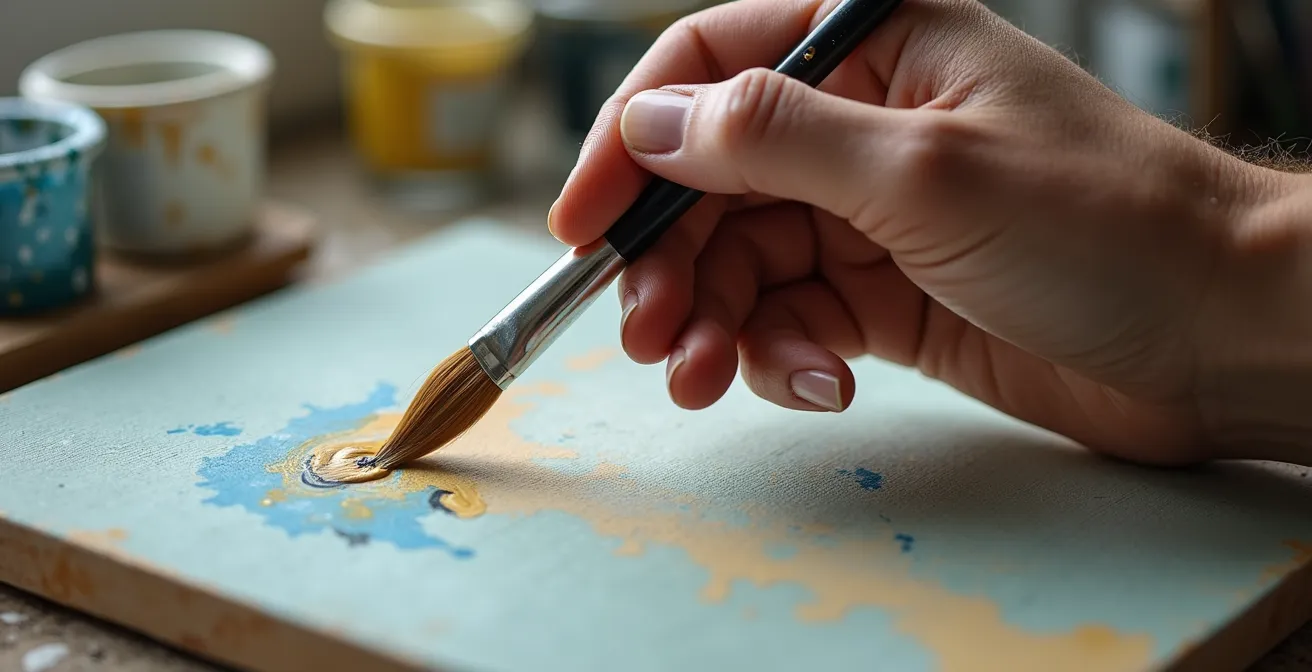
Expressive painting isn’t about abandoning control; it’s about courageously shifting control from hesitant details to bold, physical decisions about energy and rhythm.
- Your brush grip, paint viscosity, and shoulder movement are the true engines of expressive power, not a lack of discipline.
- Accuracy is a “budget” you spend strategically on key edges, not something you sprinkle evenly over the entire canvas.
Recommendation: Stop trying to “loosen up” and start focusing on making powerful, decisive marks. The freedom you seek is found in deliberate energy, not in accidental mess.
You are a master of control. Every line is precise, every detail rendered with care. Your drawings are accurate, your forms are solid. Yet, when you look at your paintings, something feels trapped. You admire the wild, energetic brushwork of others, but the thought of letting go of that hard-won accuracy fills you with a paralyzing fear of creating a muddy, incoherent mess. You’ve been told to “use a bigger brush” or “just be looser,” but this advice feels like being told to jump off a cliff without a parachute. It ignores the skill you’ve built and offers no real path forward.
The struggle is real, but it’s based on a fundamental misunderstanding. The goal is not to abandon your skill for accuracy. It’s to redefine what “accuracy” means in the context of paint. It’s not about the precision of a pencil point; it’s about the truthfulness of a gesture, the energy of a mark, the physical presence of the paint itself. True expressive freedom doesn’t come from chaos, but from a new kind of control—one that is physical, rhythmic, and strategically bold.
This guide is for you, the disciplined artist ready for a breakthrough. We will dismantle the idea that you have to choose between energy and accuracy. Instead, you will learn to channel your discipline into the physicality of painting. We will explore how to make your brush an extension of your entire body, how to treat paint like a sculptural medium, and how to make every single stroke a confident, irreversible decision. It’s time to stop trying to be loose and start learning to be powerful.
To guide you on this journey of liberation, we will break down the essential physical and strategic shifts you need to make. This article covers everything from the mechanics of your grip to the philosophy of your artistic vision in a digital age, providing a clear roadmap to unleash your brushwork.
Summary: Unleashing Your Brushwork: A Guide to Expressive Painting
- Why holding the brush at the ferrule kills your gestural energy?
- How to manipulate paint viscosity to create rhythm in a single stroke?
- Stiff Bristle vs. Soft Synthetic: Which brush drives the energy of the painting?
- The “one stroke too many” error that turns expressive art into mud
- When to use a lost edge vs. a found edge to guide the viewer’s eye?
- How to paint from the shoulder to create marks that feel monumental?
- How to load multi-colored paint on a knife for a single complex stroke?
- How to Find Your Unique Artistic Vision When Everyone Has a Camera?
Why holding the brush at the ferrule kills your gestural energy?
Your default grip is likely a tight, pencil-like hold, with your fingers choked up on the metal ferrule. This is the grip of control, of drawing, of painstaking detail. It’s what allows you to place a mark with pinpoint accuracy. And that is precisely the problem. This grip isolates movement to your fingers and wrist, producing small, tight, and cautious marks. It’s physically impossible to create a sweeping, energetic stroke from this position. The very act of holding the brush this way sends a signal to your brain: “Be careful. Stay small. Don’t make a mistake.”
Research on brush handling techniques confirms this; a tight grip on the ferrule is designed for maximum control. Studies show that metal ferrule grips create 70% more controlled marks compared to holding the brush at the end of the handle. While this control is an asset for a draftsman, it becomes a cage for a painter seeking expression. To unleash gestural energy, you must physically distance yourself from the point of contact. By moving your grip back, you force the movement to originate from your elbow and shoulder, transforming a timid dab into a confident sweep.
This isn’t about losing control; it’s about transferring control to a larger, more powerful set of muscles. The “drawing” is no longer happening at the tip of the bristles, but in the arc of your entire arm. To feel this difference, you must practice it physically. The Three Grips Drill is a non-negotiable first step to internalizing this new physical language and understanding how grip directly translates into mark energy.
How to manipulate paint viscosity to create rhythm in a single stroke?
For the detail-oriented painter, paint is often just color. You use it as a thin film to “fill in” the shapes you’ve drawn. To break free, you must start thinking of paint as a physical, sculptural substance with its own properties. The most important of these is viscosity—its thickness or thinness. Manipulating viscosity is like a composer using different notes and tempos; it allows you to create rhythm, texture, and emotion in a single stroke.
Imagine a brushstroke not as a flat line, but as a three-dimensional object with peaks and valleys. A thick, heavy body paint (high viscosity) will hold the shape of the brush, creating a short, crisp, “staccato” mark. A thin, fluid paint (low viscosity) will flow and level out, creating a long, smooth, “legato” mark. By varying the medium you add (or don’t add) to your paint, you can load your brush to create a gradient of viscosity. This allows a single stroke to start thick and textured, then trail off into a thin, transparent whisper, creating immense visual interest and a sense of movement.
This concept of viscosity as a tool was famously explored, albeit in an extreme way, by artists like Jackson Pollock. While his drip technique is legendary, scientific analysis of his work reveals a profound understanding of how fluid properties like viscosity can affect the final texture and character of the paint. You don’t need to drip paint to use this principle; you just need to start seeing it as a key expressive variable.
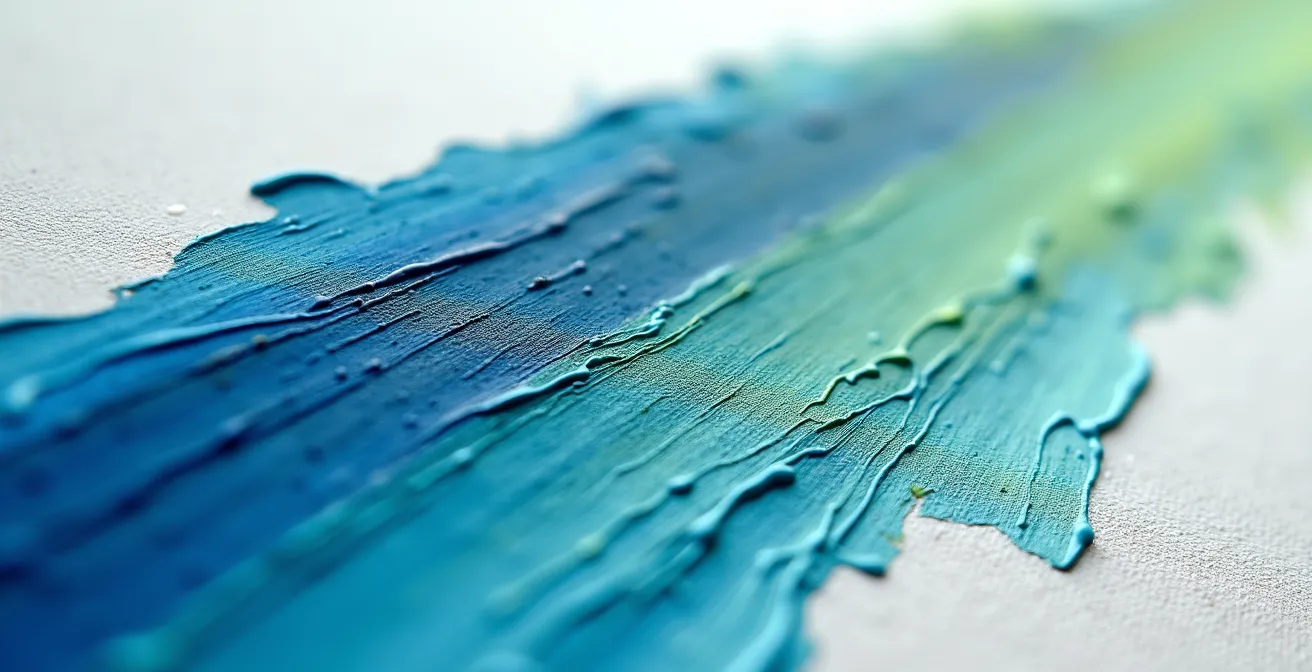
The table below provides a simple framework, linking the viscosity of your paint to a musical equivalent, helping you think about the rhythmic effect of your marks before you even make them.
| Viscosity Level | Musical Equivalent | Brush Effect | Best For |
|---|---|---|---|
| Heavy Body (Thick) | Staccato | Short, textured, emphatic marks | Impasto, sculptural strokes |
| Soft Body (Medium) | Andante | Smooth, continuous flow | Blending, glazing |
| Fluid (Thin) | Legato | Long, flowing, graceful marks | Dripping, pouring techniques |
Stiff Bristle vs. Soft Synthetic: Which brush drives the energy of the painting?
The brush itself is an active partner in your creative process, not a passive tool. The choice between a stiff, natural bristle brush (like hog) and a soft synthetic one is a choice about the kind of energy you want to create. For a painter used to smooth, controlled application, the soft synthetic brush feels comfortable and familiar. It glides across the canvas, laying down paint smoothly, perfect for blending and fine detail. However, this very compliance can rob your work of raw energy.
A stiff bristle brush, by contrast, introduces an element of physical resistance. It doesn’t glide; it scrapes and scrubs. It refuses to create a perfectly smooth mark, instead leaving behind broken color, texture, and evidence of the physical struggle between brush, paint, and canvas. This resistance is not a flaw; it is its greatest strength. It’s the key to conveying raw, untamed energy. As artist Will Kemp notes, this quality is a feature, not a bug.
A stiff bristle brush ‘fights back,’ its resistance creating broken color and a sense of raw, physical struggle—ideal for conveying tension or ruggedness.
– Will Kemp, Will Kemp Art School Guide
This doesn’t mean soft brushes have no place. The strategy is to use them with intention. Contemporary impressionist Anne Blair Brown, for instance, uses a large gesso brush at the start of a painting. The goal isn’t just to cover the canvas quickly; it’s a strategic move to deliberately prevent herself from adding detail too early. She uses a large, unwieldy tool to force herself to think in broad, simple masses of tone and color. The “right” brush, therefore, is the one that forces the kind of mark your painting needs at that specific moment—be it the raw power of a stiff bristle or the disciplined simplicity of an oversized soft brush.
The “one stroke too many” error that turns expressive art into mud
Every painter knows the feeling: you have a passage of fresh, vibrant color, but a little voice whispers, “Just one more stroke to smooth it out.” You obey, and instantly, the life drains away, leaving a patch of dull, lifeless mud. This is the “one stroke too many” error, and it is the single greatest enemy of expressive painting. It stems from a lack of confidence and an addiction to blending—the safety blanket of the detail-oriented artist.
Expressive painting is an art of decisive moments. It’s about placing a mark with intention and then having the courage to leave it alone. The energy of a painting lies in the clarity of its individual strokes. When you endlessly “pet” the canvas, you destroy that clarity, blending your colors into a homogenous gray and erasing the history of your decisions. To break this habit, you must embrace a philosophy of economy. According to many professional artists, it’s recommended that 90% of brushstrokes should remain loose suggestions, with only a tiny 10% refined into sharp details for your focal points. This is the “decision budget” in action: spend your effort where it matters most.
This side-by-side comparison tells the whole story. On the left, the result of hesitation and over-blending: the colors are dead, the form is flat. On the right, the power of decisive, minimal strokes: the color is vibrant, the form is dimensional, and the energy is palpable.
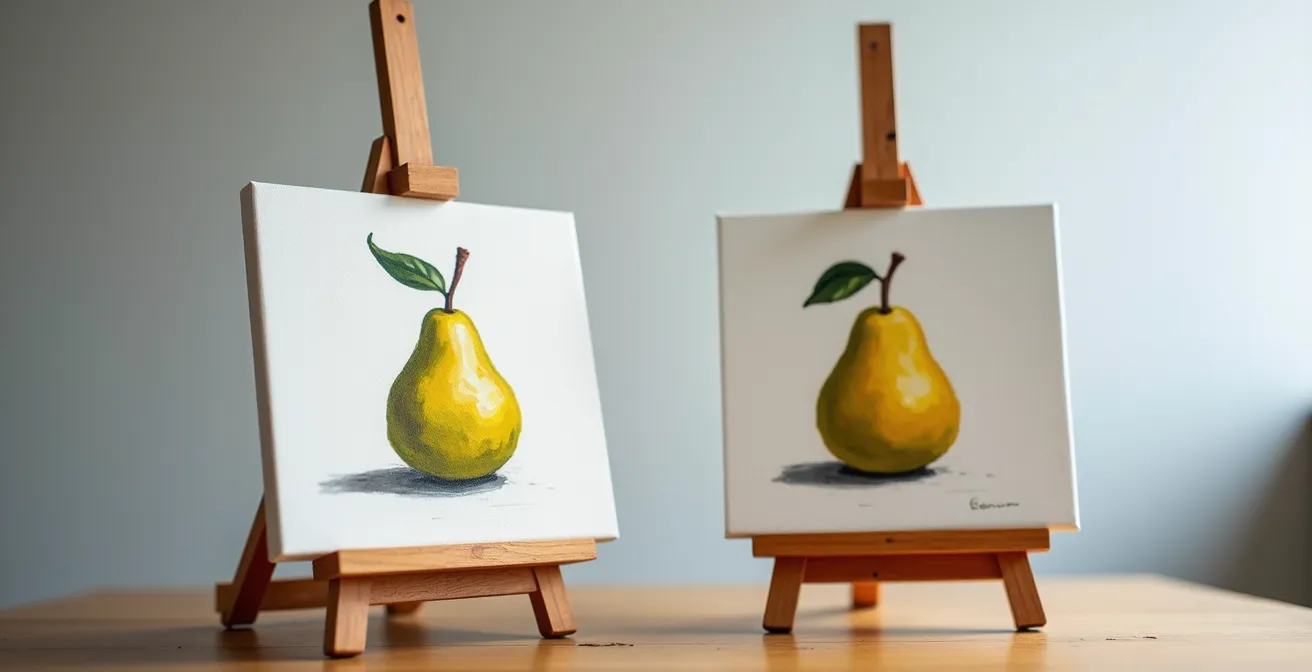
To train this new muscle of decisiveness, you need a strict exercise. The following plan forces you to be confident by imposing a severe limitation on the number of strokes you are allowed to make. It’s a boot camp for brushwork economy.
Action Plan: The Three-Stroke Rule Exercise
- Limit yourself to exactly 3 brushstrokes per shape or plane in your subject.
- Make each stroke decisive and confident; there is no room for tentative “petting” of the canvas.
- If you are tempted to add a fourth stroke, you must physically step back from the easel for one minute.
- Analyze the result: notice where the three strokes were enough and where your impulse to add more was strongest.
- Practice with a “stroke budget”: attempt an entire simple painting with a total of only 20 strokes, then 10.
When to use a lost edge vs. a found edge to guide the viewer’s eye?
Here is where your love for accuracy becomes your greatest superpower. The fear of “losing the drawing” is valid, but the solution isn’t to make everything sharp. It’s to be highly selective about *what* you make sharp. An expressive painting is a conversation of edges, ranging from razor-sharp to completely lost. Your ability to control this hierarchy is how you guide the viewer’s eye and create a sense of realism and atmosphere without rendering every single detail.
A found edge is a sharp, clear boundary between two shapes. It screams for attention. This is where you “spend” your accuracy budget. Place your sharpest edges at your focal point—the glint in an eye, the corner of a building, the petal of a flower catching the light. This tells the viewer, “Look here! This is important.” A lost edge, by contrast, is where two shapes of similar value or color merge, and the boundary between them disappears. This creates mystery, atmosphere, and a sense of unity. It allows you to suggest form in the shadows or distance without laboriously painting it.
The mistake of the tight painter is to make every edge a found edge. This flattens the painting and makes everything compete for attention, resulting in a busy, overworked feel. The masterful expressive painter understands that 90% of their edges should be soft or lost, saving that precious 10% of sharpness for maximum impact. This sentiment is perfectly captured by artist Michael Chesley Johnson:
Found edges are where you ‘spend’ your ‘drawing accuracy’ budget. Lost edges are where you embrace expressive, loose brushwork.
– Michael Chesley Johnson, Artists Magazine
This framework gives you permission to be “loose” everywhere else. As long as you nail the few critical found edges that define your subject, the rest of the painting can be an energetic playground of texture and suggestion. The drawing isn’t lost; it’s concentrated where it has the most power.
| Edge Type | Visual Impact | Purpose | Where to Use |
|---|---|---|---|
| Sharpest/Found Edge | Maximum focus | Absolute focal point | Main subject, key details |
| Firm Edge | Secondary focus | Important structural planes | Supporting elements |
| Soft Edge | Gentle transition | Forms turning from light | Rounded surfaces, distance |
| Lost Edge | Atmospheric | Melting into shadow/atmosphere | Background, deep shadows |
How to paint from the shoulder to create marks that feel monumental?
If your brush grip is the source of small, timid marks, the solution is to engage a bigger engine: your shoulder and core. Painting from the wrist is like writing; painting from the shoulder is like dancing. It involves your entire body and imbues each mark with a sense of weight, momentum, and monumental scale, even on a small canvas. This is the physical key to transforming your work from a collection of tiny observations into a singular, powerful statement.
To make this shift, you must change your entire posture. Stop sitting. Stand at arm’s length from your easel, feet planted firmly on the ground. This stance connects you to your core and allows your arm to move freely from the shoulder socket. Use a long-handled brush, which naturally discourages wrist movements and acts as a counterweight, promoting a smoother, more rhythmic motion. Before the brush even touches the canvas, rehearse the intended mark in the air. Feel the full, unbroken arc of the movement. The goal is to make the mark in one confident, continuous gesture, not a series of small, disconnected dabs.
This isn’t just about making bigger strokes; it’s about the quality of the line. A line drawn from the shoulder has a different kind of energy—a velocity and grace that a wrist-drawn line can never replicate. This connection between the artist’s physical gesture and the resulting mark is so fundamental that it has been studied to inform the movements of robotic arms in art, analyzing how the dynamics of human motion translate into the painted outcome. Your gesture is a record of your body’s energy at a specific moment in time. By using your whole arm, you are recording a much bigger, more powerful story.
How to load a multi-colored paint on a knife for a single complex stroke?
The palette knife is the ultimate tool of liberation for the recovering detail addict. It has no bristles, it cannot blend smoothly, and it forces you to think in clean, sculptural planes of color. Its greatest power, however, lies in its ability to lay down multiple colors in a single, complex, and unrepeatable stroke. This is the heart of “controlled chaos”—setting up the conditions for beautiful accidents to happen.
The technique begins on the palette. Lay out your colors side-by-side in clean bands, like geological strata. Do not mix them. Then, using the edge of your knife, scrape through them to pick up a sliver of this color “sandwich.” When you apply this to the canvas, the colors will mix partially, break against each other, and create a shimmering, impressionistic effect that would be impossible to achieve with a brush. The angle of the knife, the pressure you apply, and the speed of the stroke all determine how the colors interact. It’s a performance in a single mark.
There’s no single “right” way to load the knife. For a bright, sunlit plane, you might dab the face of the knife into small bits of multiple warm colors. For the side of a building in shadow, you might load a clean, long band of cool colors along its edge. The key is to embrace the “dirty knife.” The residual colors from your previous stroke will automatically harmonize with your new one, creating a natural and sophisticated color unity throughout the painting. You are no longer just a painter; you are a geologist, laying down layers of color and history with each pass of the knife.
Key Takeaways
- Shift your brush grip away from the ferrule to the middle or end of the handle to activate your arm and shoulder.
- Treat paint viscosity as a tool: use thick paint for textured, staccato marks and thin paint for smooth, flowing lines.
- Embrace the resistance of a stiff bristle brush to create raw energy and broken color.
- Fight the urge to overwork by setting a strict limit of 1-3 strokes per shape, then having the courage to stop.
- Spend your “accuracy budget” on a few sharp, found edges at your focal point, allowing the rest of the painting to have soft or lost edges.
How to Find Your Unique Artistic Vision When Everyone Has a Camera?
In a world saturated with high-resolution digital images, the pursuit of photorealistic accuracy in painting can feel like a losing battle. A camera can capture a billion more details than you ever could, and it can do it in a fraction of a second. So, what is the painter’s role? Why spend hours with pigment and canvas when a phone can capture the “likeness” perfectly? The answer lies in everything a camera *cannot* do. A camera cannot record the energy of a gesture. It cannot convey the physical texture of paint. It cannot translate an emotion into the rhythm of a brushstroke.
This is where your unique artistic vision is forged. It is not found in your ability to copy a photograph, but in the character and quality of your physical mark-making. The slight drag of a bristle, the thick, sculptural quality of a knife stroke, the subtle vibration of a dry-brushed line—these are your voice. They are the authentic, irreplaceable signature of your hand and your heart. Technology has always shaped art; as art history reveals, the invention of the metal ferrule in the mid-19th century enabled the flat brushes that were essential to the Impressionist “tache” or touch. Today, the ubiquity of the camera pushes us to find our value not in replication, but in expression.
This entire journey—of changing your grip, engaging your shoulder, controlling viscosity, and being decisive with your edges—is not just about learning to “paint looser.” It’s about discovering what you, as a human being, have to say that a machine cannot. It’s about realizing that the “drawing” you were so afraid to lose is still there, but it’s no longer a sterile outline. It’s alive in the energy of every mark. As artist Robert Joyner powerfully states, this is the core of your modern artistic identity.
Your unique vision lies in the energy, rhythm, and texture of your physical mark-making—something a camera can never replicate.
– Robert Joyner, Crafted by Robert – Painterly Techniques
Your journey to expressive painting is not a rejection of your skill but an expansion of it. The discipline and control you’ve cultivated are your foundation. Now, it’s time to build upon it with courage, energy, and a bold new trust in the physicality of paint. Start today by picking one exercise from this guide and committing to it. The liberation you seek is waiting on the other side of that first, fearless brushstroke.