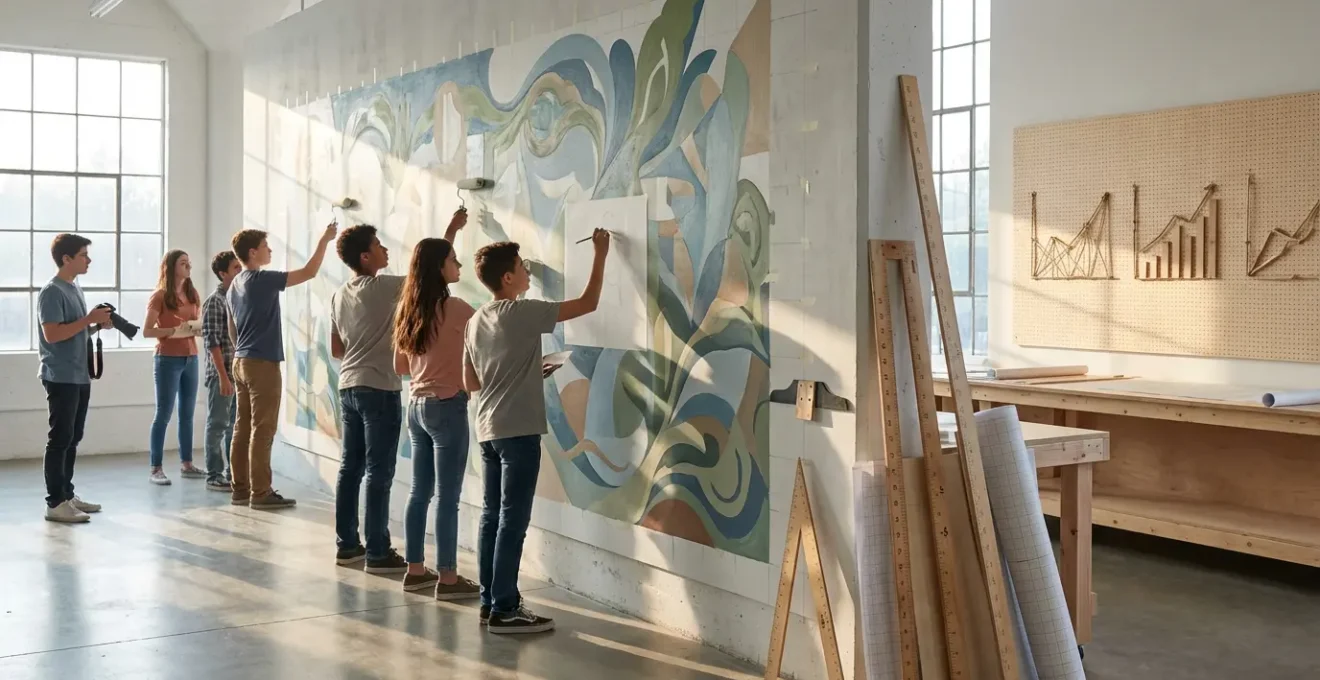
Proving your art program’s long-term success requires moving beyond participation numbers to a structured system that quantifies intangible growth.
- Replace vague metrics like “smiles” with validated tools and proxy indicators to track genuine confidence and social capital.
- Shift from a “serving” mentality to a “partnering” model by involving youth in the evaluation process itself.
Recommendation: Implement a tiered, long-term alumni tracking system to gather compelling longitudinal data that demonstrates lasting impact to donors.
As a program director, you know the feeling. The annual report is due, and you have a folder filled with photos of smiling teenagers and heartfelt, yet anecdotal, testimonials. You’ve seen the transformative power of your arts program firsthand. You’ve watched shy students find their voice and isolated youths build a community. But how do you translate that profound, observable change into the hard data that donors and grant-makers demand? The pressure to prove effectiveness often pushes organizations toward simple, but ultimately superficial, metrics like attendance figures or workshop completion rates.
These numbers tell a part of the story, but they miss the core of your mission. They don’t capture the subtle, yet critical, growth in a young person’s self-worth, their ability to collaborate, or their connection to the community. Relying solely on these metrics can inadvertently devalue the very outcomes you strive to create. The challenge isn’t a lack of impact, but a lack of the right tools to measure it.
But what if the most profound changes—the blossoming of confidence, the development of social capital, and a fundamental shift in self-perception—could be quantified? What if you could build a compelling case for funding that honors the complexity of human development? This guide provides a data-driven framework to do just that. It moves beyond feel-good stories to equip you with concrete strategies for tracking intangible outcomes, engaging alumni for longitudinal data, and reframing your entire approach to evaluation. It’s time to build an evidence base as compelling as the art your students create.
This article provides a comprehensive roadmap for program directors. We will explore specific, actionable methods to capture meaningful data, maintain long-term relationships for follow-up, and structure your programs and communications to reflect a true partnership with the youth you work alongside.
Summary: A Data-Driven Guide to Measuring Art’s Impact on Youth
- Why “smiles” are not data and how to track confidence growth instead?
- How to stay in touch with program alumni for 5 years without being intrusive?
- Teaching skills vs. Creating an exhibition: Which goal serves the student’s development better?
- The framing mistake that condescends to the community you are trying to serve
- How to reduce material costs by 20% so you can accept 5 more students?
- How to design a gallery workshop that appeals to teenagers who hate museums?
- Why “ticket sales” is a bad metric for public gallery success and what to use instead?
- How to Digitize a Physical Collection Without Losing Its Historical Context?
Why “smiles” are not data and how to track confidence growth instead?
For any program director facing a skeptical donor, the phrase “our kids are happier” is not a compelling metric. While positive emotions are a wonderful byproduct, they are not data. To prove long-term impact, you must translate abstract concepts like “confidence” into measurable indicators. This means moving from observation to structured evaluation, using methods that are both credible and respectful of the participants’ experience. The goal is to capture growth in a way that is systematic, repeatable, and quantifiable.
The key is to use proxy metrics and validated tools. For example, instead of asking “Are you more confident?”, you can track changes in specific behaviors and attitudes. The Boston Youth Arts Evaluation Project provides a powerful model. At one participating organization, The Theater Offensive, a structured survey revealed that 88% of youth agreed the program helped build their confidence. At another, ZUMIX, the percentage of youth who felt they knew how to improve their lives rose from 76% to 86% between the beginning and end of the program. This is the kind of data that demonstrates tangible change.
So how can you implement this? Focus on evidence-based techniques that integrate naturally into your artistic programming. You don’t need to turn your studio into a clinical lab. Consider these methods:
- Validated Scales in Creative Formats: Use established psychological tools like the Rosenberg Self-Esteem Scale, but embed them within creative journaling or portfolio reflections rather than sterile questionnaires.
- Pre/Post Portfolio Analysis: Systematically analyze the evolution of a student’s artwork. Track changes in artistic complexity, the use of a broader color palette, or the development of more sophisticated themes. This provides a non-intrusive indicator of growing confidence and skill.
- Mixed-Method Assessments: Combine quantitative pre/post surveys on skill development with qualitative interviews. The numbers show *what* changed, while the interviews reveal *why* and *how*, adding rich context to your data.
- Most Significant Change (MSC) Technique: At key program milestones, ask participants to share stories about the most significant change they’ve experienced. By systematically collecting and analyzing these stories, you can identify recurring themes of impact that are grounded in personal experience.
By adopting these methods, you transform the abstract goal of “building confidence” into a reportable, data-backed outcome. This shift from anecdotal evidence to structured evaluation is the first step in building a truly persuasive case for your program’s long-term value.
How to stay in touch with program alumni for 5 years without being intrusive?
The ultimate proof of your program’s impact doesn’t happen the day a student leaves; it unfolds over the next five, ten, or even twenty years. Capturing this longitudinal data is the holy grail for demonstrating lasting change. However, the challenge is immense: how do you stay connected with alumni without becoming an intrusive nuisance? The key is to shift from a mindset of “tracking” to one of “community building.” Your follow-up must provide ongoing value to the alumni themselves, not just serve your data collection needs.
The results of this long-term engagement can be profoundly compelling. For instance, a long-term study of one program found that 87% of alumni reported working to improve their choices in life after participating. This kind of statistic is a powerful testament to deep, sustained impact that goes far beyond the workshop walls. It demonstrates that the skills and mindset fostered in your program continue to influence life decisions years later.
To achieve this, you need a deliberate, multi-layered strategy that respects alumni autonomy and offers tangible benefits. A one-size-fits-all approach will fail. Instead, consider a tiered engagement framework that allows alumni to choose their level of involvement.

This visualized network represents the goal: a community that supports its members long after the formal program ends. A tiered approach can include:
- Light Touch Tier: Annual celebratory emails that highlight alumni achievements and program updates. This requires no response but keeps the connection alive and positive.
- Medium Touch Tier: A quarterly newsletter featuring job opportunities, calls for artistic collaborations, and links to professional development resources. This offers direct, practical value.
- Deep Touch Tier: Invitations for select alumni to return as paid mentors, guest speakers, or workshop facilitators. This creates a powerful cycle of value-driven reconnection and provides leadership opportunities.
Crucially, this strategy should be co-designed. Conduct exit workshops where graduating participants define their own preferred methods and frequency of communication. By giving them ownership over the process, you ensure the follow-up feels genuinely helpful, transforming data collection from an obligation into a natural part of a lasting community relationship.
Teaching skills vs. Creating an exhibition: Which goal serves the student’s development better?
A common strategic dilemma for arts organizations is whether to focus program time on foundational skill-building or on a high-stakes public outcome like an exhibition or performance. While teaching technical skills provides a clear, measurable achievement, a final exhibition offers invaluable experience in project management, public engagement, and professional practice. The most effective programs recognize this is not an either/or question. The answer lies in an integrated approach that sequences these goals, using the exhibition as the real-world application of the skills learned.
A focus solely on technical skills can build competence, but it may not build agency. Conversely, rushing to an exhibition without a solid foundation can lead to frustration and burnout. The magic happens when the two are woven together. The process of learning a skill gives a student self-efficacy, while the act of presenting their work to an audience gives them agency and social capital. As one youth participant in a study on community-based arts programs noted:
Creating and performing a show enlightened me on the significance of hard work, planning ahead, and thinking on my feet. The arts learning environment embodies the qualities that youth development scholars find are key for effective youth development programs.
– Youth participant at Destiny Arts Center, Community-Based Afterschool and Summer Arts Education Programs Study
This highlights how a capstone project synthesizes various soft skills in a way that isolated drills cannot. A structured comparison reveals how these two phases contribute differently to a young artist’s development, and why their integration is so powerful.
| Development Aspect | Skills Teaching Phase | Exhibition Phase | Integrated Approach Benefits |
|---|---|---|---|
| Hard Skills | Technical proficiency in specific media, software mastery, artistic techniques | Limited direct skill acquisition | Skills applied in real-world context, reinforcing learning |
| Soft Skills | Basic collaboration, time management | Project management, public speaking, professional networking | Progressive skill building from foundation to application |
| Social Capital | Peer connections within program | Network expansion through public engagement, community connection, professional contacts | Layered relationship building from peers to community |
| Self-Efficacy | Confidence through skill mastery | Agency through public recognition | Scaffolded confidence development |
Ultimately, the exhibition is not just a product; it’s a pedagogical tool. It transforms the learning process from an academic exercise into a professional simulation, providing a platform where technical skills and soft skills converge to create a holistic and deeply impactful developmental experience.
The framing mistake that condescends to the community you are trying to serve
Perhaps the most damaging and pervasive mistake in arts outreach is one of language and framing. The narrative of “saving at-risk youth” or transforming “troubled kids” into “creative individuals,” while often well-intentioned, is deeply problematic. This deficit-based language inadvertently condescends to the very community you aim to support. It positions your organization as the hero and the youth as passive recipients in need of fixing. This framing is not only disrespectful but also limits the potential for genuine, meaningful engagement.
Funders may look for programs that provide “structured” and “positive activities” to correct “bad” behaviors, but this approach can stifle the symbolic creativity and authentic expression that art is meant to foster. The alternative is a shift to an asset-based framing. This approach recognizes youth not as problems to be solved, but as partners and knowledge holders with inherent strengths, creativity, and unique perspectives. It’s about co-creation, not intervention.
This isn’t just a semantic game; it’s a fundamental shift in power dynamics. The goal is to move from a model of “serving” to one of “partnering.” Instead of reporting that you “served 50 at-risk youth,” you report that you “partnered with 50 young artists from a vibrant community.” This change in language reflects a change in practice, where youth are given real agency and decision-making power within the program.

Implementing this shift requires concrete structural changes. It’s about embedding youth voice into the DNA of your organization. A Youth Advisory Board isn’t just a focus group; it should be a formal body with the power to shape the program’s goals, metrics, and even its public identity.
Your Action Plan: Implementing a Partnership Model
- Recognize youth as knowledge holders: Acknowledge that youth are not empty vessels, but people who can offer new knowledge and drive change within programs.
- Establish formal decision-making power: Create structures where youth have voting rights on program goals, success metrics, and the allocation of resources.
- Implement a participatory visual identity process: Empower youth to direct and create all promotional materials, ensuring a dignified and authentic representation of their community.
- Shift from ‘serving’ to ‘partnering’: Systematically replace deficit-based language in all communications, from grant proposals to social media posts.
- Co-design evaluation: Involve youth in defining what success looks like and how it should be measured, ensuring the metrics reflect what is truly valuable to them.
This asset-based approach doesn’t just produce more respectful and effective programs; it also creates a more compelling narrative for donors who are increasingly looking to support authentic, community-led initiatives rather than top-down charity models.
How to reduce material costs by 20% so you can accept 5 more students?
For any non-profit, budget constraints are a constant reality. Material costs can be a significant barrier to expanding your program’s reach. However, reducing costs doesn’t have to mean compromising the quality of the artistic experience. In fact, approaching resource management as a creative challenge can unlock new pedagogical opportunities, teaching students about sustainability, financial literacy, and ingenuity alongside their artistic practice. The goal is to turn a constraint into a catalyst for creativity.
Innovative resource-sharing initiatives have shown remarkable results. For example, a shared studio model in Detroit not only boosted engagement but also led to a 38% cost reduction in materials. This demonstrates that strategic, collaborative approaches to resource management can have a dual benefit: increasing fiscal efficiency while simultaneously enriching the program’s creative environment. It’s about working smarter, not cheaper.
Achieving this level of efficiency requires a multi-pronged strategy that combines smart partnerships with innovative curriculum design. Here are four key strategies to significantly reduce material costs and reinvest those savings into your students:
- Build In-Kind Donation Partnerships: Proactively approach local businesses. Hardware stores can be a source for paint, wood, and building supplies. Print shops may donate paper, and corporate offices might have old electronics or furniture that can be repurposed. Frame these requests as a partnership in community investment, not just a request for a handout.
- Implement Arte Povera Methodology: Fully embrace the “poor art” philosophy by making recycled and found materials a core component of your curriculum. This not only dramatically cuts costs but also teaches valuable lessons about sustainability, resourcefulness, and seeing artistic potential in the everyday.
- Create Student-Managed Project Budgets: Empower your students by giving them ownership over their project finances. Assign a materials budget to student teams and teach them basic financial literacy skills through inventory management, purchasing decisions, and tracking expenses. This transforms a logistical task into a powerful learning experience.
- Develop a Material Grants Initiative: Turn the need for materials into a skill-building opportunity. Train students to research and write small grant proposals specifically for the materials needed for their projects. This demystifies the funding process and equips them with practical, transferable skills.
By implementing these strategies, you can reframe cost reduction from a painful cutback to a strategic initiative that enhances your program’s educational value and allows you to serve more young artists.
How to design a gallery workshop that appeals to teenagers who hate museums?
The traditional museum experience can feel alienating to many teenagers. The quiet halls, the “do not touch” signs, and the focus on historical context often clash with their desire for social interaction, personal relevance, and active participation. To design a gallery workshop that truly resonates, you must first deconstruct the barriers and then build an experience that meets them on their own terms, in their own spaces, and speaking their own language.
The first step is to break free from the physical confines of the museum itself. As demonstrated by the innovative “Drawing on Air” curriculum, bringing arts programming into non-traditional spaces is highly effective. Instead of expecting teens to come to you, go to them. Consider pop-up workshops in skate parks, shopping centers, libraries, or even digital platforms like Discord and TikTok. By meeting them in their own environment, you remove the initial barrier of intimidation and signal that this experience is different.
Once you have their attention, the content must be immediately engaging and relevant to their lives. The following framework can help you design workshops that connect:
- Center on Remix Culture: Teenagers are native to a culture of memes, mashups, and remixes. Design interactive experiences where they can use digital tools to “meme-ify,” re-contextualize, and respond to classic artworks. Let them create their own narratives and critiques, valuing their interpretation as much as the curator’s.
- Focus on Thematic Relevance: Build workshops around themes that matter to them now: social justice, identity, climate change, mental health, and even gaming culture. Use the gallery’s collection as a starting point for these conversations, rather than an end in itself.
- Highlight Career Pathways: Frame the workshop not just as art appreciation, but as a behind-the-scenes exploration of creative careers. Introduce them to roles like exhibit design, digital curation, art conservation, and marketing. This provides a practical, aspirational hook that a traditional art history lecture lacks.
- Prioritize Social Interaction: Design activities that are collaborative and social. Group challenges, team-based creations, and peer-to-peer teaching can transform a solitary, contemplative experience into a dynamic, social one.
By flipping the script—bringing the art to their world, focusing on their themes, and highlighting future possibilities—you can transform the gallery from a place they are dragged to into a space they choose to be a part of.
Key Takeaways
- Move beyond superficial metrics like attendance to quantifiable indicators of growth like validated self-esteem scales and portfolio analysis.
- Adopt an “asset-based” framework that treats youth as partners in evaluation, not subjects to be “saved.”
- Implement a tiered, value-driven alumni engagement strategy to collect compelling longitudinal data on long-term impact.
Why “ticket sales” is a bad metric for public gallery success and what to use instead?
For decades, cultural institutions have relied on a narrow set of metrics to define success: ticket sales, visitor counts, and revenue generated. While these numbers are easy to track, they are poor indicators of a public gallery’s true mission. They measure foot traffic, not engagement; transactions, not transformation. A sold-out exhibition could signify a popular success, or it could mean visitors rushed through, took a selfie, and left without a single meaningful interaction. Relying on these metrics is like judging a library by the number of books checked out, not by the knowledge gained.
As the arts funding landscape evolves, savvy stakeholders are demanding proof of deeper community value. As the research team at Grantmakers in the Arts stated, the potential of arts education is rich, but traditional measurement tools are often ill-fitting. This forces a redefinition of not just the tools, but the very rules of what constitutes success. Success is not just about getting people in the door; it’s about what happens to them once they are inside and how the institution integrates into the fabric of its community.
The potential of thoughtful programs is rich, but every approach to teaching art in and after school and then measuring what happens comes up against ill-fitting tools of measurement or redefines the tools and the rules.
– Grantmakers in the Arts Research Team, Evaluating Arts Education Report
To capture this, galleries must adopt a new suite of impact-based metrics. This requires a shift in focus from quantity of visitors to quality of experience and depth of relationship. The following table contrasts outdated measures with meaningful, impact-focused alternatives.
| Metric Type | Traditional Measure | Impact-Based Alternative | What It Actually Measures |
|---|---|---|---|
| Attendance | Total ticket sales | Average dwell time per visitor | Depth of engagement with exhibitions |
| Reach | One-time visitor count | Repeat visitation rates | Building of lasting relationships |
| Community Value | Revenue generated | Community Integration Score tracking school partnerships, off-site programs, collaborations with non-arts organizations | Gallery’s role in community ecosystem |
| Satisfaction | Exit survey ratings | Cultural Net Promoter Score with qualitative ‘why’ analysis | True advocacy and word-of-mouth potential |
| Public Space Value | Facility usage rates | Civic Belonging Index | Gallery as welcoming ‘third place’ for dialogue |
By adopting these more nuanced metrics, a gallery can tell a much richer story of its value. It can prove that it’s not just a repository for objects, but a vital hub for community connection, lifelong learning, and civic dialogue—a story that is far more compelling to funders and the public alike.
How to Digitize a Physical Collection Without Losing Its Historical Context?
In the digital age, digitizing a physical collection of student artwork or program history seems like a straightforward task of scanning and uploading. However, this approach risks turning vibrant, tangible objects into flat, lifeless images, stripped of their stories and context. The challenge is not simply to create a digital replica, but to craft an augmented object—a digital file that carries with it the object’s history, its physical nature, and the narratives that give it meaning. This process itself can become a powerful programmatic tool.
The most effective way to preserve context is to involve the community in the digitization process, particularly the youth themselves. By training program participants as “digital archivists,” you transform a technical task into a participatory history project. This approach, which emphasizes youth-adult partnerships, teaches valuable skills in research, technology, and storytelling. It empowers young people to shape the narrative of their own community and ensures that the digital archive reflects their lived experiences, not just an outsider’s interpretation.
A narrative-based digitization framework moves beyond simple documentation to active storytelling. Here are key steps to ensure your digital collection retains its soul:
- Layer the Digital Object: Go beyond a single high-resolution image. Layer the digital file with associated content: link to oral histories from the artist or their family, attach related documents or sketches, create 3D models to show texture and form, and use interactive maps to place the object in its geographical context.
- Create Thematic Pathways: Use digital storytelling tools (like Knight Lab’s StoryMapJS) to connect objects across your collection in non-linear ways. Reveal hidden relationships and build narratives around themes, artists, or historical moments. This allows users to explore the collection in a more engaging, curated way.
- Involve Youth as Digital Archivists: Train participants to conduct and record oral histories with community elders about specific objects. This intergenerational exchange enriches the archive with priceless context and strengthens community bonds.
- Expand Metadata Schemas: Don’t just capture provenance (who made it, when, where). Create custom metadata fields to capture the object’s physical texture, its weight, associated sounds (e.g., the sound a sculpture makes), and its “social life”—how it was used, displayed, or gifted.
By treating digitization as an act of storytelling rather than mere replication, you create a living archive. This not only preserves the historical context of your collection but also becomes a dynamic platform for ongoing engagement, research, and community connection, cementing your program’s legacy for future generations.
By shifting from anecdotal evidence to a structured, data-driven framework, you can build a powerful and persuasive case for your art program’s profound, long-term impact. Start today by implementing one new metric or engagement strategy to begin building your own archive of impact.