
Successfully acquiring a Pre-Columbian artifact depends less on the documents you’re given and more on your ability to build a defensible legal argument for its ownership history.
- Federal seizure is a real risk for items lacking clear, pre-1970 export licenses from their country of origin.
- Common dealer tricks, like vague “Old Swiss Collection” claims, are red flags for washed or looted items that you must learn to spot.
Recommendation: Shift from being a passive collector to a forensic investigator. Scrutinize every detail of an object’s “ownership story” before any funds are exchanged.
The allure of holding a piece of Pre-Columbian history—a ceramic vessel that predates Columbus, a textile woven by an ancient Andean artisan—is a powerful driver for any serious collector. Yet, this market is a minefield of legal and ethical tripwires. Common advice often falls short, suggesting you simply “check the paperwork” or “buy from a reputable dealer.” This passive approach is precisely what leaves aspiring investors vulnerable to acquiring a forgery, or worse, a looted artifact that places them in legal jeopardy.
The reality is that national and international laws governing cultural property are complex and strictly enforced. The 1970 UNESCO Convention is a well-known landmark, but many countries of origin, such as Mexico and Peru, have even older and more stringent patrimony laws that claim state ownership over all archaeological material. An artifact’s journey through time, including its passage through war-torn 20th-century Europe, can create significant gaps in its history that are deliberately exploited.
But what if the key to safe acquisition wasn’t just following a checklist, but adopting a completely different mindset? This guide reframes provenance verification away from passive acceptance. The goal is to equip you with a forensic mindset, treating provenance not as a document to be filed away, but as a defensible legal argument you must build and test. It’s about learning to deconstruct an artifact’s ownership story, identify the weak links, and spot the red flags that signal catastrophic risk.
This article will guide you through the critical legal frameworks, common deception tactics, and essential verification techniques. We will analyze the severe consequences of ignoring export laws, explore methods for investigating problematic historical gaps, and provide actionable frameworks for assessing both authenticity and legal title before you make a purchase.
Summary: A Forensic Approach to Acquiring Pre-Columbian Art
- Why buying an artifact without an export license can lead to federal seizure?
- How to trace the ownership history of an object during the 1933-1945 gap?
- Roman glass vs. Egyptian faience: Which holds value better in a volatile market?
- The falsified document trick used by dealers to wash looted antiquities
- When to buy ancient coins: analyzing auction cycles for the best price?
- The titanium white error that exposes fake Victorian paintings instantly
- Collected in situ vs. Bought from a runner: Which provenance is legally safer?
- How to Appraise a Painting When the Artist Has No Auction Record?
Why buying an artifact without an export license can lead to federal seizure?
The single greatest risk for a collector of Pre-Columbian art is not overpaying; it’s having the object seized by federal agents. This happens when an artifact is determined to be stolen cultural property, illegally excavated, or smuggled across borders in violation of international treaties and national laws. The U.S. government, through agencies like Homeland Security Investigations (HSI), actively pursues and repatriates such items. The scale of this enforcement is significant; since 2007, HSI has repatriated over 20,000 cultural objects to more than 40 countries.
The legal basis for these seizures is often a combination of the National Stolen Property Act (NSPA) and bilateral agreements between the U.S. and the artifact’s country of origin. The NSPA makes it a federal crime to transport or possess goods valued at $5,000 or more that are known to be stolen. Critically, U.S. courts recognize the patrimony laws of other nations. If a country like Mexico declared all Pre-Columbian artifacts state property in 1972, any item removed from Mexico after that date without an official export license is considered stolen property under U.S. law.
A recent case highlights this danger: in 2023, HSI returned nearly 100 Pre-Columbian artifacts to Mexico that had been stolen from a private collection and smuggled into the U.S. years earlier. This demonstrates that the passage of time provides no safe harbor. The U.S. has specific Memoranda of Understanding (MOUs) with numerous Latin American countries, including Peru, Guatemala, Honduras, and Colombia, which create a strict legal framework for the import of archaeological materials. Purchasing an artifact from one of these regions without ironclad proof of legal export pre-dating these agreements is an invitation for federal seizure and total financial loss.
How to trace the ownership history of an object during the 1933-1945 gap?
An artifact’s journey is not always linear. A Pre-Columbian piece excavated in the 19th century could easily have entered a European collection by the early 20th century. This exposes it to one of the art market’s most significant historical black holes: the Nazi era (1933-1945). During this period, vast amounts of art, including antiquities, were systematically looted from Jewish citizens and institutions. An object with a gap in its ownership story during these years requires the highest level of scrutiny, as it may be subject to a restitution claim from the heirs of the original owners.
Adopting a forensic mindset is essential. Your research must extend beyond the object itself and into the archival records of the period. Fortunately, several international databases have been established to aid in this exact type of research. The German Lost Art Foundation, for example, operates the Lost Art Database, which lists cultural property seized as a result of Nazi persecution. Another critical resource is the Art Loss Register, the world’s largest private database of stolen and missing art and antiquities. Cross-referencing a potential acquisition against these databases is a non-negotiable step in due diligence.

As the image above suggests, this level of research is meticulous. It involves searching for the names of previous owners, gallery inventory numbers, and exhibition histories. Key resources for this work include:
- The German Lost Art Foundation (Lostart.de)
- The Getty Provenance Index
- The Art Loss Register
- The Federal Archives of Germany (Bundesarchiv)
Failing to investigate a 1933-1945 provenance gap is a serious oversight. It not only carries the ethical weight of potentially trafficking in looted property but also the significant financial risk of a future ownership claim that could nullify your title to the piece.
Roman glass vs. Egyptian faience: Which holds value better in a volatile market?
While this guide focuses on Pre-Columbian art, a savvy collector understands that risk and value are assessed differently across various categories of antiquities. Analyzing these differences sharpens your forensic mindset. Consider two popular collecting fields: Roman glass and Egyptian faience. Their value stability is not just a function of beauty or age, but is directly tied to their unique legal and supply-side characteristics. An object’s “ownership story” is a tangible financial asset, where market analysis shows that artifacts with exceptional, published provenance can command a 20-50% price premium over similar, undocumented pieces.
Roman glass is relatively abundant. Due to the vastness of the Roman Empire and, in some regions, historically permissive laws regarding finds, a large volume of material entered the market legally over many decades. This leads to a wider range of price points but also carries a risk of market saturation, which can depress values for common items. Its legal risk is moderate, provided it has documented provenance pre-dating modern antiquities laws in its specific country of origin.
Egyptian material, including faience amulets and shabtis, operates under a completely different legal reality. Egypt’s Law 117 of 1983 established absolute state ownership of all antiquities, reinforcing a total ban on exports that has been in effect since the 1970s. This creates extreme scarcity in the legal market. Consequently, any Egyptian artifact without an ironclad, pre-1970s provenance and export record is at a very high risk of being declared stolen property. While this scarcity can drive up prices for verifiably legal pieces, the legal risk for anything else is catastrophic.
This comparison highlights a core principle of antiquities investment: legal risk directly impacts value stability. The lower the verifiable legal risk, the more secure the investment. The table below, based on an analysis of U.S. cultural property law, breaks down this risk profile.
| Aspect | Roman Glass | Egyptian Material |
|---|---|---|
| Primary Legal Framework | Variable by findspot region | Egypt’s Law 117 (1983) – absolute state ownership |
| Export Restrictions | Often from regions with historically permissive laws | Complete prohibition since 1970 |
| Market Saturation | High due to metal detecting finds | Limited legal supply post-1970 |
| Provenance Risk Score | Medium (if pre-1970 documented) | Very High (without pre-1970 export) |
| Value Stability | Moderate – oversupply risk | Higher for authenticated pieces with clear provenance |
The falsified document trick used by dealers to wash looted antiquities
The most insidious threat to a collector is not a complete lack of provenance, but a skillfully fabricated one. Unscrupulous dealers understand that buyers are looking for paperwork, so they create documents designed to provide a veneer of legitimacy to looted or fake artifacts. The “forensic mindset” requires you to treat every document with professional skepticism until it can be independently corroborated.
A classic tactic is the use of vague, unverifiable collection histories. In an investigation into the sale of the world’s most expensive ancient coin, HSI Special Agent Brenton Easter noted a common red flag. As he stated in a report from an ARTnews investigation on the Roma Numismatics case, a claim that an item came from “an old Swiss collection” is often code for dubious or untraceable origins.
an old Swiss collection
– HSI Special Agent Brenton Easter, ARTnews investigation report on Roma Numismatics case
This phrase, and others like it (“private European collection,” “gentleman’s estate”), is used to create an illusion of a long and legitimate ownership history without providing any verifiable names, dates, or locations. Forgers may also create physical documents, artificially aging paper with tea stains or using period-inappropriate typewriter fonts. Your job is to look for anachronisms and inconsistencies. A single, notarized affidavit from a person who is now conveniently deceased is not strong provenance. A legitimate chain of title will have multiple, interlocking pieces of evidence: old auction catalogs, gallery receipts, personal letters, and exhibition records.
Your Checklist for Spotting Forged Provenance Documents
- Verify Terminology: Check if terms used in the document (e.g., ‘Mayan stele’) are anachronistic. Were they in common use at the document’s supposed date?
- Examine Physicality: Scrutinize the paper and ink. Look for signs of artificial aging, modern paper composition, or printer/typewriter fonts that don’t match the period.
- Cross-Reference Names: Investigate every collector or gallery name mentioned. Did they exist? Were they known to collect this type of material? Use resources like the Getty Provenance Index.
- Demand Corroboration: Be wary of a single document. Legitimate provenance is a trail of evidence (receipts, catalogs, letters), not a lone affidavit.
- Match Descriptions: Compare the description in the documents to the artifact with extreme precision. Do dimensions, materials, and condition notes match perfectly? Any discrepancy is a major red flag.
When to buy ancient coins: analyzing auction cycles for the best price?
While the principles of due diligence are universal, each category of antiquity has its own market dynamics. The world of numismatics, or coin collecting, is particularly active, with major auction houses like the Classical Numismatic Group (CNG) maintaining continuous auction cycles. For a collector, understanding these cycles can seem like an opportunity to “time the market.” However, the forensic mindset teaches that provenance risk always outweighs potential price advantages.
The allure of a good price can blind a collector to red flags. A recent, high-profile scandal serves as a stark warning. In 2020, Roma Numismatics sold an “Eid Mar” coin for a record-breaking $4.2 million. The provenance was later revealed to be false. The seller used the classic “old Swiss collection” ruse to wash a coin that likely had a problematic and untraceable history. This case proves that even at the highest echelons of the market, at world-renowned auction houses, fraudulent provenance can and does slip through. The pressure to secure a “trophy” piece or a good deal can lead to catastrophic due diligence failures.
Rather than trying to predict price fluctuations, the wise investor focuses on opportunities where provenance can be most thoroughly vetted. This may mean focusing on less “hot” areas of the market where there is more time for research, or prioritizing coins from well-documented, multi-generational collections being deaccessioned. The best time to buy is not when the price is lowest, but when the ownership story is clearest.
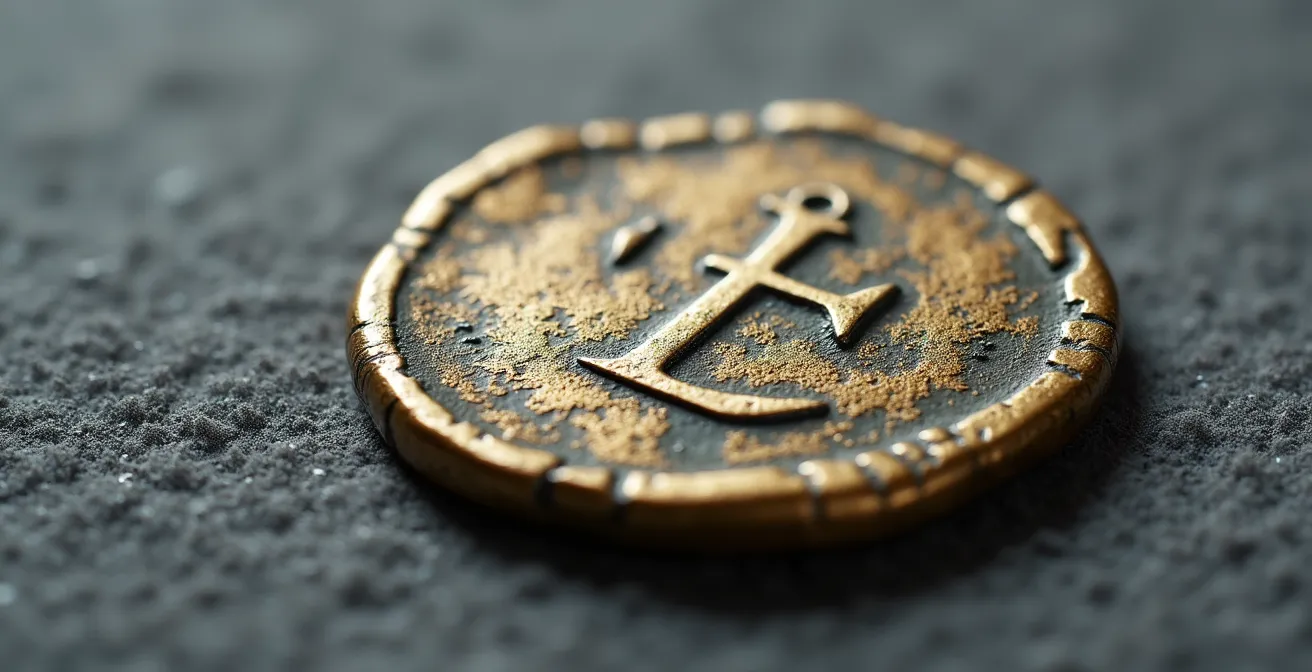
Physical examination is also a key part of this process. As seen in the macro detail above, an authentic ancient coin bears microscopic traces of its history—patina, flow lines from striking, and specific patterns of wear—that are difficult to fake. Your due diligence should always combine rigorous provenance research with expert, hands-on authentication.
The titanium white error that exposes fake Victorian paintings instantly
A crucial tool in the forensic investigator’s kit is the ability to spot an anachronism—an element that is out of its proper time period. For example, in the world of fine art, a forger might try to pass off a modern creation as a 19th-century masterpiece. An expert authenticator can instantly expose such a fake by testing the paint. The discovery of titanium white pigment, which was not commercially available until the 1920s, on a supposed “Victorian” painting is definitive proof of forgery.
This principle of material anachronism is a universal and powerful method for authentication, and it is especially critical in the Pre-Columbian field. Forgers often make mistakes related to materials and manufacturing techniques that are invisible to the naked eye but obvious under scientific analysis. For example, many Pre-Columbian cultures did not use the potter’s wheel. A perfectly symmetrical ceramic vessel claiming to be from one of these cultures is an immediate red flag.
Similarly, the tools used leave tell-tale marks. Ancient artisans used tools of stone, bone, and obsidian. The presence of sharp, regular marks left by modern steel blades or power tools, often visible only under magnification, is a clear sign of a fake. Another common anachronism is the use of synthetic pigments or modern restoration materials. Under UV light, many modern paints, glues, and fillers will fluoresce brightly, betraying recent repairs or a complete lack of authenticity. A key takeaway from a guide on spotting fakes is that if any part of an artifact fluoresces, it should be treated with extreme suspicion. To go beyond visual inspection, a collector must be aware of the advanced scientific tests available for authentication:
- Thermoluminescence (TL) Dating: The standard test for determining the age of fired ceramics. It measures the last time the object was heated to a high temperature.
- X-Radiography or CT Scanning: These methods can reveal hidden modern repairs, internal structures, or construction methods inconsistent with ancient techniques.
- Radiocarbon Dating: Used for organic materials like wood, textiles, or bone to determine when the original material stopped living.
- Trace Element Analysis: Can identify modern refining processes or alloys in metalwork that were not available to ancient cultures.
Collected in situ vs. Bought from a runner: Which provenance is legally safer?
In the shadowy corners of the antiquities trade, sellers may use romanticized language to describe an object’s origin. You might be told an item was “collected in situ” by a past owner, or “bought from a local runner” deep in the country of origin. From a legal standpoint, both of these descriptions are catastrophic red flags. Neither is a safe acquisition method; in the eyes of the law, they are admissions of trafficking in stolen goods.
“Collected in situ” is a euphemism for looting. It means the object was taken directly from an archaeological site without official permission, supervision, or documentation. Since virtually all source countries for Pre-Columbian art have laws vesting ownership of such finds in the state, this is an act of theft. “Bought from a runner” is no better. It means you are the end-purchaser in a chain of smuggling that began with a looter (the “runner”). In both cases, you are in possession of stolen property, putting you in violation of the National Stolen Property Act.
The only legally defensible provenance is one that can be documented with concrete evidence. As stated in the legal framework provided by U.S. Immigration and Customs Enforcement (ICE), the standard is uncompromising.
The only legally safe provenance is a chain of ownership that predates the 1970 UNESCO convention AND the specific patrimony laws of the country of origin
– Cultural Property Legal Framework, ICE Cultural Property, Art and Antiquities Investigations
This means you must have proof—such as a dated receipt from a known gallery, an auction catalog from the 1960s, or an official government export license—that the item was already out of its country of origin before these stringent laws took effect. Any ambiguity falls on the buyer to resolve. Without this proof, the legal risk remains absolute, as the following table illustrates.
| Acquisition Method | Legal Status | Risk Level | Potential Consequences |
|---|---|---|---|
| ‘Collected in situ’ post-1970 | Illegal looting | Catastrophic | Federal seizure, criminal prosecution |
| ‘Bought from runner’ | Receiving stolen goods | Catastrophic | NSPA violations, forfeiture, prosecution |
| Pre-1970 documented export | Generally legal | Low | Safe if documentation authentic |
| Licensed excavation (rare) | Legal with permits | Very Low | Requires extensive documentation |
Key Takeaways
- Legal Risk is Paramount: An artifact’s legal status, determined by export licenses and patrimony laws, is more critical than its age or beauty. A flawed title can lead to total loss.
- Adopt a Forensic Mindset: Do not passively accept provenance documents. Actively investigate them, looking for anachronisms, unverifiable claims, and classic red flags like the “old Swiss collection” tale.
- Scarcity vs. Safety: The rarity of legally-available artifacts (like Egyptian material) drives up prices but also means most items on the market carry extreme legal risk. Abundant items (like some Roman glass) may be safer but have less value stability.
How to Appraise a Painting When the Artist Has No Auction Record?
The final piece of the puzzle, after confirming authenticity and legal title, is valuation. How do you determine a fair price? For well-known artists, this is straightforward; a rich history of public auction records provides a clear market value. But what about a more unique object, like a painting by an artist with no auction record, or a rare type of Pre-Columbian artifact? In these cases, appraisers use a method of comparative analysis.
This principle is transferable across all collecting categories. While authentic Pre-Columbian pieces can range from $10 to over $1 million, the value of a specific piece without a direct sales history is determined by comparing it to similar objects that *do* have records. The appraiser analyzes a set of key value-driving factors: artistic quality, condition, rarity, and iconographic significance.
A valuation example of a Colima dog effigy from West Mexico provides a perfect case study. A standard, 6-inch Colima dog might be worth around $600. A larger, 24-inch version of average quality could be worth $5,000. Here, size is a factor. However, artistic quality can quickly override size. A small but exceptionally well-crafted piece will be worth more than a large, crude one. Condition is also paramount; significant repairs or restoration will drastically reduce value. The biggest multiplier, however, is rarity and iconography. A standard Colima dog is common. But a Colima dog depicted wearing a human mask, dancing, or nursing a pup is exceptionally rare. Such an iconographically unique piece could be worth $7,000-$8,000, far more than a larger but more common example. This demonstrates that value is a complex matrix of factors, not a simple calculation of age or size.
To appraise an object with no direct record, you or a professional appraiser must build a case for its value based on these comparable metrics. This involves researching auction results for similar items from the same culture, period, and quality tier to establish a defensible price range.
Acquiring Pre-Columbian art with confidence requires a fundamental shift in perspective. Moving beyond the passive role of a buyer and embracing the active, skeptical mind of an investigator is the only way to navigate this complex market safely. By treating provenance as a legal argument to be tested and building your own case for an object’s authenticity and clear title, you transform a risky purchase into a sound, long-term investment in history. For those serious about building a collection, the next logical step is to apply this forensic mindset to every potential acquisition.