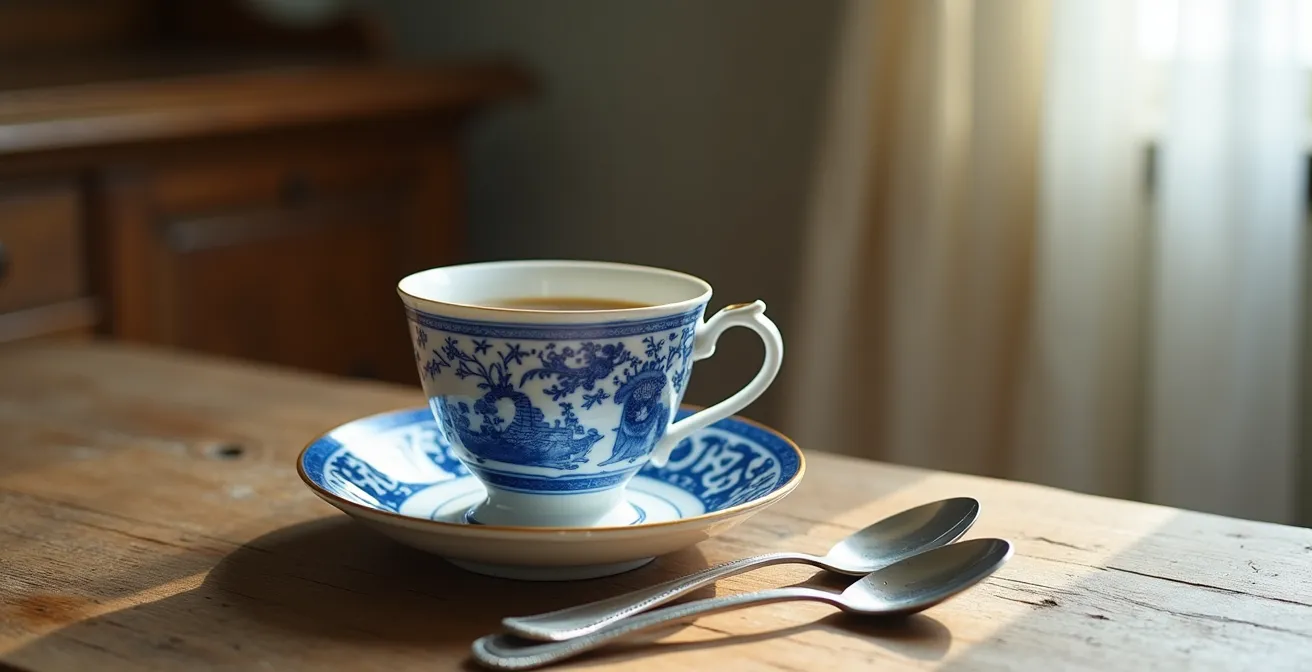
Contrary to the ‘hands-off’ approach, using your antiques is not only possible but desirable. The key isn’t a list of fear-based rules, but an understanding of the material science behind each piece—from porcelain’s hardness to wood’s reaction to humidity. This guide shifts the focus from ‘don’t’ to ‘how,’ empowering you to integrate priceless heirlooms into your daily life with elegance and confidence.
Inheriting a set of 18th-century Sèvres china or a magnificent Louis XV commode is a moment of awe, quickly followed by a paralyzing question: what now? The conventional wisdom is to lock these treasures away, treating them as museum pieces too fragile for modern life. We are told to use them only on “special occasions,” which often means they are never used at all. This approach, while well-intentioned, misses the point of craftsmanship. These objects were made to be used, admired, and integrated into a life of elegance.
The fear of damage—a scratch on a plate, a crack in a veneer—is real. But what if the solution wasn’t to live in fear, but to live with knowledge? The true secret to enjoying your heirlooms lies not in a list of prohibitions, but in understanding the material science and historical context that define their care. Knowing *why* a modern knife scratches soft-paste porcelain is infinitely more empowering than simply being told not to use it.
This guide moves beyond the simplistic ‘don’ts’ to explore the ‘hows’ and ‘whys.’ We will delve into the science of preservation, the logic of valuation, and the ethics of provenance. By understanding the nature of your antiques, you can transform them from static decorations into active, cherished participants in your daily life, honoring their history through confident and knowledgeable use.
To navigate this journey from apprehensive owner to confident custodian, we have structured this guide to address the most pressing concerns for any collector. The following sections will provide clear, science-backed answers to help you use and care for your heirlooms with grace.
Table of Contents: A Guide to Living Elegantly with Your Antiques
- Why soft-paste porcelain scratches instantly with modern cutlery?
- How to place an 18th-century commode in a modern heated home without cracking the veneer?
- Mint Condition vs. Old Repair: Which is better for a functional antique table?
- The hallmark reading error that costs collectors thousands at flea markets
- When to polish silver: why over-polishing strips the details off antique flatware?
- The cleaning error that strips gold leaf off antique frames instantly
- Insurance Value vs. Resale Value: Why the numbers are different for the same painting?
- How to Verify the Provenance of a Pre-Columbian Artifact Before Buying?
Why soft-paste porcelain scratches instantly with modern cutlery?
That heart-stopping grey line appearing on an antique plate is not a sign of poor quality; it’s a predictable clash of material science. The core of the issue lies in hardness. Early European porcelain, particularly soft-paste varieties like those from Sèvres or Chelsea, were formulated to mimic Chinese hard-paste porcelain but resulted in a beautiful yet more delicate material. The science behind this is clear: porcelain typically falls between 6 and 7 on the Mohs scale, while modern stainless steel cutlery ranges from 5.5 to 6. While this seems close, the older, soft-paste formulations are often softer than the cutlery used upon them.
When a harder material (your modern fork) is dragged across a softer one (the plate’s glaze), the metal abrades, leaving a microscopic deposit in the scratch. This isn’t just about caution; it’s about physics. The solution is not to banish the china to a display cabinet, but to use historically appropriate tools. Period-appropriate sterling silver or silver-plated flatware is much softer, with a Mohs hardness of around 2.5-3. Using these pieces together isn’t just historically authentic; it’s scientifically sound, ensuring neither piece harms the other.
Beyond cutlery, handling requires a similar mindset. Rings and bracelets, often made of hard metals and gemstones, are a primary cause of accidental scratches. The best practice is to remove all jewelry before handling delicate porcelain. When storing, the enemy is movement and contact. Placing thin sheets of chamois leather or even acid-free paper between stacked plates prevents the hard foot-rim of one plate from grinding against the delicate glazed face of the one below it. This isn’t just about padding; it’s about creating a frictionless environment.
How to place an 18th-century commode in a modern heated home without cracking the veneer?
Placing an antique commode in a modern, centrally heated home can feel like an act of vandalism. We see the intricate marquetry and imagine it splitting apart in the dry air. This fear is rooted in the nature of wood: it is a hygroscopic material, meaning it absorbs and releases moisture to balance with its environment. Rapid changes cause the wood to expand or shrink, putting immense stress on the delicate veneers and animal-hide glues that hold them in place. The key, however, is not to chase an impossible, static level of humidity, but to create a stable environment.
Conservation experts have identified a “safe zone” for antique furniture. For instance, the Winterthur Museum maintains its collection at a steady 18°C (65°F) and 50% relative humidity (RH). However, they also note that gradual, seasonal changes are far less damaging than rapid fluctuations. Before central heating, furniture survived because the changes in temperature and humidity happened slowly over weeks and months. Your goal is to replicate this gradualness. According to furniture conservation experts, the recommended relative humidity range is 40% to 60%. Staying within this range is more important than hitting a specific number.
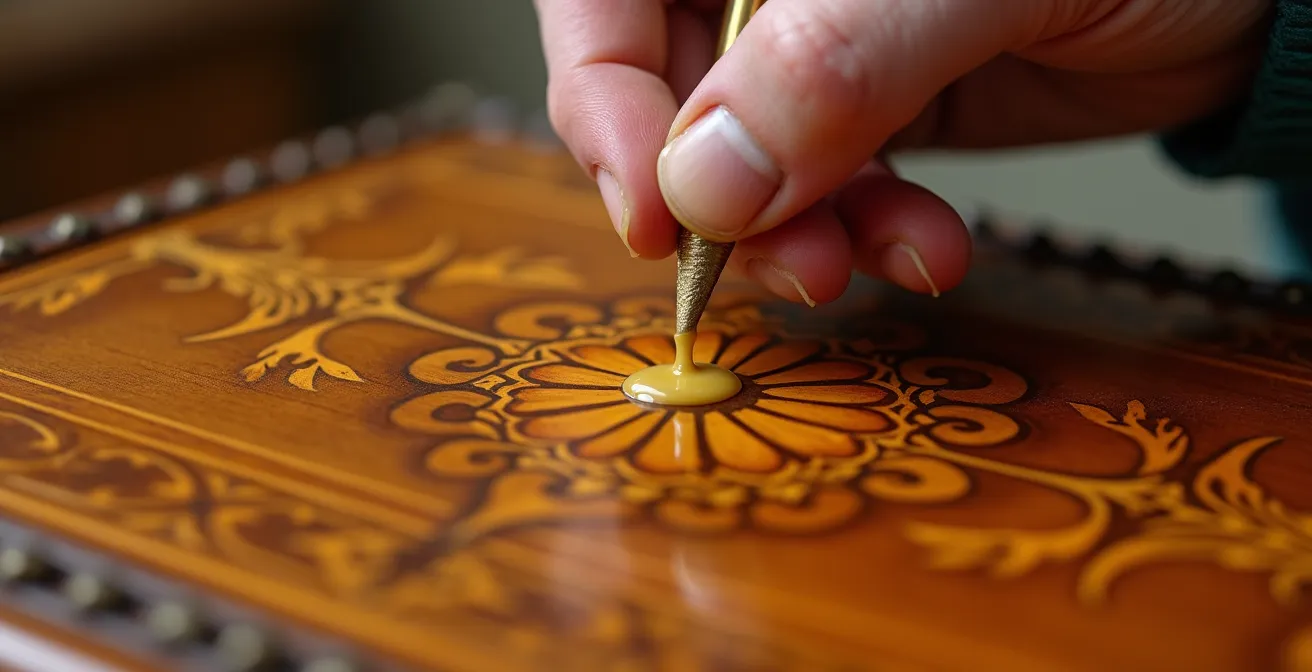
To achieve this, avoid placing furniture directly in front of radiators, air conditioning vents, or in direct sunlight, as these create radical micro-climates. Using a room humidifier during dry winter months can be a lifesaver. Furthermore, a traditional protective layer, like a high-quality carnauba-based paste wax, does more than just shine the surface. It helps to slow the rate of moisture exchange, acting as a buffer against sudden environmental shifts and giving the wood’s natural visco-elastic properties time to adapt without damage.
Mint Condition vs. Old Repair: Which is better for a functional antique table?
The collector’s instinct, honed by auction catalogs and museum displays, screams for “mint condition.” Any repair, any sign of wear, is often seen as a flaw that diminishes value. However, when transitioning an object from a collectible to a functional piece of your home, this mindset must be re-evaluated. For a table you intend to use for dining, writing, or family gatherings, a strong, honest, and well-executed old repair is often far superior to a fragile, “mint” but structurally compromised original.
Value is not a single concept; it is a hierarchy. A piece has a Museum Value, a Resale Value, and a Functional Value, and they are not the same. For daily use, Functional Value is paramount. A wobbly leg on a “mint” table makes it useless, whereas a table with a 200-year-old butterfly key repair that renders it perfectly stable is an object of immense utility and historical charm. The repair tells a story of the piece’s life and its journey through generations.
This table from Christie’s clarifies the different priorities when assessing the condition of an antique for various purposes.
| Value Type | Priority | Condition Preference | Best For |
|---|---|---|---|
| Museum Value | Mint condition essential | No repairs, original throughout | Collections, exhibitions |
| Resale Value | Mint preferred | Good repairs acceptable if disclosed | Investment, trading |
| Functional Value | Stability over appearance | Strong repairs superior to fragile mint | Daily use, family heirlooms |
When evaluating a piece for use, the quality of the repair is what matters. Look for traditional methods like dovetailed patches or the use of reversible hide glue, which demonstrate a respect for the original object. A good repair is a badge of honor, a testament to an object so beloved it was worth saving. It adds a chapter to its history, a chapter you now get to be a part of.
The hallmark reading error that costs collectors thousands at flea markets
At a bustling flea market, spotting a familiar hallmark can feel like finding treasure. The temptation is to quickly identify the mark, equate it with a high-value maker, and make the deal. This is the single most expensive error a novice collector can make. A hallmark is not a signature; it is a single data point in a complex matrix of authentication. Context is everything. Forgers are adept at copying marks from catalog photos, but they rarely get the subtle, physical context of the piece right.
Christie’s specialists, for example, emphasize that when authenticating Chinese porcelain, reign marks must be studied alongside the physical characteristics of the object itself. The way a vessel’s base was cut, finished, and glazed changed between dynasties. Forgers often neglect these details. A classic example is the “heaped and piled effect” of cobalt blue underglaze seen in 15th-century pieces, which is distinct from the almost purple-violet blue of the Jiajing period (1522-1566). An authentic mark on a piece with the wrong glaze is a red flag.
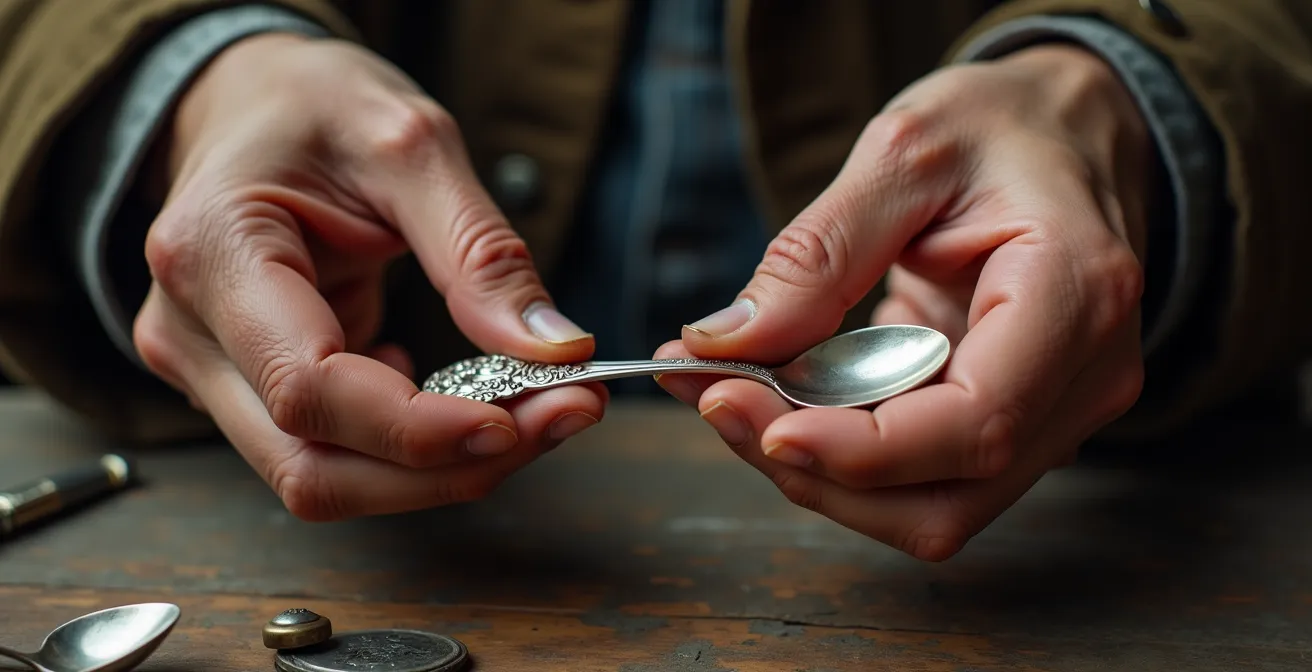
This principle extends to all fields, from silver to furniture. You must learn to “read” the entire object. How does it feel in your hands? What is the weight? Does the wear pattern look natural or artificially applied? Does the construction method match the period of the hallmark? As experts from the Christie’s Chinese Ceramics Department famously stated in their guide, this is a skill honed by tactile experience. As they note in their guide to collecting:
There is no quicker way to learn than by handling as many pieces as possible
– Christie’s Chinese Ceramics Department, Christie’s Guide to Collecting Chinese Ceramics
This hands-on knowledge is your best defense. The hallmark confirms what your hands and eyes already suspect; it should never be the sole basis for a purchase.
When to polish silver: why over-polishing strips the details off antique flatware?
The desire for gleaming, mirror-bright silver is understandable, but it’s a modern aesthetic that is deeply destructive to antiques. The most common error is confusing tarnish—a chemical reaction—with dirt. Tarnish is a thin layer of silver sulfide that forms on the surface. While a heavy, black layer can be unsightly, the subtle, dark oxidation that settles into the low points of a design is called patina. This patina is not dirt; it is a desirable sign of age that accentuates the details of the engraving and carving, giving the piece depth and character.
Over-polishing is the act of using an abrasive polish to remove not just the tarnish, but the patina as well. Every time an abrasive polish is used, it removes a microscopic layer of the silver itself. Over decades, this process literally erases fine details, leaving the once-sharp patterns looking soft and blurred—a condition collectors call “tired.” A “butler’s finish” is not a high shine, but a soft, lustrous glow that retains the patina in its crevices.
So, when should you polish? The answer is: as rarely as possible. For functional flatware, regular washing with a non-lemon-scented soap and hot water, followed by immediate and thorough drying, will dramatically slow the tarnishing process. Storing silver in flannel bags or chests with anti-tarnish strips also helps. When polishing is absolutely necessary, choose the least aggressive method. A non-abrasive chemical dip can remove tarnish without removing metal, though it will also remove all patina. For a more controlled approach, a very mild, non-abrasive cream polish, applied sparingly with a soft cloth, is preferable. The goal is to clean and brighten, not to strip the piece of its history.
The cleaning error that strips gold leaf off antique frames instantly
Of all the cleaning mistakes an antique owner can make, few are as swift, devastating, and irreversible as using a liquid cleaner on a gilded surface. The brilliant shine of a gold leaf frame is not due to a solid layer of metal. It is an incredibly thin sheet of gold—often just microns thick—applied over a preparatory base of gesso and bole (a type of clay), all held together with a water-soluble animal hide glue. This structure is its fatal flaw in the modern cleaning world.
The moment any water-based liquid touches the surface, it begins to dissolve the glue base underneath the gold leaf. The result is instantaneous: the gesso turns to mush, and the gold leaf flakes away, floats off, or is wiped away with the cleaning cloth. It is a catastrophic failure that cannot be undone. Research consistently shows that 100% of water-based cleaners will instantly dissolve the water-soluble gesso and hide glue base of gold leaf. This includes plain water, ammonia-based glass cleaners (a common error when cleaning the glass in a frame), and any form of furniture polish.
Properly cleaning a gilded frame is a dry process. It requires patience and a gentle touch, not chemicals. For routine dusting, the only safe tool is a very soft, natural-bristle brush, used with a light flicking motion to push dust away from, not into, the intricate details. For more stubborn grime, the surprising professional tool is a piece of fresh, crustless white bread, gently dabbed (never rubbed) onto the surface to lift dirt. This seems archaic, but it works because it is a non-abrasive, non-liquid method.
Action Plan: Professional Dry-Cleaning for Gilded Surfaces
- Use only a very soft, natural-bristle brush (like a squirrel or sable artist’s brush) for light dusting.
- Apply a gentle, upward flicking motion to move dust away from the frame, especially any loose flakes. Never wipe.
- For ingrained dirt, gently dab the surface with a piece of fresh, crustless white bread. Do not rub.
- Avoid all liquids, especially water, ammonia-based cleaners, or any commercial polishes. They will cause irreversible damage.
- Never use microfiber cloths, which can snag and lift delicate leaf, or canned air, which can blast away loose fragments.
Key Takeaways
- True antique care is based on understanding material science—like hardness and hygroscopy—not just following rules.
- Functional Value, which prioritizes stability for daily use, is more important than “mint condition” for items you want to live with.
- Authentication relies on deep, contextual knowledge of an object’s physical properties, not just a superficial reading of its hallmarks.
Insurance Value vs. Resale Value: Why the numbers are different for the same painting?
One of the most confusing aspects for a new collector is the vast gap between the value on an insurance appraisal and the check received when selling the same piece. It’s not uncommon for the resale value to be only 40-60% of the insured value, leading to feelings of being cheated. This discrepancy isn’t a scam; it’s a reflection of the fact that “value” means different things in different contexts.
Insurance Value, or Replacement Value, is the highest-end retail price required to replace an item immediately. It represents what you would have to pay a top-tier gallery to find a comparable piece in a short amount of time. It’s the “worst-case scenario” cost. In contrast, Resale Value, or Fair Market Value, is defined as what a willing buyer will pay a willing seller when neither is under pressure. This is a much lower, more realistic number that accounts for the costs and time involved in a transaction.
The gap is created by transaction costs. As explained in case studies of major auction houses like Christie’s and Sotheby’s, these costs are significant. A gallery might take a 50% commission. An auction house charges both a buyer’s premium and a seller’s premium, each ranging from 15-25%. These costs, plus the time and effort to find the right buyer, are all factored into the lower resale value.
This table breaks down the key types of value every collector should understand:
| Value Type | Definition | Typical Percentage | When It Applies |
|---|---|---|---|
| Insurance Value (Replacement Cost) | High-end retail price to immediately replace | 100% (baseline) | Insurance policies |
| Resale Value (Fair Market) | What willing buyer pays willing seller | 40-60% of insurance | Private sales, auctions |
| Utility Value | Daily pleasure and use value | Subjective/Personal | Functional use |
How to Verify the Provenance of a Pre-Columbian Artifact Before Buying?
For many classes of antiquities, particularly pre-Columbian art, archaeological finds, and tribal art, the question of provenance is not just a matter of academic interest—it is the single most important factor determining the piece’s legality, value, and ethical standing. “Provenance” is an object’s documented history of ownership. A piece with no provenance is not just a mystery; it is a potential liability. The international art market has established a clear, hard line to combat illicit trafficking in cultural property.
This line was drawn in 1970 with the UNESCO Convention on the Means of Prohibiting and Preventing the Illicit Import, Export and Transfer of Ownership of Cultural Property. This convention is the bedrock of modern collecting ethics. As a result, any piece without proof of export from its country of origin before 1970 is presumed to be illicitly trafficked. Such a piece is legally radioactive—it cannot be sold at major auction houses, imported or exported between signatory countries, or donated to a museum for a tax deduction. It is, for all intents and purposes, unsellable on the legitimate market.
Therefore, when buying, your primary task is to vet the documentation. Not all “proof” is created equal. A handwritten note from the dealer is effectively worthless. A sworn affidavit from a family saying “it’s been in our collection since the 1950s” is weak without supporting evidence. The strength of provenance lies in verifiable, third-party, pre-1970 documentation. This creates a clear hierarchy of evidence that every serious collector must understand.
Action Plan: Hierarchy of Provenance Documentation (Weakest to Strongest)
- Weakest: A modern dealer’s certificate or a simple note of sale.
- Weak: An old family photograph showing the item in the background, or an unverifiable family story.
- Moderate: An entry in an auction catalog from the 1950s or 1960s.
- Strong: A physical museum or collection label affixed to the piece itself, or a collection inventory number that can be cross-referenced.
- Strongest: Publication in a scholarly journal, book, or major exhibition catalog dated before 1970.
Moving from a passive owner to a knowledgeable custodian requires this shift in perspective—from fear of damage to confidence in care. The principles of material science, functional value, and diligent provenance verification are the tools that empower you. They allow you to honor the history of your heirlooms not by hiding them, but by giving them a new life, intelligently and elegantly integrated into your own. To truly master this approach, it is always wise to revisit the fundamental principles we have discussed. By applying this knowledge, you can begin to truly live with your antiques, transforming your home into a space of living history.