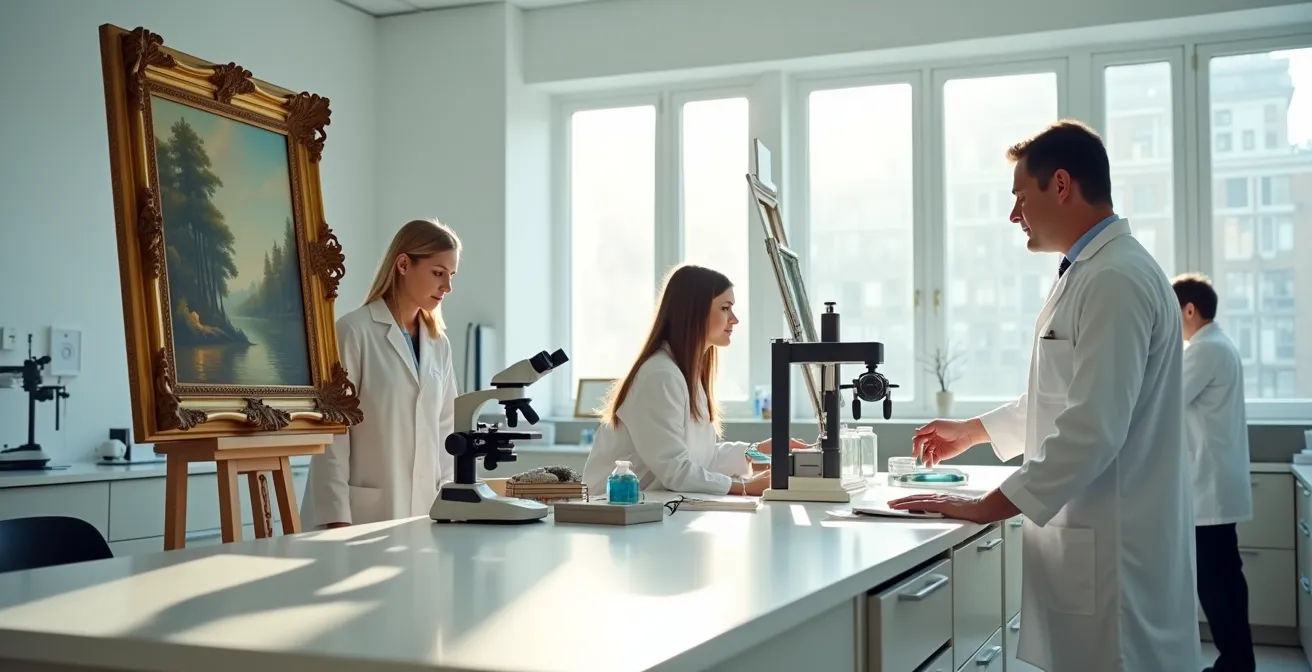
Spotting a sophisticated art forgery is not about a “gut feeling”; it’s a forensic investigation into the painting’s physical materials.
- Artificial aging cracks consistently lack the microscopic depth and complex patterns of natural craquelure.
- The construction of the wooden stretcher bar—its joints, tool marks, and fasteners—provides a surprisingly accurate timestamp.
- A single anachronistic material, like a trace of titanium white pigment, can instantly betray a modern fake posing as a Victorian work.
Recommendation: If you suspect a discovery, the protocol is absolute: document everything, disturb nothing, and engage a triumvirate of independent experts—an art historian, a conservation scientist, and an art law specialist.
The thrill of discovering a potential lost masterpiece in an antique shop or dusty attic is a powerful fantasy. The romantic notion of connoisseurship suggests a gifted eye can simply “feel” the hand of a master. But in the world of high-stakes art, where forgeries can be masterpieces of deception in their own right, relying on intuition is a fool’s errand. The most accomplished forgers don’t just mimic a style; they attempt to replicate an object’s entire history. They are masters of the superficial narrative, from aged varnish to convincing signatures.
The common advice—to check the signature, look for old labels, or use a blacklight—is merely scratching the surface. These are the very first things a competent forger learns to fake. A true investigation dismisses the subjective and embraces the skeptical, detective-like mindset of material forensics. The real story isn’t in the image; it’s embedded in the physical and chemical biography of the object itself. The canvas, the wood, the pigments, and even the dirt hold immutable truths that science can unlock.
But if the real key isn’t a feeling, but a fact, what are we looking for? This guide moves beyond the basics into the realm of the conservator and the forensic analyst. We will dissect the physical evidence that forgers struggle to replicate, from the microscopic structure of cracks to the chemical signature of the paint. This is not about becoming a connoisseur; it’s about learning to think like a forensic investigator and recognizing when an object’s story just doesn’t add up.
By examining the crucial tells that betray a forgery, we will build a framework for evidence-based appraisal. This journey will take us through the structure of the canvas, into the chemical makeup of the pigments, and finally, to the professional protocol for handling a potential discovery.
Summary: A Forensic Guide to Unmasking a Fake 19th-Century Landscape
- Why artificial aging cracks look different from natural stress patterns under magnification?
- How to date a painting solely by the construction of its stretcher bars?
- Carbon dating vs. Pigment analysis: Which method is foolproof for 20th-century art?
- The titanium white error that exposes fake Victorian paintings instantly
- What steps to take first when you suspect you’ve found a lost masterwork?
- Infrared vs. X-Ray: Which reveals the underdrawing and which reveals the lead white?
- Why oil and smoke deposits inside a mask prove it was danced?
- How to Appraise a Painting When the Artist Has No Auction Record?
Why artificial aging cracks look different from natural stress patterns under magnification?
Craquelure, the fine network of cracks on an old painting’s surface, is often seen as the ultimate sign of authenticity. Forgers know this and have developed numerous methods to create it, from baking the canvas to applying solvents. Yet, under a microscope, these artificial cracks betray themselves. Natural craquelure is the result of centuries of the paint layers slowly shrinking and becoming brittle at different rates from the canvas and ground layers. It’s a slow, deep, and organic process.
The primary difference is depth and geometry. Natural cracks are a response to the underlying structure, often following the weave of the canvas. They have a distinct “V” shape in cross-section with softly rounded edges, a result of slow, persistent stress. Artificial cracks, created by rapid, uniform stress like heat, are often isotropic—appearing random and directionless. They tend to be shallow, with sharp, “U”-shaped profiles that sit on the surface. Research has put a number to this: 2022 optical coherence tomography data shows natural cracks average 219.1 μm in depth, while forced cracks are significantly shallower at around 104.3 μm.
Furthermore, genuine aging produces a complex ecosystem of cracks. You’ll find primary, larger cracks, and within them, a network of secondary, finer micro-cracks. Another crucial sign is the presence of “bar marks”—faint vertical lines of craquelure that form directly over the stretcher bars, a clear indicator of long-term tension against the frame. A forger can fake a uniform web of cracks, but faking this multi-generational, structurally-influenced pattern is nearly impossible. It’s the difference between a real river delta and a pattern drawn in the sand.
How to date a painting solely by the construction of its stretcher bars?
If the paint layer is the skin, the stretcher is the skeleton. A forger might dress the “body” in period-correct clothing, but they often get the bone structure wrong. The construction of the wooden frame that supports the canvas is a remarkably reliable timestamp, as manufacturing techniques evolved in predictable ways. An appraiser with a skeptical eye turns the painting over immediately, knowing the back holds as many clues as the front.
The joinery is the first tell. Before the mid-19th century, stretcher corners were typically constructed with hand-carved mortise-and-tenon joints. After roughly 1850, machine-milled mitered corners with keys or expandable mechanisms became the standard. An expert can distinguish the tell-tale marks of a hand-powered pit saw (common pre-1850) from the clean, curved marks of a modern circular power saw, a dead giveaway on a supposed 18th-century work. This forensic examination of tool marks provides a clear “terminus post quem”—a date after which the object must have been made.
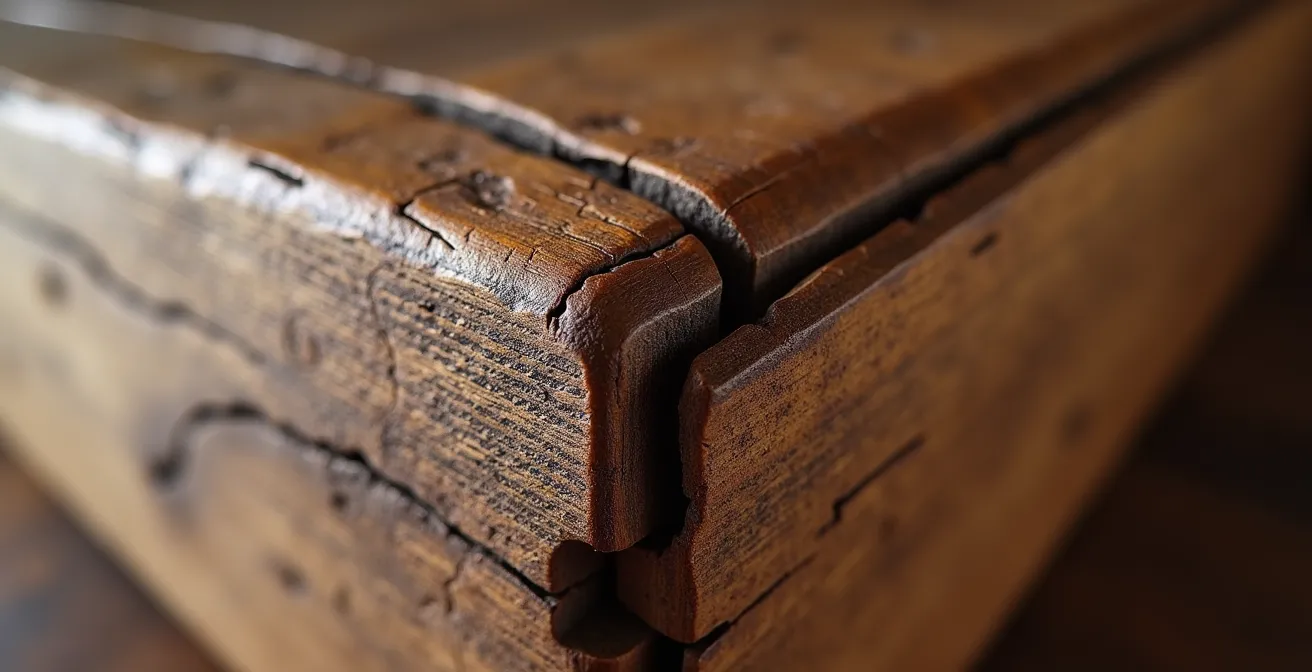
As the image above illustrates, the texture and detail of these joints are telling. Even the method of canvas attachment tells a story. Early paintings used hand-forged tacks with irregular heads, placed unevenly. The shift to mass-produced, uniform fasteners and eventually staples in the 20th century provides a clear timeline. A forger might find an old piece of wood, but they are unlikely to replicate the precise combination of wood species, oxidation patterns, joint construction, tool marks, and fastener technology of a specific decade.
Carbon dating vs. Pigment analysis: Which method is foolproof for 20th-century art?
When the visual clues are ambiguous, appraisers turn to hard science. Two of the most powerful tools are Carbon-14 dating and pigment analysis. However, a common misconception is that these tests provide a simple “authentic” or “fake” verdict. The truth, as any good detective knows, is that your evidence is only as good as the question you ask. Neither method is foolproof; they answer different, complementary questions.
Carbon-14 dating measures the decay of the radioactive carbon-14 isotope in organic materials. For a painting, this means it can date the canvas (linen or cotton) or the wooden stretcher bars. However, it dates the death of the plant, not the creation of the artwork. A forger can easily acquire genuinely old canvas or wood to create a new painting. Therefore, Carbon-14 can only prove a forgery if the support material is *younger* than the artist’s lifetime. It can never prove a painting is authentic, only that its materials are old enough to be.
Pigment analysis, using techniques like Raman spectroscopy or X-ray fluorescence (XRF), identifies the chemical composition of the paints. This is incredibly powerful for spotting anachronisms. Every pigment has a known date of invention. As forensic scientist Dr. Lucile Beck notes, this provides a critical clue:
Neither method is foolproof alone; they answer different questions. Carbon-14 dates the organic support, not the act of painting. Pigment analysis provides a ‘terminus post quem’ – a date after which the painting must have been made.
– Dr. Lucile Beck, Forensic Science International
For 20th-century art, carbon dating is often less useful due to the “bomb pulse”—nuclear testing in the mid-20th century flooded the atmosphere with carbon-14, skewing results for anything created after 1950. In this context, pigment analysis becomes the far more definitive tool for unmasking a fake.
The titanium white error that exposes fake Victorian paintings instantly
Sometimes, an entire multi-million dollar forgery scheme can be brought down by a single microscopic particle of the wrong color. The most devastating mistake a forger can make is a material anachronism—using a substance that didn’t exist at the time the work was supposedly created. For paintings of the 19th and early 20th centuries, the history of the color white is a minefield for the uninformed forger.
Throughout the 19th century, the primary opaque white used by artists was lead white or, to a lesser extent, zinc white (introduced around the 1840s). Titanium white (titanium dioxide), the bright, highly opaque white standard in modern paints, was not commercially available to artists until after 1921. Its presence in a painting purported to be from the Victorian era (1837-1901) is an irrefutable “smoking gun.” It proves, beyond any doubt, that the painting is a modern creation.
The case of master forger Wolfgang Beltracchi, whose scam collapsed in 2010, is a perfect illustration. He created a supposed 1914 painting by Heinrich Campendonk that fooled experts for years. However, as detailed in an analysis of the methods used to expose him, forensic analysis found traces of titanium white in what was meant to be zinc white. Beltracchi had used a modern tube of paint that, while labeled “Zinc White,” contained titanium dioxide as a bulking agent, a common modern practice. This single chemical fingerprint unraveled his entire criminal enterprise. It’s a stark reminder that no matter how good the story, the materials don’t lie.
What steps to take first when you suspect you’ve found a lost masterwork?
The moment of suspicion is charged with excitement and possibility. It’s also the moment of maximum risk. The wrong move can damage the object, destroy crucial evidence, or compromise your legal claim. If you believe you have found something significant, your first role is not that of an owner, but that of a custodian. The prime directive is simple: do no harm. Resist the overwhelming temptation to “clean it up.” That layer of grime may be a crucial part of its history, and a clumsy attempt at restoration can cause irreversible damage.
Before engaging any outside party, begin a quiet research phase. Document every marking on the back—faded labels, stamps, inscriptions—with high-resolution photos in neutral light. These are provenance clues that can help trace the object’s ownership history. Consult the artist’s catalogue raisonné, the definitive, scholarly compilation of their known works. Many catalogues include a section on “lost works” or “unlocated works,” and your find might match a description.
Once you have gathered your preliminary information, professional authentication requires a “triangle” of independent experts. This is not a job for a single appraiser. You need an art historian who is a published specialist on the specific artist, a conservation scientist to perform material analysis, and an art law specialist to navigate potential title claims. The key is to manage expectations: the vast majority of “discoveries” turn out to be copies, works from the artist’s “school” or studio, or hopeful misattributions. The goal must be to uncover the truth, not to force a desired outcome.
Action Plan: Protocol for a Potential Art Discovery
- Do No Harm: Never attempt to clean, repair, or remove the work from its frame. Document every detail, including the front, back, and frame, with high-resolution photography in neutral, even lighting.
- Quiet Research Phase: Check the artist’s catalogue raisonné for any listings of “lost” or “unlocated” works that match your piece. Carefully research any labels, stamps, or inscriptions on the reverse to trace its provenance.
- Assemble the Triangle of Authentication: Engage three separate, independent experts: an Art Historian specializing in the artist, a Conservation Scientist for material analysis, and an Art Law specialist to investigate ownership and title.
- Check for Hidden Clues: Use non-invasive methods like UV light to look for modern restorations, which fluoresce differently than old varnish. Examine the sides of the canvas (selvedge) for signs of it being cut from a larger work.
- Manage Expectations: Approach the process with scholarly skepticism. Accept that the probability is high that the work is a copy or misattribution. Focus on the process of discovery, not on a presumed financial windfall.
Infrared vs. X-Ray: Which reveals the underdrawing and which reveals the lead white?
To move beyond what the naked eye can see, investigators use different wavelengths of light to peer through the paint layers. Two of the most common non-invasive techniques are Infrared Reflectography (IR) and X-ray Radiography. They are often spoken of interchangeably, but they are fundamentally different tools that reveal different secrets. Understanding what each one shows is key to interpreting the evidence they provide.
Infrared Reflectography (IR) is used to reveal the underdrawing. It works because infrared light is absorbed by carbon-based materials (like charcoal or graphite used for sketching) but is reflected by most paint pigments. The result is a ghostly image of the artist’s initial sketch on the canvas. For a forger, this is a dangerous test. A master’s underdrawing is often confident, exploratory, and full of small changes (called pentimenti) as they refined the composition. A forger’s underdrawing, especially if they are tracing a known image, is often timid, rigid, and unnaturally precise.
X-ray Radiography, on the other hand, works by detecting atomic density. X-rays pass through lighter elements but are blocked by heavy ones. In historical paintings, the heaviest element is often the lead in lead white pigment. An X-ray image, therefore, doesn’t show the final painting but rather a map of where lead white was used. This is invaluable for detecting a common forger’s trick: painting over an old, worthless painting to acquire a genuinely aged canvas. An X-ray will reveal the “ghost” of the original painting underneath the forgery, a damning piece of evidence.
As the following table demonstrates, each technology has a specific application in the forensic analysis of a painting. True comprehensive analysis often involves Multispectral Imaging, which combines data from many wavelengths to build a complete picture that no single method can provide.
| Technology | What It Reveals | How It Works | Forgery Detection Application |
|---|---|---|---|
| Infrared Reflectography | Carbon-based underdrawings | IR absorbed by carbon, reflected by paint | Reveals forger’s timid traced lines vs master’s confident sketches |
| X-Ray Radiography | Lead white pigment, pentimenti | X-rays blocked by heavy elements like lead | Exposes paintings underneath used for authentic old canvas |
| Multispectral Imaging | Combined information | Multiple wavelengths from UV to IR | Comprehensive view missed by single methods |
Why oil and smoke deposits inside a mask prove it was danced?
This question, though it refers to a ceremonial mask, applies a powerful forensic principle directly to our canvas. Just as an anthropologist can read an object’s life story through its use-wear, an art detective can read a painting’s history through its accumulated environmental grime. The evidence of a painting having “lived” in the real world for centuries is one of the most difficult things for a forger to convincingly replicate. They can fake age, but they struggle to fake a biography.
A painting that hung over a coal or wood-burning fireplace for a hundred years will develop a specific pattern of darkened, heat-crazed varnish, often darker at the top where heat and smoke rose. This authentic patina, sometimes called the “Fireplace Test,” has a unique chemical composition and distribution that is very different from a uniform layer of tinted varnish applied in a forger’s studio. As described in reports on the methods of notorious forgers like Eric Hebborn, even the fly specks on a painting can be analyzed. Authentic specks have a raised texture, a specific chemical makeup, and a natural, random distribution that forgers fail to copy.
Another crucial part of a painting’s biography is the history of its care. A valuable 19th-century painting that suffered a tear would have been professionally repaired with a period-correct canvas patch and animal-hide glue. A split in a wood panel would be mended with a “Dutchman” insert. These old, well-executed repairs are signs that the painting was valued and conserved long ago. A forger is focused on creating a “pristine” old object and rarely goes to the trouble of faking a convincing, century-old repair. The absence of a life lived can be as suspicious as the presence of a modern pigment.
Key Takeaways
- Material anachronism is the forger’s most fatal error; the presence of modern materials like titanium white is irrefutable proof of a fake.
- Natural aging is a complex, structural process; a forger can imitate the look of age but not the microscopic geometry of real craquelure or the specific tool marks of historical construction.
- Scientific analysis is not a simple yes/no test. Each method answers a different question, and interpreting the results requires expertise and a skeptical mindset.
How to Appraise a Painting When the Artist Has No Auction Record?
After the entire forensic process, you may be left with a painting that appears authentically of its period but is by an unknown or unrecorded artist. The signature is illegible, and there is no auction history. How do you assign a value to a ghost? This is where the detective work of authentication transitions into the nuanced art of appraisal. Without a sales record, value is determined by a combination of comparative analysis and an honest assessment of its intrinsic qualities.
The first step is the Concentric Circles Method. If you can’t research the artist, research their world. If you can identify the school, region, or even the master under whom they might have studied, you can research the auction records of their direct contemporaries. This establishes a baseline value for works of a similar period, style, and quality. Auction results for paintings cataloged as ‘Anonymous’, ‘Attributed to’, or ‘School of’ a known artist are invaluable here. You are no longer appraising one painting; you are placing it within a known market ecosystem.
Next, you must divorce the work from its mystery and judge it on its own merits using a QCS Scoring System: Quality, Condition, and Subject. How high is the technical quality of the composition and execution? What is the physical condition—is it pristine or in need of costly restoration? And critically, what is the subject matter? A charming genre scene or a pleasing landscape has a broader commercial desirability than a somber religious portrait, regardless of the artist. Finally, a skilled appraiser factors in “wall power”—a subjective but critical assessment of a painting’s commanding presence and decorative appeal. For an unknown artist, this decorative value often forms the floor price.
The forensic journey from suspicion to authentication is a demanding one, requiring skepticism, knowledge, and access to scientific tools. By learning to read the material evidence embedded in the object itself, an appraiser can move beyond the forger’s deceptive narrative and uncover the truth written in the language of chemistry and time. For those serious about art investment, developing this forensic eye is no longer a niche skill but an essential shield against deception.