Selling digital art successfully isn’t about finding a marketplace; it’s about engineering a robust system of value around your work.
- NFTs must be architected with legal and technical permanence to establish undeniable provenance.
- Display strategies like augmented reality and modular design create new revenue streams beyond a single sale.
Recommendation: Shift your focus from creating a single piece to building a valuable, future-proofed artistic asset.
For a digital artist, the greatest frustration isn’t the creative process; it’s the moment after. You’ve poured weeks into a masterpiece that exists only as pixels, and the market’s response is often a fleeting social media ‘like’. The conventional advice feels hollow: “build a following,” “mint an NFT,” or “sell prints.” These are tactics, not a strategy. They don’t solve the fundamental problem: how do you convince a collector to invest significant capital in an asset that can be infinitely copied and has no physical form?
The conversation often stalls around basic NFT platforms or traditional merchandise. But these approaches barely scratch the surface of what’s possible. They fail to address the collector’s core anxieties about authenticity, longevity, and a return on investment. The truth is, selling intangible art has very little to do with the art itself and everything to do with the framework of value you construct around it. But what if the key wasn’t to mimic the physical art world, but to leverage the unique properties of the digital medium to create a new, more robust form of value?
This guide moves beyond the platitudes. We will not be discussing how to get more followers. Instead, we will focus on value engineering for your digital creations. This is a business-minded approach that treats your art as a strategic asset. We’ll deconstruct how to build an unshakeable system of provenance, explore innovative display contexts that create new revenue models, and implement technical strategies to ensure your work’s legacy—and its value—endures.
This article provides a strategic roadmap for monetizing your digital work. We will cover the essential pillars, from the technical foundations of ownership to the business models that unlock new opportunities for exhibition and sales.
Summary: How to Sell Digital Art When Collectors Can’t Hang It on a Wall?
- Why NFTs (despite the crash) solved the “right click save” problem for provenance?
- How to map a video onto a 3D sculpture without expensive software?
- Augmented Reality vs. Virtual Reality: Which creates more engagement for gallery visitors?
- The coding mistake that will make your net-art unplayable in 2 years
- How to cut 3D render times in half without losing texture quality?
- Physical display vs. digital twin: Which serves the legacy better for fragile items?
- Fixed Location vs. Modular Design: Which strategy maximizes exhibition opportunities?
- How to Find Your Unique Artistic Vision When Everyone Has a Camera?
Why NFTs (despite the crash) solved the “right click save” problem for provenance?
The common dismissal of NFTs, “I can just right-click and save it,” fundamentally misunderstands the problem they solve. The issue was never about preventing copies; it was about authenticating the original. NFTs, despite market volatility, introduced a robust mechanism for a system of provenance. This isn’t just a digital certificate; it’s an on-chain, immutable ledger that tracks an artwork’s entire history. This solves the collector’s primary concern: proving they own the authentic piece, not just a copy.
The sale of Beeple’s digital artwork for a staggering $69.3 million by Christie’s wasn’t just a headline; it was the art establishment validating the blockchain as a legitimate registrar of ownership. This digital-native solution is arguably more secure than a paper trail, which can be forged or lost. It transforms an easily replicable file into a unique, verifiable asset whose history is transparent and permanent.
However, a smart contract alone is not enough. True value engineering requires a more comprehensive approach that combines on-chain verification with off-chain legal clarity. This creates a bulletproof package for collectors.
Case Study: The Power of Off-Chain Legal Agreements
Forward-thinking NFT projects now embed IPFS links to legal documents directly within the token’s metadata. One such Rights Agreement explicitly states: ‘Control over on-going provenance, ownership of and rights corresponding to this artwork is hereby assigned to this contract and this blockchain entry.’ This strategy, detailed in an analysis of NFT legal structures, creates a dual-layered assurance. The NFT serves as the public, unchangeable title, while the off-chain agreement defines the specific rights (display, commercial use) the owner actually holds, providing the legal bite that smart contracts alone may lack.
By architecting this combination of technical and legal safeguards, you are no longer just selling a JPG. You are selling a secure, verifiable asset with a clear and enforceable set of rights, justifying a premium price point. It’s the difference between a poster and a signed, numbered, and authenticated master print.
How to map a video onto a 3D sculpture without expensive software?
Bringing digital art into the physical world is a powerful way to create value, but the perceived cost of technologies like projection mapping can be a major barrier. The secret isn’t expensive hardware or proprietary software; it’s a streamlined, open-source workflow. By leveraging free tools like Blender and the non-commercial version of TouchDesigner, artists can achieve professional-grade projection mapping on complex 3D surfaces, turning any sculpture into a dynamic canvas.
The core technique involves creating a perfect digital replica of your physical sculpture in Blender. You then perform a “UV unwrap,” which is like creating a flattened blueprint of the sculpture’s surface. This UV map becomes your guide for creating video content that aligns perfectly with the physical object’s contours. When projected, the video appears to be an integral part of the sculpture’s texture, rather than a simple overlay. This process allows for incredible precision without the high costs typically associated with this medium.
While paid software offers convenience, a free, open-source pipeline provides unparalleled control and customization, democratizing a once-exclusive art form. For an artist focused on value engineering, mastering this workflow is a strategic advantage.
The table below breaks down the software landscape, highlighting why the free combination of Blender and TouchDesigner is so powerful for artists on a budget.
| Software | Cost | Key Features | Best For |
|---|---|---|---|
| Blender + TouchDesigner | Free | Full 3D modeling, UV mapping, real-time processing | Complete open-source workflow |
| MadMapper | $399 | Intuitive interface, quick setup | Live performances |
| Resolume Arena | $935 | VJ features, effects library | Professional installations |
| Processing + Syphon | Free | Code-based, highly customizable | Interactive installations |
For a collector, receiving a “plug-and-play” system with a Raspberry Pi running pre-configured open-source software is a high-value proposition. It makes a complex installation accessible and demonstrates a level of technical mastery that justifies a higher price for the work.
Augmented Reality vs. Virtual Reality: Which creates more engagement for gallery visitors?
Once your digital art has a physical presence, the next frontier is interactive display. Augmented Reality (AR) and Virtual Reality (VR) are often grouped together, but they serve fundamentally different strategic purposes for visitor engagement. While VR offers deep, solitary immersion, AR generates significantly more social engagement and shareability, making it a more powerful marketing tool for artists and galleries. VR isolates the user, while AR integrates the digital into the shared physical world.
The key difference lies in the user experience. VR requires a dedicated headset that blocks out the real world, creating an intense but individual experience. It’s difficult to share and discuss in real-time. AR, typically accessed through a smartphone, overlays digital content onto the physical environment. This allows multiple people to view the same artwork, discuss it, and, most importantly, capture photos and videos of themselves interacting with it. This social element is a massive driver of organic promotion.
Case Study: AR as a Cultural Amplifier
The viral potential of AR in an art context was perfectly demonstrated by Saturday Night Live’s parody sketch about NFTs. As noted in an analysis of new media in museums, the sketch itself was sold as an NFT, but its cultural impact came from its shareability. AR allows for similar “shareable cultural moments” within a gallery. Visitors don’t just see the art; they become part of it, and their social media posts become free advertising for the exhibition, driving both foot traffic and online buzz.
This image conceptually illustrates the core difference: the shared, social experience of AR versus the solitary, immersive nature of VR.
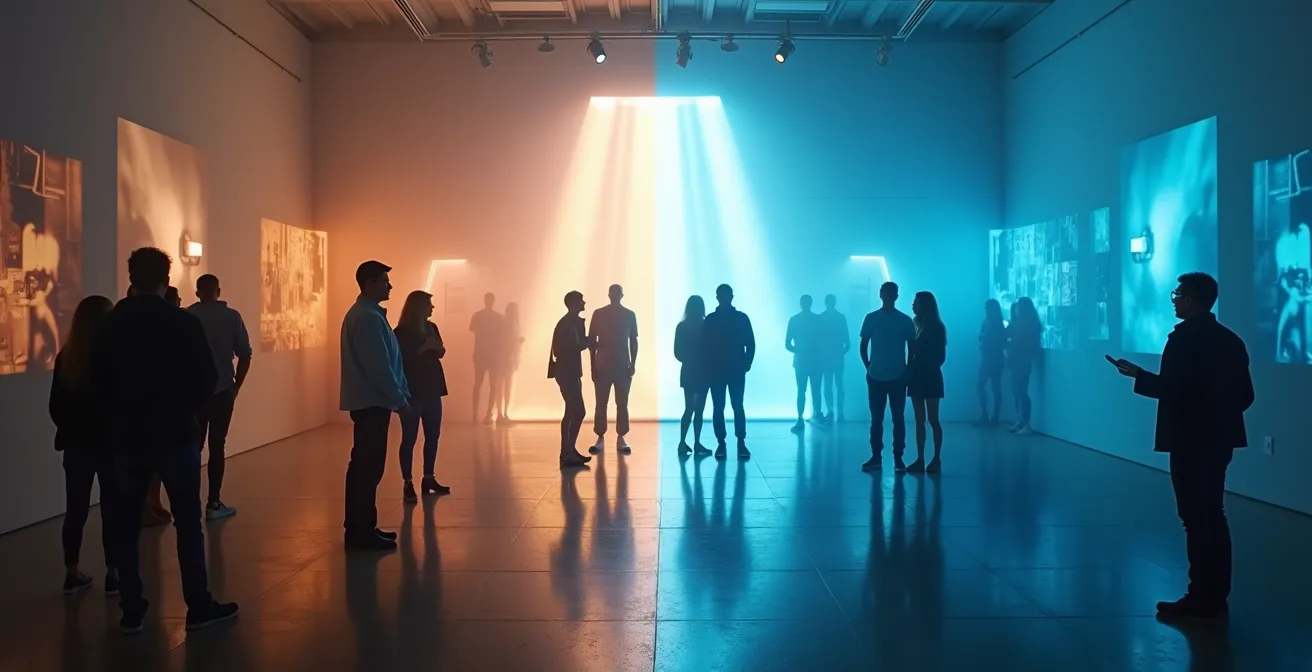
From a business perspective, the metrics speak for themselves. The low barrier to entry (no special hardware) and high social sharing rate make AR the superior choice for maximizing an artwork’s reach and public engagement. While VR can provide a profound artistic experience, AR delivers a better return on investment in terms of audience growth.
The following table, based on gallery implementation data, quantifies the difference in engagement between the two technologies.
| Metric | Augmented Reality | Virtual Reality |
|---|---|---|
| Social Sharing Rate | 65% of visitors share AR experiences | 12% share VR (harder to capture) |
| Average Engagement Time | 3-5 minutes | 15-20 minutes |
| Group Participation | Supports 10+ simultaneous users | Individual experience only |
| Setup Cost | $0 (smartphone-based) | $300-1000 per headset |
| Accessibility | 95% visitor device compatibility | Limited by hardware availability |
The coding mistake that will make your net-art unplayable in 2 years
For generative or net-art that relies on code, the greatest threat isn’t a market crash; it’s dependency rot. The most common and fatal mistake artists make is hardcoding dependencies on external APIs, libraries, or specific browser versions. An API you call today for weather data could be deprecated tomorrow. The JavaScript library that powers your visuals might have a breaking change in its next update. When these external pieces fail, your artwork breaks, becoming unplayable and worthless.
This is where the concept of legacy-proofing becomes critical. Unlike a static painting, a piece of net-art is a living system, and its long-term survival must be engineered from the start. The immutability of the blockchain amplifies this risk. As legal analyses of the technology point out, blockchains are permanent digital ledgers where data, once recorded, cannot be modified or deleted. If your NFT points to a work that breaks, the token becomes a permanent record of a dead link.
The solution is to build self-contained, resilient artworks. This involves several key strategies. Firstly, abstracting all external calls into replaceable modules allows you to easily swap out a defunct API for a new one. Secondly, using tools like Docker to package your entire application—including the specific browser version and all dependencies—creates a time capsule that can be run on future hardware, guaranteeing playability. Finally, storing all assets on decentralized file systems like IPFS or Arweave ensures they are permanently accessible and not subject to a single server going offline.
An artist who can provide a collector with a Docker container of their artwork is demonstrating a professional commitment to legacy. They aren’t selling a fragile piece of code; they are selling a robust, self-contained system designed to last. This is a powerful selling point that builds immense collector confidence.
How to cut 3D render times in half without losing texture quality?
For 3D artists, render time is a direct cost—it’s time, electricity, and computational resources that could be spent creating. The conventional wisdom is that a trade-off exists: faster renders mean lower quality. However, modern rendering workflows allow you to slash render times significantly, often by 50% or more, without any perceptible loss in final texture quality. The key is to work smarter, not harder, by leveraging AI-driven denoising and procedural textures.
AI denoisers (like OptiX in Blender) are revolutionary. They are trained to remove noise from images rendered with far fewer samples, allowing you to get a clean result in a fraction of the time. Instead of rendering for 1000 samples, you might get an equivalent-quality image at 500 samples, effectively halving your render time. This is the single most impactful optimization you can make.
The second major optimization is shifting from image-based textures to procedural textures. Image textures are large files that consume significant memory. Procedural textures are generated by mathematical algorithms. They are infinitely scalable, require minimal memory, and can produce incredibly complex and detailed surfaces. This not only speeds up render times by reducing memory load but also becomes part of your artistic signature—the “DNA” of your visual style.
This image shows an extreme close-up of a procedural texture, illustrating the infinite detail and complex patterns that can be achieved with mathematical formulas instead of static image files.

By combining these techniques with a professional workflow—such as separating renders into passes (diffuse, shadows, reflections) for more control in post-production and using geometry instancing for repeated objects—you build an efficient creation engine. This allows you to iterate faster, take on more ambitious projects, and ultimately increase your profitability as an artist.
Physical display vs. digital twin: Which serves the legacy better for fragile items?
When dealing with art that has a physical—but fragile—component, artists and institutions face a dilemma: display it and risk degradation, or store it and lose public access? The solution is a dual strategy that serves both preservation and access: creating a digital twin. For serving the long-term legacy of a fragile item, the digital twin is unequivocally superior to physical display alone, as it offers permanence, global access, and deeper analytical possibilities.
A digital twin is more than just a 3D scan. It’s a comprehensive digital replica that can include layered metadata such as conservation history, material analysis, and interactive 3D models. As highlighted in a White & Case report on NFTs and digital assets, the NFT acts as a pointer on the blockchain to where this rich digital asset is located. This allows museums, and by extension artists, to keep the fragile original in perfect archival conditions while providing the public with a virtual version that is arguably more engaging and informative than the real thing.
With a digital twin, a scholar across the world can virtually disassemble an artifact to study its construction, something impossible with the physical object. Its provenance is immutably recorded on the blockchain, safe from physical loss or damage. This approach doesn’t replace the original; it enhances its legacy by making it permanent and universally accessible.
Case Study: Heritage Preservation Through Digital Twinning
Museums are leading the way in this “physical-plus-digital” strategy. A fragile ancient manuscript, for example, can be stored in a climate-controlled vault to halt its decay. Simultaneously, its digital twin—a high-resolution 3D model with translated text overlays, historical annotations, and links to related documents—can be experienced by millions online. The physical object is preserved for future generations, while its story and knowledge are disseminated globally without risk.
This comparative table clearly outlines the advantages of a digital twin in preserving an artwork’s legacy.
| Preservation Aspect | Physical Display | Digital Twin |
|---|---|---|
| Longevity | Subject to decay and environmental damage | Permanent blockchain record with immutable provenance tracking |
| Access | Limited to physical visitors | Global 24/7 availability |
| Analysis | Restricted to non-invasive methods | Virtual dissection and material simulation |
| Authenticity | Physical patina tells story | Perfect fidelity capture at any moment |
| Cost | Ongoing conservation expenses | One-time digitization plus minimal storage |
Fixed Location vs. Modular Design: Which strategy maximizes exhibition opportunities?
For artists creating large-scale or installation-based digital work, a fixed design presents a major logistical and financial bottleneck. It limits exhibitions to venues that can accommodate its exact specifications. A far more strategic and profitable approach is modular artistry: designing artworks as a “kit-of-parts” that can be reconfigured for different spaces. This strategy exponentially increases exhibition opportunities and creates new, scalable revenue streams.
Instead of creating one monolithic piece, you design a system of core components and a set of rules for their combination. This could involve independent video modules, adjustable software parameters (like color or speed), and responsive scaling algorithms. For each exhibition, the curator receives the digital assets and a clear set of instructions, allowing them to adapt the work to their specific gallery dimensions, screen sizes, or context. You retain artistic control through the rule system, while the venue gains flexibility.
This approach transforms your business model from selling a single product to licensing a flexible system. It allows for multiple simultaneous exhibitions across the globe, generating passive income without requiring your physical presence at each installation.
Case Study: The “Kit-of-Parts” Revenue Model
Platforms like Fourthwall have seen artists succeed with this model. An artist might provide a set of high-resolution digital files (e.g., 3600×5400 pixels) and a parameter file. One gallery might display it on a single large projector, while another uses it across a bank of 12 smaller screens in a different configuration. According to insights from creator platforms, by offering these modular editions, artists generate revenue from multiple venues at once, with each exhibition feeling unique while adhering to the core artistic vision.
Implementing this strategy requires careful planning and documentation, ensuring that curators can easily assemble the work while respecting its integrity. Your role shifts from just an artist to a systems designer.
Action Plan: Auditing Your Digital Asset’s Value System
- Provenance Audit: Review your NFT’s smart contract and any off-chain legal agreements. Is ownership technically and legally undeniable?
- Display Context Audit: Inventory all existing display documentation. Does the work have a documented plan for at least three distinct scenarios (e.g., AR, projection, digital frame)?
- Legacy Audit: Confront all external dependencies. Are all assets, code libraries, and APIs archived locally or fully containerized with a tool like Docker?
- Modularity Audit: Analyze your artwork’s components. Can key elements be reconfigured, or parameters adjusted, to create distinct editions for different exhibition opportunities?
- Vision Articulation: Collect all process journals, code comments, and system rules. Is your unique artistic process clearly articulated as part of the work’s official documentation?
Key takeaways
- True value in digital art comes from a robust “system of provenance,” combining on-chain NFTs with off-chain legal agreements.
- Leveraging open-source software for physical displays (like projection mapping) and AR for social engagement are cost-effective strategies to increase an artwork’s reach and value.
- “Legacy-proofing” your work by eliminating external dependencies and adopting modular design principles transforms a single artwork into a durable, scalable asset.
How to Find Your Unique Artistic Vision When Everyone Has a Camera?
In a world saturated with digital imagery, a “unique style” is no longer enough. The market is flooded with technically proficient artists. The key to finding—and monetizing—your unique vision is to shift focus from the final product to the underlying system. Your vision is not just what your art looks like; it’s the process, the rules, and the unique perspective that only you can bring. When everyone has a camera, the most valuable art is the one that questions the medium itself.
As one expert notes, commercial success is often disconnected from pure artistic skill. It’s about strategy.
The artists that are the biggest in terms of how much they sell aren’t always the best artists. They may sell the most because they are the best marketers who know how to get their products in front of eyeballs.
– Digital Art Marketing Expert, Pretty Little Lines
This means your “vision” must be something that can be marketed. A reproducible aesthetic is forgettable. A unique *process* is a story. Instead of just creating another glitch art piece, build a custom tool that creates glitches from a specific data source, like stock market fluctuations or local weather. Document this process. The tool, the process, and the final output become your unique artistic vision, a system that no one else can replicate.
To stand out, you must innovate not just in what you create, but how and why you create it. Here are concrete strategies for developing a truly unique and defensible artistic system, inspired by recommendations from platforms like DreamHost on selling digital art:
- Document your process as the art: Create time-lapses, write process journals, or share code snippets. The story behind the work becomes as valuable as the work itself.
- Build custom tools: Develop your own software plugins, scripts, or physical controllers that become part of your signature workflow. This creates a technical moat around your style.
- Create art that questions the medium: Make pieces that decay over time, evolve with user interaction, or exist only as a transient data stream. This subverts expectations and creates scarcity.
- Focus on a specific intersection: Combine two seemingly unrelated fields that others ignore, such as 18th-century botanical illustrations and real-time generative algorithms.
- Share the ‘DNA’ of your work: Don’t just show the final image; reveal the rules, parameters, and systems that generate your unique aesthetic across all your pieces.
By shifting from simply creating art to engineering these systems of value, you transform your practice from a hobby into a sustainable business. The next logical step is to audit your current portfolio against these strategic principles and begin implementing them in your next project.