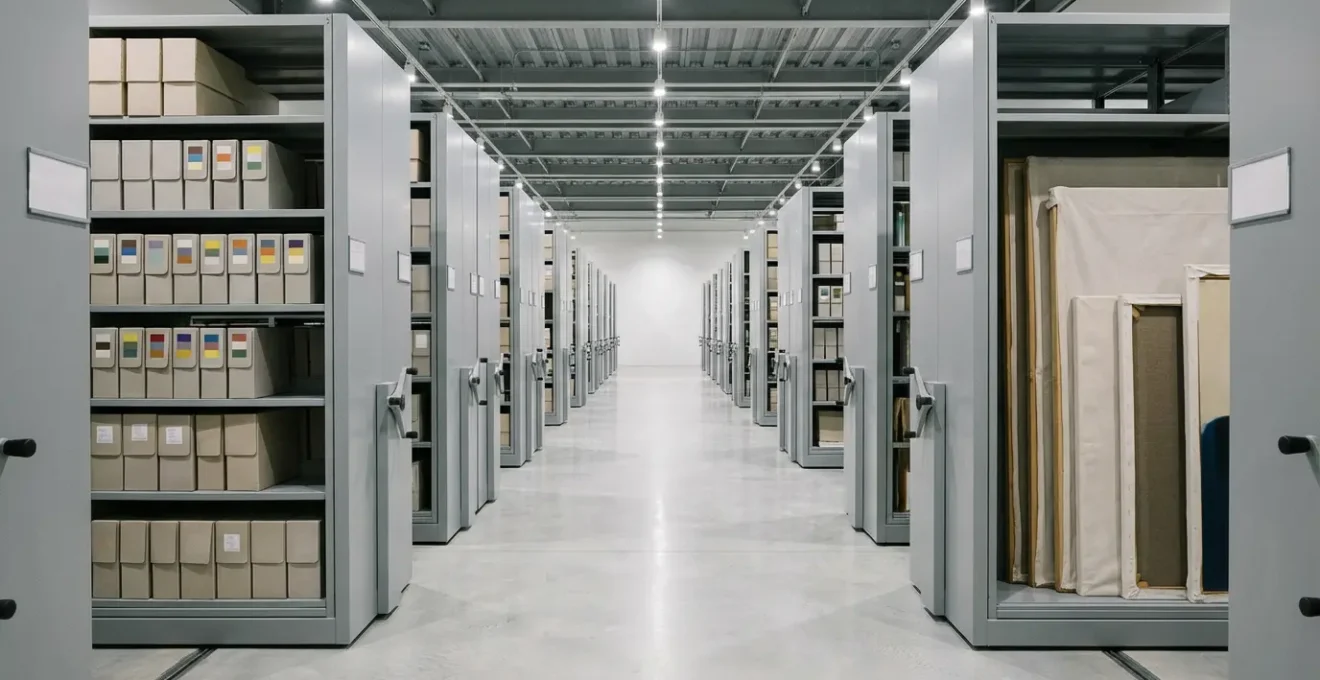
The key to unlocking 30% more storage space isn’t a bigger budget, but achieving maximum volumetric efficiency with the assets you already have.
- Analyze object dimensions to replace air with artifacts through custom-fit housing.
- Prioritize data-driven decisions over generic solutions to optimize every cubic inch.
Recommendation: Start with a single, problematic shelving unit. Measure its contents and redesign its internal layout to create a scalable model for the entire facility.
For any collections manager, the sight of an overflowing storage area is a familiar source of anxiety. Aisles become impassable, objects are stacked precariously, and the constant fear of damage looms. The conventional wisdom often points to expensive solutions: off-site rentals, new construction, or facility-wide installations of high-tech systems. But what if the budget for such an overhaul is zero? The immediate challenge feels insurmountable, leading many institutions to simply accept a state of managed chaos.
This approach, however, overlooks a more powerful and accessible strategy. The problem is rarely a fundamental lack of square footage; it’s an inefficient use of volume. We treat shelves as flat planes rather than three-dimensional containers, leaving vast pockets of air around our artifacts. The standard-issue archival box, while safe, is often a primary culprit in this wasted space. We accept its generic dimensions instead of demanding it conform to our collection’s specific needs.
The true key to reclaiming your storage lies in a strategic shift in mindset. Instead of thinking about expansion, we must focus on volumetric efficiency. This article will demonstrate that gaining 30% more space is not about finding more money, but about implementing a data-driven system of reorganization. It’s about making smarter, more precise choices—from the boxes we use to the way we calculate load-bearing capacity—to make every cubic inch count.
We will explore a series of practical, scalable strategies that address the core inefficiencies in museum storage. This guide will provide a clear roadmap, moving from high-impact capital projects you can plan for, to immediate, low-cost actions that yield significant results, and finally to the critical risk-management and cataloging practices that support a truly optimized facility.
Summary: How to Reorganize a Museum Storage Facility to Gain 30% More Space?
- Why replacing static shelving with rolling compactors pays for itself in 5 years?
- How to build custom archival boxes that fit perfectly into your shelf grid?
- Hanging racks vs. Flat drawers: Which is better for framed works on paper?
- The weight calculation mistake that cracks the slab under your sculpture rack
- How to number shelves so a new intern can find an object in 30 seconds?
- Active climate control vs. passive buffering: Which is safer for organic materials?
- How to catalog oral histories alongside physical artifacts effectively?
- How to Appraise a Painting When the Artist Has No Auction Record?
Why replacing static shelving with rolling compactors pays for itself in 5 years?
For a collections manager constrained by space, high-density mobile shelving, or rolling compactors, often seems like an unattainable dream. The upfront capital investment is significant. However, framing it as a long-term investment rather than an expense reveals a compelling financial case. The core benefit is simple: compactors can double the storage capacity within the same footprint by eliminating all but one “floating” aisle. This immediately defers or cancels out the enormous costs associated with new construction or long-term off-site storage rentals.
The return on investment (ROI) extends beyond raw space. By consolidating the collection, you improve security, reduce the area requiring strict climate control, and increase staff efficiency by minimizing travel time between storage locations. These are all tangible operational savings. The growing adoption of these systems is a testament to their value; the mobile compactor storage systems market is expected to reach USD 0.6 billion by 2032, driven by this recognized efficiency. To build a successful business case, it’s crucial to model the “cost-of-inaction”—quantifying the escalating expenses of off-site storage, increased insurance premiums for scattered assets, and inefficient staff time against the one-time cost of an upgrade.
While this may not be a “zero-budget” solution for today, a thorough analysis can provide the powerful data needed to secure funding for tomorrow. Proving that the system will pay for itself in five to seven years transforms the request from a plea for more space into a sound financial strategy for the institution’s future sustainability and collection care.
How to build custom archival boxes that fit perfectly into your shelf grid?
The single greatest source of wasted space in any museum storage is air. Standard, off-the-shelf archival boxes force you to store a small, irregular object in a large, rectangular void. The solution is to reverse the logic: instead of fitting the object to the box, fit the box to the object. Creating custom archival boxes is the most impactful, low-cost strategy for achieving high volumetric efficiency. By designing boxes that perfectly match the dimensions of your artifacts and nest tightly within your shelf grid, you can often reclaim 20-30% of your space immediately.
This process begins with data. Export the dimensions of objects from a specific collection category out of your Collection Management System (CMS). Analyze this data to identify common size groupings and determine the optimal dimensions for a set of custom enclosures. This allows for the creation of nested trays and compartments within a larger “mother” box, ensuring no cubic inch is wasted. The Western Science Center, for instance, faced the immense challenge of storing over a million fossils and artifacts, a task made manageable only through highly efficient, customized storage solutions that maximized their existing footprint.
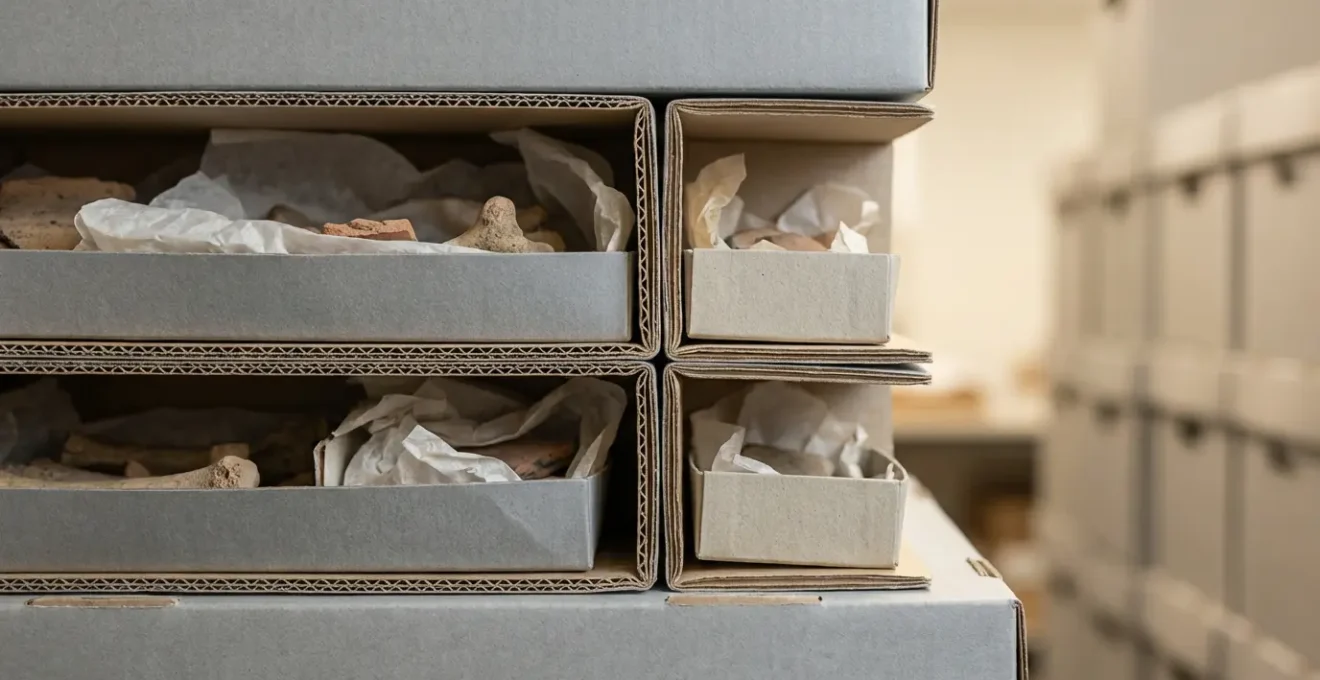
As the image above illustrates, a system of nested, custom-fit trays eliminates wasted air and provides superior organization and support for delicate items. The decision then becomes whether to fabricate these in-house or outsource production. While outsourcing has no initial investment, creating them in-house can be more cost-effective for large collections after the initial setup costs are met.
The following table provides a clear comparison to guide your decision-making process based on the scale of your collection and available resources.
| Factor | In-House Fabrication | Outsourced Production |
|---|---|---|
| Initial Investment | High (equipment, training) | None |
| Per-Unit Cost | Lower after break-even | Higher but consistent |
| Customization Speed | Immediate | 2-4 week lead time |
| Quality Control | Direct oversight | Vendor dependent |
| Best For Collections | >10,000 objects | <5,000 objects |
Hanging racks vs. Flat drawers: Which is better for framed works on paper?
When it comes to storing framed works on paper, the choice between vertical hanging racks and horizontal flat file drawers is a critical decision that impacts both space utilization and long-term preservation. There is no single “best” answer; the optimal solution depends on the specific nature of your collection, its size, and frequency of access. The goal is to match the storage method to the objects’ needs to maximize both safety and storage density.
Hanging racks, often on mobile carriages, offer incredible space efficiency for collections of uniformly sized frames. They allow you to store a large number of works in a small footprint, making them ideal for institutions with extensive holdings of paintings or prints. However, they can pose a risk for works with delicate or ornate frames, and repeated sliding can introduce vibrations. They are best suited for structurally sound, stable pieces that are accessed infrequently. Accessing a specific piece can also require moving several others, which increases handling risks.
Flat file drawers, conversely, provide superior individual protection. Each work is housed in its own environment, isolated from the movement and weight of others. This is the preferred method for fragile pastels, charcoals, or works in delicate historical frames. Drawers allow for easy and safe access to individual pieces without disturbing others. The trade-off is significantly lower storage density. A stack of flat file cabinets consumes a much larger footprint than a hanging rack system holding the same number of objects. A hybrid approach, as implemented at History Colorado, often provides the best of both worlds. They combined mobile shelving systems with both hanging racks and integrated drawers, allowing them to tailor the storage method to different parts of their collection within a single, efficient system.
The weight calculation mistake that cracks the slab under your sculpture rack
While gaining space is the primary goal, ignoring the foundational physics of your building can lead to catastrophic failure. One of the most dangerous and costly mistakes in a storage reorganization is underestimating the total weight of a fully loaded shelving unit, particularly high-density systems or racks for heavy objects like sculptures. This oversight can lead to floor deflection, stress fractures in the concrete slab, or in the worst-case scenario, structural collapse. A staggering 60% of museum collections suffer from poor storage conditions, according to an ICCROM-UNESCO survey, and this includes fundamental safety issues like overloading.
The most common error is calculating only the static load—the combined weight of the shelving and the objects themselves. This is dangerously incomplete. You must also account for the dynamic load, which is the force exerted when the system is in motion. For mobile shelving, this includes the weight of the carriages and the concentrated forces as they move. For sculpture storage, it includes the weight of gantries, pallet jacks, or forklifts used to move the objects. These transient forces create intense point loads that the slab may not be designed to handle.
Furthermore, the calculation must be forward-looking. A structural engineer needs to factor in a 20-year collection growth projection, which typically adds another 15-30% to the total weight estimate. Ignoring this future growth means a system that is safe today could become a hazard in a decade. A comprehensive structural assessment is non-negotiable before installing any high-density system.
Action Plan: Pre-Installation Structural Load Audit
- Calculate static load: Total weight of objects, shelving, and fully loaded mobile carriages.
- Add dynamic load calculations: Forces from moving heavy objects with equipment like pallet jacks or gantries.
- Conduct point load analysis: Assess stress under specific points like jack supports or carriage wheels.
- Factor in collection growth: Add a 15-30% weight increase to account for 20 years of acquisitions.
- Verify seismic bracing requirements: Ensure compliance with local building codes for your geographic zone.
How to number shelves so a new intern can find an object in 30 seconds?
An optimized storage facility is not just about fitting more objects; it’s also about finding them quickly and accurately. A confusing or inconsistent location numbering system is a major source of inefficiency and can lead to misplaced artifacts and wasted staff time. The goal is to create a system so intuitive that a new intern, armed with a location number from the CMS, can locate any object in under a minute. The key is choosing a system that is scalable, logical, and unambiguous.
The two primary approaches are a coordinate-based grid system and a semantic (or category-based) system. A semantic system might use a code like “TEX-Blue-03” (Textiles, Blue Box, #3), which is human-readable but struggles with scale. What happens when a new textile category is added, or when objects are moved? It quickly breaks down. A coordinate grid system, by contrast, is infinitely scalable and completely independent of the objects it contains. It functions like a map’s grid reference.

A typical coordinate format might be `Zone-Aisle-Bay-Shelf-Position` (e.g., Z1-A04-B02-S05-P01). This code tells you exactly where to go: Zone 1, Aisle 4, Bay 2, Shelf 5, Position 1. This system is logical, easy to learn, and drastically reduces retrieval errors. Augmenting this with visual cues, such as the color-coded zones shown in the image, further speeds up navigation. While QR codes linked to a database offer the lowest error rate, a well-implemented physical coordinate system is the most robust and budget-friendly solution for most institutions.
This comparative table highlights the clear advantages of a coordinate grid for any institution focused on long-term efficiency and scalability.
| System Type | Example Format | Scalability | Learning Curve | Error Rate |
|---|---|---|---|---|
| Coordinate Grid | A-01-S1-P1 | Excellent | 1-2 days | <2% |
| Semantic Category | TEX-Blue-03 | Limited | 1 week | 5-8% |
| QR/Digital Twin | QR + Database | Unlimited | Immediate | <1% |
Active climate control vs. passive buffering: Which is safer for organic materials?
Once space is optimized, the focus must shift to preservation within that space. For organic materials—wood, textiles, paper, leather—stable environmental conditions are paramount. The traditional approach has been active climate control: powerful, energy-intensive HVAC systems that constantly heat, cool, humidify, and dehumidify the air to maintain a precise setpoint. While effective, these systems are costly to run, complex to maintain, and vulnerable to power outages, which can cause damaging environmental fluctuations.
A more sustainable and often safer approach is passive buffering. This strategy focuses on creating a highly insulated and sealed building envelope that naturally resists external climate changes. It uses the thermal mass of the building and the hygroscopic properties of internal materials (like wood or certain wallboards) to absorb and release heat and moisture slowly, thus “buffering” the collection against rapid fluctuations. This method significantly reduces energy consumption and provides a more stable environment during a power failure. Recognizing these benefits, many museums are exploring new sustainable approaches that prioritize these passive methods.
The ideal modern solution is often a hybrid one. A well-designed passive system can maintain a broadly stable environment, with smaller, targeted active systems used only when and where necessary for the most sensitive materials. The Depot Boijmans Van Beuningen in Rotterdam is a world-leading example. This publicly accessible storage facility uses advanced passive buffering as its primary strategy, creating different climate zones within the building that are fine-tuned with minimal active intervention. For a collections manager with a limited budget, investing in improving the existing building envelope—sealing air leaks, adding insulation, and using archival cabinets as microclimates—is a far more cost-effective and resilient strategy than relying solely on an aging, expensive HVAC system.
How to catalog oral histories alongside physical artifacts effectively?
In a modern museum, the collection is no longer limited to tangible objects. Oral histories, artist interviews, and community stories provide essential context and are often artifacts in their own right. The challenge for a collections manager is how to catalog this intangible heritage so that it is inextricably linked to the physical objects it illuminates. Simply storing audio files in a separate folder is insufficient; the connection must be robust, searchable, and permanent within your collection management system (CMS).
The most effective method is to treat the oral history as a distinct, yet related, record in your CMS. The process involves several key steps. First, the digital audio or video file must be stored on a secure server or digital asset management system (DAMS) with a stable, permanent URI. Second, a new object record is created in the CMS for the oral history itself. This record should contain detailed metadata: the interviewee, interviewer, date, location, a full transcript, and a summary of its content. Crucially, this record must contain the permanent link to the digital file.
The final and most critical step is creating a reciprocal link between the oral history record and the physical object’s record. The CMS’s “related objects” function should be used to link the two records. For example, the record for a handmade quilt should link to the oral history of its maker, and the oral history record should, in turn, link back to the quilt. This creates a powerful research tool. A user looking at the quilt can instantly discover the maker’s story, and a researcher studying the oral history can just as easily find the associated physical object. This integrated approach ensures that the rich context provided by oral histories is not lost, but preserved and made accessible as a core part of the collection’s data.
Key Takeaways
- Space optimization is achieved through volumetric efficiency, not just by adding square footage.
- Data-driven decisions, based on object dimensions from your CMS, are the foundation of any successful reorganization.
- Custom-fit archival housing is the most immediate and cost-effective way to reclaim wasted space.
- Risk management, especially structural load calculations and climate control strategy, must be integrated into your space plan.
How to Appraise a Painting When the Artist Has No Auction Record?
While the physical organization of storage is paramount, holistic collection management also involves understanding an object’s value. This becomes particularly complex when appraising works by emerging artists or historical figures who have no established auction record. Without the benchmark of public sales, valuation must rely on a matrix of qualitative and indirect quantitative factors. This is not guesswork; it is a structured analysis of the artist’s position within the art historical context.
The most reliable method is the Comparable Contemporaries approach. This involves identifying artists from the same school, period, and with a similar exhibition history who *do* have an auction record. The appraiser analyzes the subject matter, size, medium, and quality of your painting against sold works by these comparable artists to establish a credible value range. This requires deep art historical expertise. The National Galleries of Scotland, for instance, developed comprehensive appraisal systems for its Art Works facility specifically to handle the valuation of emerging artists without market history, relying heavily on contextual analysis.
Other methodologies can supplement this approach. A Historical Significance Score can be created by quantifying factors like the number of times the work has been cited in publications, its exhibition history (provenance), and its role in a particular artistic movement. For living artists, a Cost and Career Approach can be used, which considers the cost of materials, the artist’s representation by a reputable gallery, and any grants or awards received. While no single method is perfect, using a combination of these structured approaches provides a defensible and realistic valuation, essential for insurance, loan agreements, or potential deaccessioning decisions.
This table outlines the primary methodologies used to establish value in the absence of direct market data.
| Method | Key Factors | Reliability | Best Use Case |
|---|---|---|---|
| Comparable Contemporaries | Similar school, period, exhibition history | High | Academic artists |
| Historical Significance Score | Exhibition citations, provenance, movement role | Medium | Historical pieces |
| Cost and Career Approach | Materials, gallery representation, grants | Medium-Low | Living artists |
By shifting your focus from budget limitations to data-driven efficiency, you can systematically transform your overcrowded storage into a model of organization. The next step is to begin the process with a small, manageable pilot project to prove the concept and build momentum for a facility-wide change.