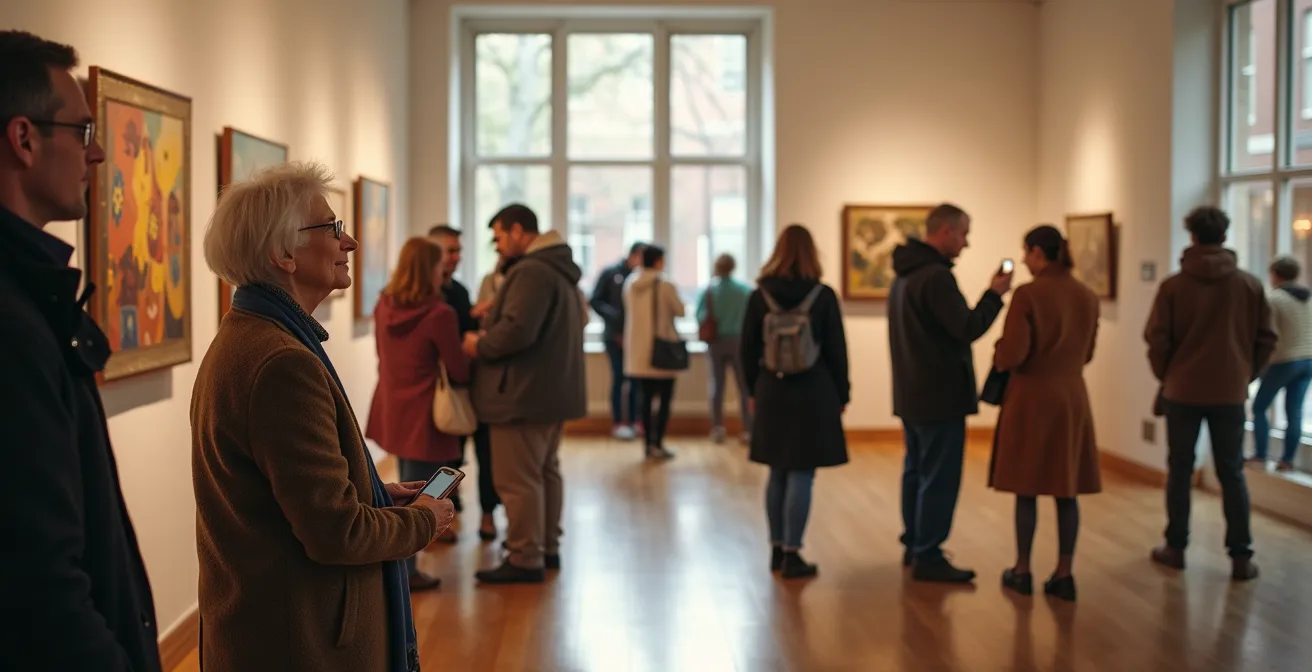
True visitor diversity isn’t bought with expensive programs; it’s earned by fundamentally re-engineering a gallery’s internal systems to reflect the community it wishes to serve.
- Shift from measuring ticket sales to tracking meaningful engagement metrics like dwell time and repeat visits.
- Empower new audiences, especially teens and community groups, by giving them genuine creative control over programs and curation.
Recommendation: Start by analyzing your signage and entrance experience. The smallest, zero-cost changes to language and design can remove the biggest psychological barriers for first-time visitors.
As a gallery director, the pressure is constant: be more relevant, engage a broader community, and prove your value. Yet, this mandate often comes with the harsh reality of stagnant or shrinking budgets. The conventional wisdom suggests launching new outreach programs, hosting expensive events, or rolling out large-scale marketing campaigns. But what if the most powerful levers for change cost nothing at all? What if the barriers to entry aren’t financial, but psychological, systemic, and woven into the very fabric of how our institutions operate?
Many galleries focus on surface-level fixes, like translating a brochure or hosting a single “community day,” hoping to attract non-traditional visitors. These efforts, while well-intentioned, often fail to create lasting change because they don’t address the root causes of exclusion. The feeling of “this place isn’t for me” is built on a thousand subtle cues, from the metrics we prioritize to the language on our wall labels.
This guide takes a different approach. The key to unlocking genuine visitor diversity on a zero budget lies not in adding more, but in rethinking what we already have. It’s about a strategic, internal shift—a re-engineering of our core systems. We will explore how to change our metrics, our programming design, our curatorial methods, and even our storage philosophy to build an institution that is intrinsically welcoming.
By focusing on these deep, structural adjustments, we can cultivate an authentic sense of belonging that no marketing budget can buy. This is not about spending more; it’s about thinking differently and transforming our spaces from the inside out.
This article provides a detailed roadmap for making these powerful, zero-cost changes. Each section tackles a critical internal system, offering practical steps to foster a more inclusive and representative public gallery.
Summary: How to Cultivate a Diverse Audience for Your Gallery on a Zero Budget
- Why “ticket sales” is a bad metric for public gallery success and what to use instead?
- How to design a gallery workshop that appeals to teenagers who hate museums?
- Donation box or Ticket price: Which model sustains small galleries better?
- The signage mistake that makes working-class visitors feel unwelcome at the door
- How to let the public curate an exhibition without compromising professional standards?
- How to stay in touch with program alumni for 5 years without being intrusive?
- Thematic vs. Chronological labels: Which engages the Gen Z visitor more?
- How to Reorganize a Museum Storage Facility to Gain 30% More Space?
Why “ticket sales” is a bad metric for public gallery success and what to use instead?
For decades, the primary measure of a gallery’s success has been the number of people coming through the door. Ticket sales and visitor counts are simple, tangible, and easy to report to funders. However, these “gate metrics” tell us nothing about the quality of the visit or, more importantly, who we are failing to attract. When we only chase numbers, we inadvertently design experiences for the existing majority. Data confirms this bias, revealing that 85% of frequent art museum visitors identify as white. This isn’t an accident; it’s the result of a system designed to serve a specific demographic.
To truly serve the public, we must shift our focus from quantity to quality and equity. This means adopting engagement metrics that measure a sense of belonging and connection. The High Museum of Art in Atlanta provides a powerful case study. They transformed their visitor demographics, increasing nonwhite visitors from 15% to 45%, by abandoning ticket sales as their primary KPI. Instead, they began measuring neighborhood representation, repeat visitation from underserved postcodes, and qualitative feedback on feelings of welcome.
Adopting this mindset is a zero-cost change with profound implications. It forces us to ask better questions: Are people staying longer in certain areas? Are they returning with their families? Are they advocating for us on social media? These metrics evaluate our success based on building relationships, not just transactions. This shift requires no new software, only a new perspective on what “success” truly means for a civic institution.
Here are some alternative metrics you can start tracking immediately:
- Visitor Dwell Time: Use simple observation or existing Wi-Fi analytics to see where different groups spend their time. This reveals which spaces feel welcoming versus alienating.
- Repeat Visitation by Postal Code: Are you a one-time destination or a genuine part of the local community’s life?
- Social Media Sentiment & Advocacy: Monitor not just mentions, but the emotional tone. Are visitors becoming advocates?
- Qualitative Feedback Scores: Use simple surveys (even a “how did you feel today?” board) focused on inspiration and belonging, not just satisfaction.
How to design a gallery workshop that appeals to teenagers who hate museums?
The phrase “museum workshop” often conjures images of passive listening and prescribed activities—an instant turn-off for most teenagers. The perception of galleries as quiet, rule-bound spaces where they are merely observers is the primary barrier. To break through this, we must invert the model: stop designing for them and start designing with them. The key is to transform them from a passive audience into active creators and give them genuine agency.
This approach requires no budget, only a shift in control. Instead of a lecture on art history, create a workshop around digital content creation, like a TikTok or Instagram Reel challenge inspired by the collection. Provide themes, not instructions. The goal isn’t to teach them about a specific artist, but to give them a reason to look closely and construct their own meaning. This validates their skills and their way of seeing the world, making the gallery a backdrop for their own creativity.
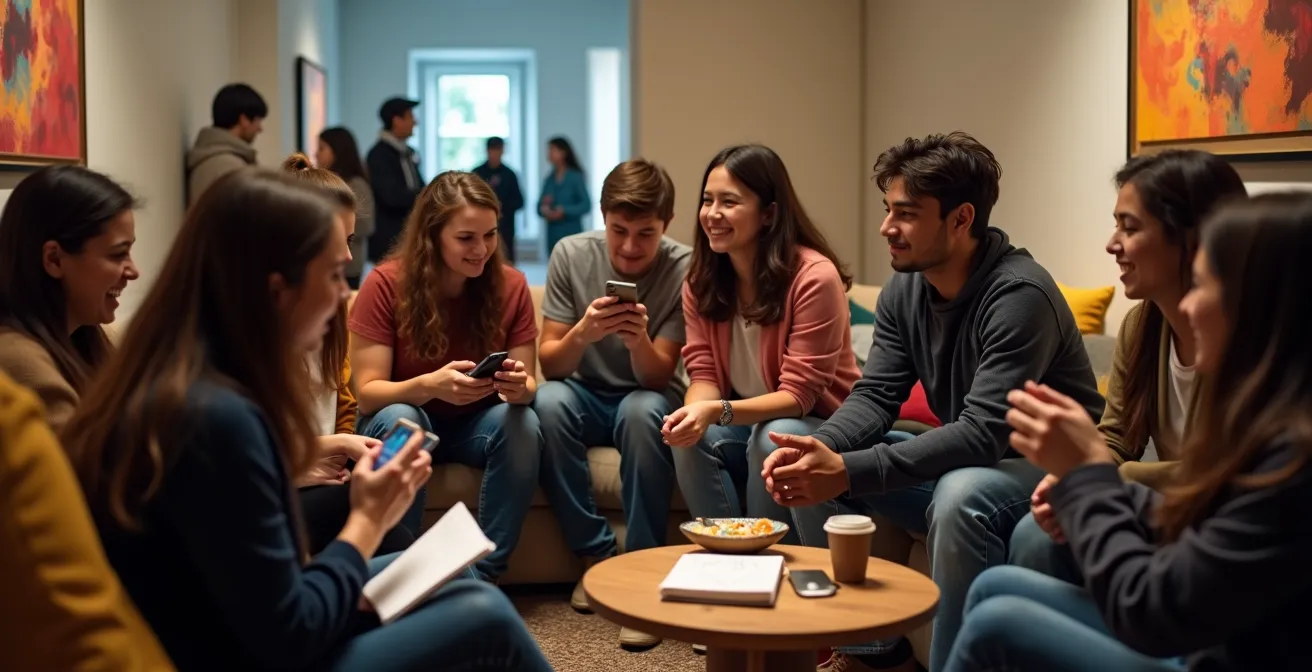
As the image above suggests, a successful teen workshop is about energy, collaboration, and authenticity. Notice the relaxed environment and active engagement—they are directors, not just spectators. The Museum of Contemporary Art Chicago’s Teen Creative Agency is a prime example. It succeeds by prioritizing peer-led projects, direct interaction with artists, and sustained mentorship. It cedes authentic creative control, and in doing so, forges a lasting connection to the institution.
Small galleries can replicate this by inviting a small group of teens to form a “Youth Advisory Board” to co-design a single event. Give them a real problem to solve (“How can we make this exhibition interesting to your friends?”) and the authority to implement their ideas. As museum professional Geva Avnet advises, “Focus on creating activities of substance that allow for engagement with the museum itself. Appeal to groups of friends. Give teens behind-the-scenes access.” This insider status is a powerful, no-cost incentive that builds ownership and turns skeptical teens into the gallery’s most passionate ambassadors.
Donation box or Ticket price: Which model sustains small galleries better?
The choice between a fixed ticket price and a “pay-what-you-can” or donation model feels like a direct trade-off between financial stability and accessibility. A fixed price offers predictable revenue, but it erects a clear financial and psychological barrier, instantly signaling that the space may not be for everyone. The donation model, on the other hand, removes this barrier but introduces revenue uncertainty. For a small, resource-strapped gallery, which path offers genuine sustainability?
The answer lies in redefining “sustainability” beyond immediate cash flow. True sustainability for a public gallery is rooted in its community relevance and support. A donation-based model, while seemingly risky, excels at building this foundation. It reframes the relationship with the visitor from a transactional one (“I paid for a service”) to a philanthropic one (“I am a supporter of this community resource”). This psychological shift is critical. A visitor who donates, even a small amount, feels a sense of ownership and partnership. They are more likely to return, become a member, and advocate for the gallery.
The Metropolitan Museum of Art’s successful pay-what-you-wish model for New York residents demonstrates that accessibility and revenue are not mutually exclusive. By combining this policy with free community programs, they fostered goodwill and attracted a more diverse audience without sacrificing their financial health.
The following table, based on industry-wide data, breaks down the systemic impact of each model. A recent analysis of museum-goer demographics supports these findings, showing how pricing structures directly influence visitor profiles.
| Model Aspect | Donation/Pay-What-You-Can | Fixed Ticket Price |
|---|---|---|
| Visitor Demographics | More diverse socioeconomic backgrounds | Skews toward higher income |
| Psychological Impact | Visitors feel like patrons/benefactors | Transactional relationship |
| Average Revenue per Visitor | Variable but potentially higher from engaged donors | Predictable but capped |
| Community Perception | Seen as community resource | Viewed as exclusive destination |
| Repeat Visitation | Higher frequency due to low barrier | Lower frequency, planned visits |
For a small municipal gallery, the donation model is a long-term investment in community integration. The potential for higher per-visitor revenue from engaged donors, coupled with increased repeat visitation, often creates a more resilient and sustainable financial ecosystem than a fixed-price model ever could. It’s a zero-cost policy change that declares the gallery belongs to everyone.
The signage mistake that makes working-class visitors feel unwelcome at the door
A visitor’s sense of belonging is often determined within the first ten seconds of arrival, long before they see any art. The most significant, yet overlooked, barrier is the “psychological welcome”—the collection of subtle cues at the entrance that signal who is and isn’t welcome. Chief among these is signage. We tend to create signs that are functional for us, not welcoming for our visitors. A long list of rules—”No Food or Drink,” “Do Not Touch,” “No Flash Photography,” “Large Bags Must Be Checked”—can feel like a list of accusations before a visitor has even stepped inside.
This “wall of no” is particularly alienating to first-time or working-class visitors who may already feel apprehensive about entering an art space. It reinforces the stereotype of the gallery as a stuffy, intimidating place where they are likely to do something wrong. The mistake is not the rules themselves, but the way they are communicated. This is a crucial insight, especially when data shows that 49% of casual museum-goers don’t have college degrees, a group that may be less familiar with institutional codes of conduct and more sensitive to prohibitive language.
The zero-cost solution is a radical audit of your entrance language. Reframe every “no” into a positive or helpful instruction. Instead of “No Large Bags,” try “For your comfort, please check large bags with us.” Instead of “Do Not Touch,” place a friendly sign near a robust sculpture saying, “This one is okay to touch!” to show you trust your visitors. This shift from prohibitive to permissive language transforms the atmosphere from one of suspicion to one of shared care for the space.
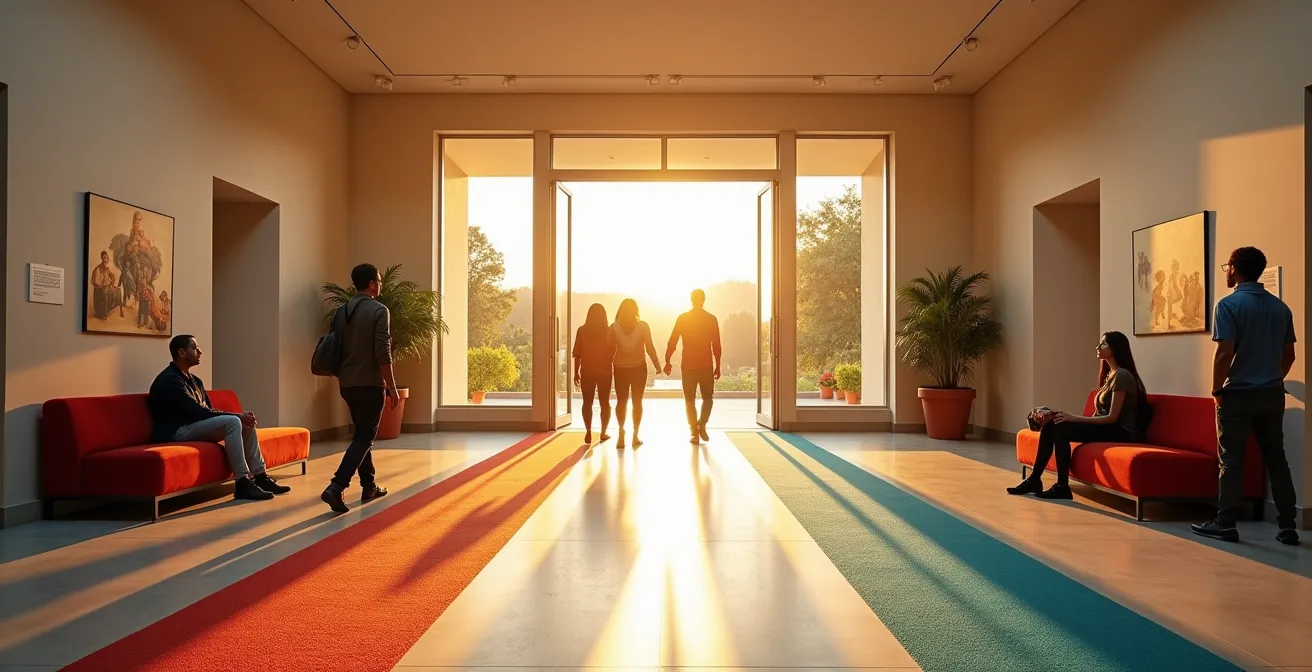
This welcoming aesthetic extends beyond signs to the entire entrance experience. Are there comfortable places to sit near the entrance without having to buy something? Is the staff trained in “here for you” hospitality, making eye contact and smiling rather than acting as guards? Removing these invisible barriers—what we call creating a strong psychological welcome—is the most effective way to make a diverse audience feel that they truly belong. It costs nothing to change a “Don’t” to a “Please do,” but the impact on a visitor’s sense of ease is immeasurable.
How to let the public curate an exhibition without compromising professional standards?
The idea of “public curation” can be terrifying for a professional curator. It conjures images of chaos, incoherent narratives, and a complete loss of institutional authority. Yet, the desire for community participation is real and powerful. The solution is not to abdicate responsibility but to provide a structured framework for collaboration. This is the concept of “scaffolded curation,” a zero-cost strategy that empowers the public within professionally defined boundaries.
Instead of a curatorial free-for-all, we can create models where the public’s expertise—their lived experiences, stories, and perspectives—is the star, while the gallery’s professional expertise provides the stage. For example, in an “Interpretive Curation” model, the curatorial team selects the artworks, but a community group is given full control over writing the labels, creating the audio guide, and designing the related public programs. This maintains collection integrity while ensuring the interpretation is relevant and accessible to a wider audience.
The Audubon Nature Institute successfully used this approach for their Bayou Gallery exhibit. Rather than telling the community’s story for them, they held structured input sessions and asked, “Who should tell the story?” By featuring the voices and portraits of real community members, they created an authentic and deeply engaging experience while a professional team managed the overall exhibition design and object care. This is asset-based community engagement: treating the community’s stories not as a deficit to be filled, but as a core asset for the exhibition.
This process builds immense trust and ownership. The community sees themselves reflected on the walls—not just as subjects, but as authors. For the gallery, it results in a more dynamic, multi-vocal, and ultimately more interesting exhibition, all achieved through the reallocation of staff time, not financial resources.
Your Action Plan: A Framework for Public Curation
- Scaffolded Curation: Pre-select a pool of 30-50 works from your collection based on a theme, and allow a public group to make the final selection of 15-20 for the exhibition.
- Interpretive Curation: Give a community council complete control over writing all exhibition labels and interpretive text for a show you have curated.
- Exhibition-in-Dialogue: Dedicate a small gallery space for a community-curated response to a main, professionally curated exhibition, creating a direct conversation.
- Crowdsourced Archives: Use social media to let the public vote on which rarely-seen items from your archives should be put on physical display for a limited time.
- Stakeholder Planning: Form a diverse community advisory group at the very beginning of the exhibition planning process to help shape its core themes and messages, before a single object is chosen.
How to stay in touch with program alumni for 5 years without being intrusive?
Galleries invest significant time and energy into intensive programs, especially for youth, but our connection with participants often evaporates the moment the program ends. We might send a generic newsletter or an occasional fundraising appeal, but these intrusive, one-way communications fail to honor the deep relationship that was built. The key to long-term engagement is not to “stay in touch” through marketing, but to build a systemic ladder of continued involvement. This approach costs nothing but foresight and a commitment to nurturing talent.
The New York Hall of Science’s “Science Career Ladder” program offers a brilliant model. It creates a natural, progressive pathway for alumni. Participants start as high school volunteers, can return as paid college apprentices, and may eventually come back as full-time educators or mentors. The “touchpoints” are not forced emails; they are meaningful opportunities for growth and contribution. This creates a self-sustaining ecosystem where alumni don’t just feel connected—they *are* the institution’s past, present, and future.
For a small gallery, this can be scaled down. An alumnus of a teen workshop could be invited back next year as a paid “peer mentor” for the new cohort. A participant from a community curation project could be asked to join the gallery’s advisory or acquisitions committee two years later. The goal is to see program alumni as an invaluable talent pool, not a mailing list. This requires us to create a simple internal database tracking participants’ skills and interests, and to think about their potential future roles from day one.
The value of this long-term view is immense. Research shows these relationships have a profound and lasting effect on participants’ lives and their lifelong connection to culture.
In the long term, study participants referenced definite impact to their personal identity and self-knowledge, lifelong relationship to museums and culture.
– Museum Teen Program Study, MuseumNext Impact Research
By offering genuine opportunities for progression, we provide a reason for the relationship to continue that is mutually beneficial. We gain dedicated, knowledgeable ambassadors and future leaders, and they gain a lifelong institutional home. This is the ultimate form of sustainable, zero-budget community engagement.
Thematic vs. Chronological labels: Which engages the Gen Z visitor more?
The traditional museum label is an exercise in chronology and data: artist, title, date, medium. This format assumes a visitor who wants a linear, authoritative history lesson. However, this approach is profoundly alienating to younger audiences, particularly Gen Z, who are accustomed to non-linear, user-driven, and emotionally resonant content. With research highlighting an 8.25 seconds average attention span for digital content, our labels must capture interest immediately or be ignored.
For Gen Z, relevance trumps reverence. A chronological label for a 17th-century painting is a dead end. A thematic label that connects that same painting to contemporary issues of social justice, identity, or climate change is an invitation to a conversation. The zero-cost solution is to rewrite our labels to prioritize connections over data. Instead of starting with the artist’s name, start with a provocative question or a bold statement that links the work to the world outside the gallery.
This is about shifting from an informational to an interpretive and narrative-driven approach. Here are a few practical, no-cost strategies to make your labels more engaging for a younger audience:
- Start with a question: Instead of “Artist Name, 1922,” try “What does it mean to feel like an outsider? This artist explored that feeling…”
- Tell a story: Structure the label as a mini-narrative with a hook, rising action, and a resolution, focusing on the human drama behind the artwork.
- Connect to today: Explicitly link the themes in historical works to current events or pop culture. (“Long before ‘self-care’ was a hashtag, this artist used painting to manage her mental health.”)
- Offer multiple voices: Add a short, secondary label written by a teen, a community member, or another artist, offering a different perspective. This shows that interpretation is a dialogue, not a monologue.
Implementing these changes requires only staff time and a willingness to let go of old conventions. By making our labels less about an object’s history and more about its ongoing relevance, we validate the visitor’s own process of inquiry and make the art feel alive and essential to their world.
Key Takeaways
- True diversity is achieved through deep, systemic changes, not expensive, superficial programs.
- Shift your primary success metric from ticket sales to measures of genuine community engagement and belonging.
- Empower your audience by giving them authentic creative control, turning them from passive consumers into active partners.
How to Reorganize a Museum Storage Facility to Gain 30% More Space?
At first glance, reorganizing a cramped storage facility seems like a purely operational chore, disconnected from the grand mission of increasing visitor diversity. But what if that reorganization could directly fuel your community engagement efforts at zero cost? By viewing a storage overhaul not just as a spatial project but as a strategic opportunity, we can unlock immense, public-facing value from a back-of-house task.
The primary benefit of a well-organized storage is efficiency, which saves staff time. That saved time is a resource that can be directly reallocated to community outreach, program development, or building partnerships. But the potential goes much further. The 30% or more space gained from high-density shelving or better cataloging isn’t just empty air—it’s a new asset. This newfound space can be transformed into a “visible storage” area, allowing public tours of the collection that were previously impossible. This provides a compelling, behind-the-scenes experience at no acquisition cost.
Furthermore, the process of reorganization itself is a unique opportunity. The required handling of every object is the perfect moment for a systematic digitization project. As a case study on museum reorganizations shows, leveraging this process for photography and cataloging creates vast online resources that dramatically expand global access to the collection. This digital access is a powerful tool for equity, reaching audiences who may never be able to visit in person.
A storage reorganization is a moment to build systemic empathy into your collection’s infrastructure. Here’s how to connect this operational task to your diversity goals:
- Create Visible Storage: Convert gained space into a public-access area, making more of your collection visible to all.
- Enable Community Curation: Use newly accessible “second-tier” collections for the public curation projects discussed earlier.
- Implement Inclusive Cataloging: As you handle each object, update its catalog entry with more inclusive language and keywords, making it easier for researchers and the public to find works by underrepresented artists.
- Reallocate Staff Hours: Formally redirect the staff time saved by a more efficient storage system toward building community partnerships.
By re-engineering these core systems—from the metrics you track to the way you organize your storage—you are building a fundamentally more open and welcoming institution. This work is not easy, but it is the most sustainable and authentic path to reflecting the true diversity of the community you serve. The next step is to begin an audit of your own institution and identify the first small, systemic change you can make today.