Contrary to popular belief, a unique artistic vision isn’t discovered through passive inspiration; it is actively constructed through a rigorous process of intentional constraints and critical self-curation.
- Copying masters is a necessary step for skill, but true voice emerges from deconstructing, not replicating, their work.
- Imposing strict limitations, like using a single lens for a year, forces innovation and breaks dependency on gear.
Recommendation: Shift your focus from creating singular “good” images to building a cohesive series where every photo serves a larger narrative. Be prepared to discard technically perfect shots that don’t fit.
In an age where billions of images are uploaded daily, the question for any photographer or digital artist is no longer “Can I take a good picture?” but “Can I create an image that is unmistakably mine?” The sheer volume of visual content creates a deafening noise, pushing many creatives toward mimicry of viral trends or imitation of their idols. The common advice is to “shoot a lot” or “find your niche,” but these platitudes often lead to a portfolio that feels generic, a collection of technically proficient but soulless images.
The pressure to conform to what’s popular on social media can feel overwhelming, leading to a frustrating cycle of creating work that garners fleeting attention but fails to provide deep, personal satisfaction. This feeling of being drowned out isn’t a sign of lacking talent; it’s a symptom of a flawed approach. We’ve been taught to look outward for inspiration, to find our voice as if it were a lost object waiting to be discovered. But what if the entire premise is wrong? What if a powerful, unique artistic vision isn’t found, but forged? This guide proposes a radical shift: instead of searching for your voice, you must consciously build it through deliberate constraints, intellectual rigor, and a process of ruthless self-curation.
To help you analyze how masters built their own unique styles, the following video breaks down the secrets of seven legendary black and white photographers. Watch it not to copy their results, but to deconstruct their thinking process and visual decisions.
This article will guide you through a structured methodology to move beyond imitation and cultivate a visual signature that is authentic and resonant. We will explore how to use limitations as a creative engine, define your narrative intent, and curate your work with the discipline of an editor building a story.
Summary: How to Build Your Authentic Artistic Voice in Photography
- Why copying your idols prevents you from finding your own voice?
- How to force innovation by shooting with only one prime lens for a year?
- Documentary Style vs. Fine Art construction: Which approach suits your narrative?
- The viral trend mistake that dates your portfolio within six months
- When to kill a good image because it doesn’t fit the series narrative?
- Stillness vs. Movement: Which branch of expressionism suits your temperament?
- The Eurocentric blind spot that ruins modern interpretations of global art
- How to Spot the Next Blue-Chip Artist at a Graduate Degree Show?
Why copying your idols prevents you from finding your own voice?
The path to artistic mastery almost universally begins with imitation. It’s a fundamental learning stage, a necessary rite of passage. As author and illustrator Wendy MacNaughton notes, it’s a process of trying on other voices before finding our own. In her view, it’s by studying and copying other artists that we build the visual vocabulary and skills necessary for our own practice to emerge. The danger, however, lies not in the act of copying itself, but in getting stuck there. When imitation becomes the destination instead of the vehicle, it smothers the very voice it was meant to awaken. Your portfolio becomes a technically sound but hollow echo of someone else’s vision.
The crucial transition from imitator to creator happens when you shift from replicating an artist’s *what* (their subject, their colors) to deconstructing their *why* (their principles, their decisions). This is the essence of bridging what is often called the “Ira Glass Gap”—the frustrating space between your sophisticated taste and your current creative abilities.
The Ira Glass Gap – From Copying to Creating
An analysis of master photographers like Sally Mann, Nadav Kander, and Todd Hido reveals they all masterfully evoke a sense of ‘stillness.’ However, they achieve this through different means, often employing soft, diffused light and atmospheric conditions. An emerging artist can study this common theme—this intellectual construct of ‘stillness’—and experiment with its principles using their own subjects and environment. By focusing on the underlying principle rather than the surface-level aesthetic, they begin to incorporate the masters’ thinking into their own unique approach, effectively closing the gap between their taste and their ability to execute a personal vision.
The goal is to build a library of concepts, not a gallery of copies. Instead of recreating a specific photo, ask yourself: What fundamental choice about light, composition, or moment did the artist make here? How can I apply that *same principle* to a subject that is entirely my own? This pivot from replication to deconstruction is the first, most critical step in forging your own path.
How to force innovation by shooting with only one prime lens for a year?
The paradox of creativity is that freedom often paralyzes, while limitation liberates. In a world of endless gear options, the most powerful tool for forging a unique vision is often not a new lens, but a radical, intentional constraint. Committing to shooting with a single prime lens (e.g., a 35mm or 50mm) for an entire year is a transformative exercise. It removes the crutch of zooming and forces you to “zoom with your feet,” fundamentally changing your relationship with your subjects and environment. You can no longer passively capture a scene from a distance; you must physically engage with it, moving closer, finding new angles, and seeing the world through a fixed frame.
This limitation creates a productive creative friction. When your gear can’t solve a compositional problem, your mind must. This process forces you to master every nuance of your chosen focal length, understanding its strengths, its weaknesses, and its unique way of rendering the world. It’s a slow, deliberate process, and the answer to “how long does it take to find an artistic style?” is often found in this focused dedication. Landscape photographer Jeremy Vesely’s journey is a testament to this, having taken over 20,000 photos in his first two weeks, only to find later that true quality emerged from intentional methodology, not sheer volume.
This constraint-based approach turns photography from a technical exercise into a problem-solving one. It strips away the distractions and forces you to focus on the core elements of a powerful image: light, composition, and moment. Your vision becomes a product of your ingenuity, not your inventory.
Your action plan: The single lens methodology
- Months 1-3: Master every technical nuance of your chosen lens through daily, focused practice on varied subjects.
- Months 4-6: Apply a thematic constraint. Shoot only one subject type (e.g., portraits, street corners, doorways) to explore depth over breadth.
- Months 7-9: Intentionally break traditional compositional rules. Use your mastered lens to explore asymmetry, negative space, and unconventional framing.
- Months 10-12: Build a cohesive 10-image series that tells a complete story, ensuring every shot is indispensable to the narrative.
Documentary Style vs. Fine Art construction: Which approach suits your narrative?
At its core, an artistic vision is a point of view, a way of telling a story. One of the most fundamental choices you must make is where you stand on the spectrum between observation and construction. This decision aligns closely with your temperament: are you an observer who finds stories in the world as it is, or a director who builds worlds to tell stories from your imagination? This choice defines your “ethical contract” with the viewer. The documentary approach carries a promise of truth, while fine art offers a metaphorical or fictional interpretation.
This distinction is not about which is “better,” but about which is more authentic to your narrative intent. An artist’s vision is sharpened by this clarity of purpose. However, it’s crucial not to confuse this fundamental approach with a superficial processing style. As the New York Institute of Photography wisely advises, “Don’t confuse style with processing technique.” A trendy filter or editing style is a fleeting aesthetic, while your narrative approach is the bedrock of your vision.
Understanding whether you are fundamentally a finder or a maker of images is a pivotal moment in your artistic development. It clarifies your entire process, from how you approach a scene to how you edit the final image. The table below outlines the key differences between these two powerful photographic traditions.
| Aspect | Documentary Style | Fine Art Construction |
|---|---|---|
| Temperament | Observer – finds stories in the world | Director – builds worlds to tell stories |
| Ethical Contract | Promise of truth to viewer | Metaphorical or fictional interpretation |
| Creative Control | No intervention, pure observation | Full control over light, pose, setting |
| Example Artists | Alec Soth (lyrical documentary) | Jeff Wall (near-documentary construction) |
The viral trend mistake that dates your portfolio within six months
In the creator economy, the pull of viral trends is immense. The algorithm rewards what’s popular, creating a powerful incentive to adopt the latest “look”—be it a moody, desaturated color grade, a specific film simulation, or a compositional gimmick. While engaging with trends can be a great way to gain visibility and commercial work, mistaking them for a genuine artistic vision is a critical error. A portfolio built on fleeting aesthetics will look dated within months, a time capsule of a passing fad rather than a testament to a timeless voice.
The speed and power of these trend cycles are undeniable. Market analysis shows how social media can dramatically impact consumer behavior, with some reports noting that camera gear from the early 2000s has seen price increases of up to 300% driven by trends on platforms like Instagram and TikTok. Chasing these waves is exhausting and ultimately pulls you away from the deep work of developing your own style. The solution isn’t to ignore trends entirely, but to manage them strategically.
This is where the concept of aesthetic bifurcation comes in. This strategy involves maintaining two distinct streams of work. One portfolio can be for your commercial and social media channels, where you might consciously engage with current trends to meet market demands. The other is your core, personal portfolio, which must be ruthlessly protected from these influences. This is where you develop your true vision. A powerful test is to strip your personal images of all trendy post-processing. Does the photograph still hold up in its most basic form? If its power relies entirely on a filter, it’s not a strong image; it’s a fashionable one. This separation allows you to have multiple photography styles for different purposes without diluting your authentic voice.
When to kill a good image because it doesn’t fit the series narrative?
Perhaps the most difficult—and most crucial—discipline in forging an artistic vision is narrative curation. This is the understanding that your vision is not defined by a single, spectacular image, but by a cohesive body of work. It requires shifting your mindset from a hunter of individual “banger” shots to an author of a visual story. This means you must be willing to “kill your darlings”—to discard a technically perfect, aesthetically pleasing photograph simply because it doesn’t serve the overarching narrative of your series.
This act of exclusion is what gives a series its power and clarity. A single outlier, no matter how strong on its own, can dilute the message and confuse the viewer. It introduces a note of discord that weakens the entire composition. This demanding process of selection and rejection is where your true voice is refined and amplified. It’s a quiet, internal battle fought on your light table or in your editing software, far from the instant gratification of social media likes.
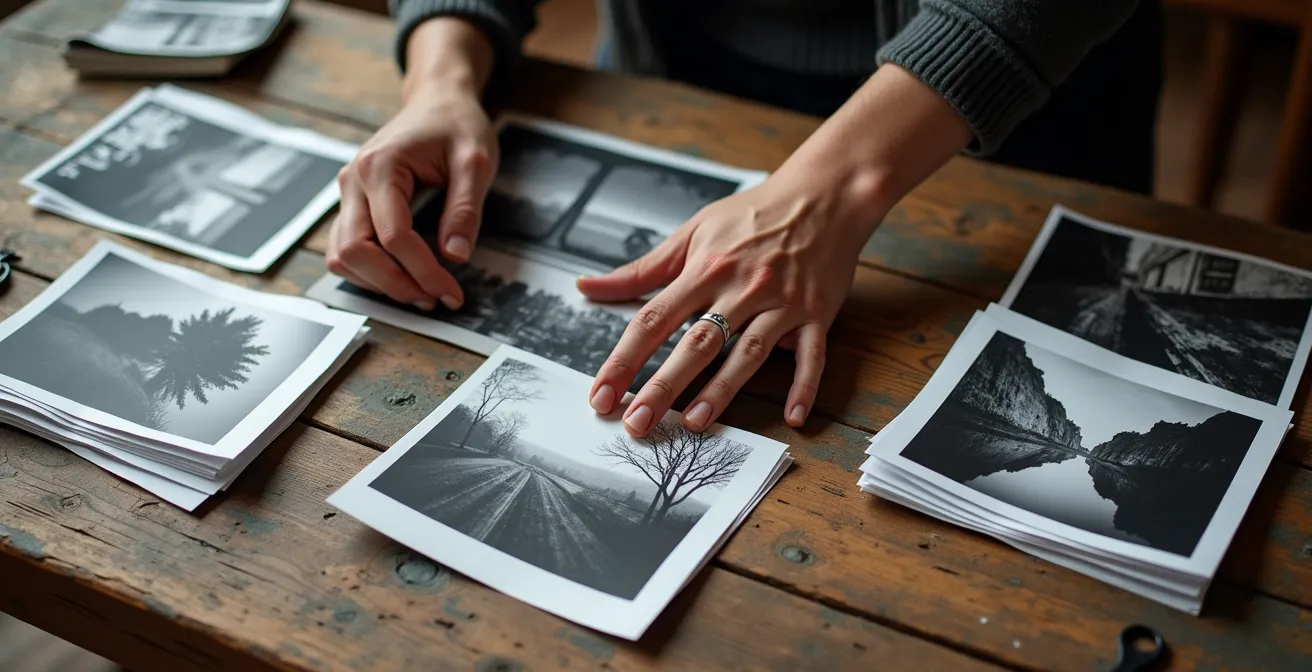
This level of critical self-assessment is a mark of artistic maturity. In a candid review of his own work, professional photographer Alex Kilbee reflected on black and white photographs he made 30 years prior. He described many as “rubbish,” not because of technical flaws, but because they lacked a cohesive vision. His analysis revealed a profound lesson: technical mastery must be in service of artistic vision. An image that breaks the narrative consistency, even if perfectly exposed and composed, ultimately weakens the body of work. This long-term perspective is essential for any artist who wants their work to endure.
Stillness vs. Movement: Which branch of expressionism suits your temperament?
Your artistic vision is not just an intellectual choice; it’s a deep reflection of your own temperament. Are you drawn to the quiet, contemplative energy of stillness, or the dynamic, fleeting energy of movement? Recognizing this innate preference is key to creating work that feels authentic and sustainable. Forcing yourself to shoot in a style that runs contrary to your nature will almost always result in work that feels strained and inauthentic. The question, as photographer Alex Cooke puts it, is a real one: “If we want to be known for our soft light images, can we afford to shoot hard light images?” The answer lies in aligning your expression with your core self.
Developing a consistent artistic vision or body of work that defines us as a photographer seems to preclude making a diversity of images. If we want to be known for our soft light images, can we afford to shoot hard light images?
– Alex Cooke, Fstoppers
Exploring this dichotomy can be a powerful exercise in self-discovery. Stillness in photography can be found in minimalist compositions, the serene surfaces of long-exposure seascapes, or the quiet dignity of a formal portrait. It speaks of permanence, reflection, and a meditative state. Movement, on the other hand, is about capturing the “decisive moment” in street photography, the blur of Intentional Camera Movement (ICM), or the kinetic energy of a live performance. It speaks of immediacy, spontaneity, and the ephemeral nature of time.
To find where you naturally reside, engage in contrasting exercises:
- For Stillness: Dedicate a week to creating minimalist compositions using only single objects and vast negative space. Practice long-exposure photography on water or clouds to smooth out all motion.
- For Movement: Spend a day practicing Intentional Camera Movement (ICM), embracing the blur and abstract patterns. Shoot street photography with the sole aim of capturing peak action or emotion.
- Synthesis: Try to create tension by capturing a moment of frantic movement within an otherwise perfectly still and ordered frame.
By experimenting with both, you’ll discover which mode of expression feels less like work and more like a natural extension of your own way of seeing the world.
The Eurocentric blind spot that ruins modern interpretations of global art
A truly unique artistic vision in a globalized world requires a global perspective. For centuries, the dominant narrative in art history and theory has been overwhelmingly Eurocentric, built on principles like linear perspective, the golden ratio, and a specific set of compositional rules. While these tools are powerful, treating them as universal truths creates a significant blind spot. It prevents artists from tapping into a vast wealth of aesthetic philosophies from around the world that can radically enrich and differentiate their work.
Today, access to this global art history has never been easier. Databases are expanding, with resources like the WikiArt visual encyclopedia offering over 250,000 artworks from more than 100 countries. To develop a unique voice, you must actively seek out and deconstruct these non-Western aesthetic concepts. This is not about exoticism or appropriation; it’s about expanding your visual vocabulary and understanding that there are countless valid ways to render reality, emotion, and story. It’s about questioning the default settings of your own creative brain.
For example, incorporating the Japanese concept of Wabi-Sabi can transform your portraiture, teaching you to find profound beauty in imperfection and impermanence. Exploring Ma, another Japanese concept, can revolutionize your use of negative space, treating emptiness not as a void to be filled but as an active, essential element of the composition. The table below offers a starting point for exploring these alternative visual philosophies.
| Concept | Origin | Photographic Application |
|---|---|---|
| Wabi-Sabi | Japanese | Finding beauty in imperfection and age in portraiture or still life |
| Ma (negative space) | Japanese | Emphasis on the power of emptiness and pause in composition |
| Horror Vacui | Various cultures | Creating dense, pattern-filled, “fear of empty space” compositions |
| Flat perspective | Persian miniatures | Layering subjects to imply depth without relying on Western linear perspective |
Key Takeaways
- Your unique vision is not found but built through deliberate, often difficult, choices.
- Intentional constraints, like using one lens, are a powerful engine for forcing creative solutions and breaking habits.
- The most critical skill is narrative curation: the willingness to kill a good photo to serve the strength of a series.
How to Spot the Next Blue-Chip Artist at a Graduate Degree Show?
The final step in forging your own artistic vision is to learn how to recognize it in others. By shifting your perspective from creator to critic, you can sharpen your understanding of what makes a body of work truly compelling and unique. A graduate degree show is the perfect training ground. Here, you are confronted with hundreds of artists all vying for attention, and you must learn to filter the noise to find the signal. This exercise is not about discovering investment opportunities; it’s about reverse-engineering what constitutes a powerful, coherent vision.
When you walk through the exhibition, look beyond the surface-level appeal of individual pieces. A strong vision manifests as a set of consistent qualities across an entire body of work. Ask yourself: Is there visual cohesion? Do the works share a consistent style and quality, or does it feel like a random assortment? Is there conceptual rigor? Can you identify a “big idea” or a compelling question that drives the work? Does the artist demonstrate material innovation by using their chosen medium in a new or unexpected way? And finally, does their unique vision tap into current cultural conversations, achieving a strong narrative-market fit?
Ultimately, this exercise will lead you to a profound realization about the nature of artistic vision, a point perfectly articulated by photographer and educator Alex Kilbee. It’s a concept that moves beyond the purely visual.
A strong vision is an intellectual and verbal construct, not just a visual one. Does the artist have a coherent, well-written artist statement? Can they speak about their work with clarity and depth?
– Alex Kilbee, The Photographic Eye
By learning to spot a well-constructed vision in the wild, you validate its components in your own mind. You confirm that a true artistic voice is a combination of consistent aesthetics, intellectual depth, and a clear narrative purpose. It is the final proof that a vision is not an accident of inspiration, but the deliberate product of hard-won clarity.
Now that you understand the principles behind forging a vision, the next logical step is to begin the practical work. Start by auditing your own portfolio not for its best images, but for its most cohesive ones, and build from there.