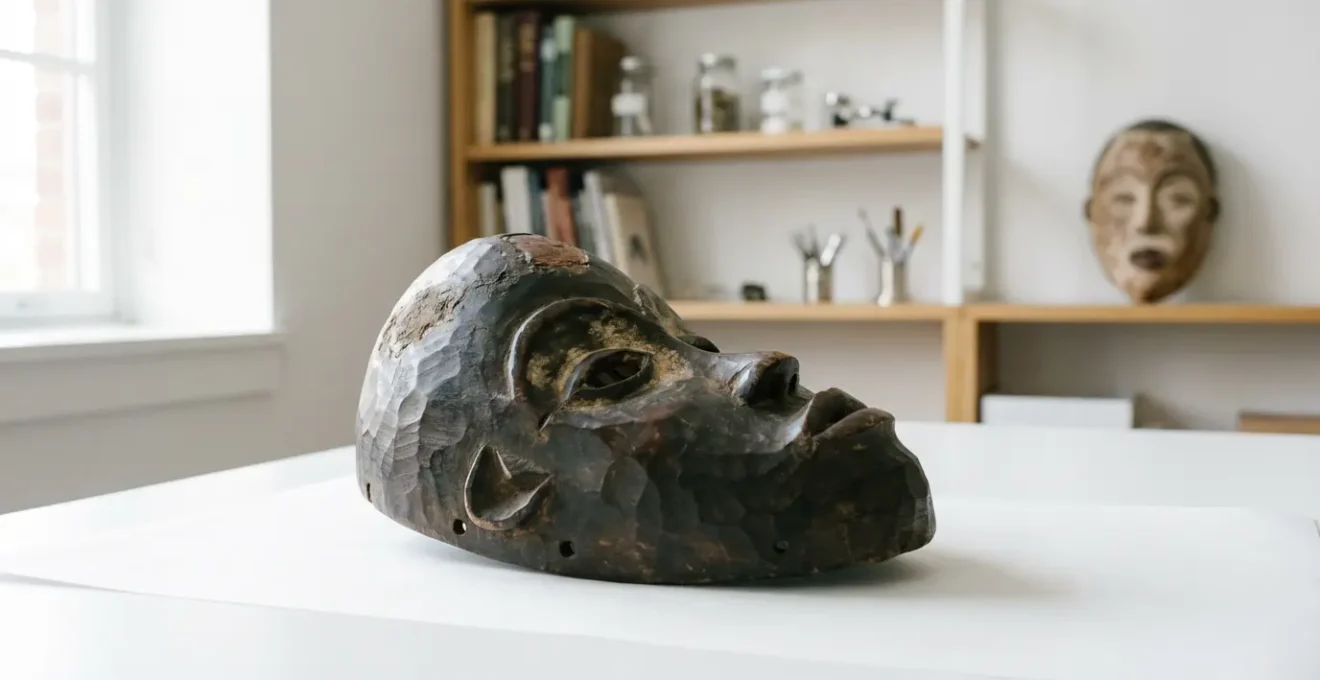
In summary:
- Authenticity is proven by a forensic analysis of wear, not just its presence. Focus on the specific location and nature of patina.
- Traditional adze carving leaves distinct, rhythmic facets, unlike the smooth, uniform finish of modern sandpaper.
- A documented provenance hierarchy, from museum publications to field notes, determines an object’s legal and historical safety.
- Understanding cultural context, including an object’s spiritual needs and taboos, is as crucial as verifying its physical attributes.
–
–
For any serious collector of ethnographic art, the challenge is stark: navigating a market flooded with mass-produced fakes, often dubbed “airport art,” to find a piece with true ritual history. The desire for an object that has danced, that has lived within a culture, is profound. Yet, many collectors rely on vague advice like “look for signs of wear,” a metric that forgers have become adept at mimicking. This superficial approach often leads to acquiring a cleverly aged tourist souvenir rather than a genuine artifact.
Common wisdom suggests checking provenance papers or simply trusting a dealer, but this overlooks the complex realities of the market and the nuanced history of the objects themselves. The truth is, authenticating a ritual mask is less about a simple checklist and more about adopting an investigative mindset. It requires a deeper, almost forensic, examination of the object’s material properties, its life history, and its place within a cultural and spiritual ecosystem.
But what if the key wasn’t just identifying wear, but understanding the science of patina? What if, instead of just noting a hand-carved finish, you could read the story told by the tool marks themselves? This guide moves beyond the platitudes to equip you with a multi-layered analytical framework. We will transform you from a passive buyer into an informed detective, capable of discerning the subtle clues that separate a spiritually significant artifact from a commercial reproduction.
This article will guide you through the essential layers of authentication. We will explore the forensic evidence left by ritual use, decipher the language of carving tools, assess the legal risks of provenance, and finally, consider the ethical responsibilities of owning and displaying a sacred object.
Summary: A Collector’s Forensic Guide to Authentic Ritual Masks
- Why oil and smoke deposits inside a mask prove it was danced?
- How to spot the difference between traditional adze carving and modern sandpaper finishes?
- Collected in situ vs. Bought from a runner: Which provenance is legally safer?
- The grave goods mistake: buying objects that are illegal to own or sell
- When to consult a tribal elder: validating significance before purchase?
- Why some cultures believe a mask must be fed or covered when not in use?
- The cataloging mistake that misrepresents indigenous artifacts for decades
- How to Display Sacred Masks Respectfully Without Violating Taboos?
Why oil and smoke deposits inside a mask prove it was danced?
The first step in patina forensics is to look inside the mask. While forgers are skilled at artificially aging the exterior, the interior tells a more honest story. An authentically used mask accumulates a complex patina from direct contact with a dancer’s body and breath over many ceremonies. This is not a simple layer of dirt, but a deep impregnation of oils, sweat, and sometimes sacrificial materials into the wood fibers. The distribution of this patina is a critical clue. It should be concentrated at points of contact: the forehead, the bridge of the nose, the chin, and around the eye holes from breath condensation.
A key indicator of authenticity is the smell, or rather, the lack of it. A mask with a genuine, decades-old smoke patina from being stored in a hut with a cooking fire will have no discernible odor. The volatile compounds will have long since dissipated. In contrast, a recently faked patina, created by smoking the mask over green wood, will retain a sharp, chemical, or smoky smell for years. This simple test can instantly flag many modern forgeries.
The texture of the patina provides further evidence. Under raking light (light shone from a low angle), an authentic patina reveals a layered, complex buildup. You can see the history of repeated use. A fake patina, often created with a single application of tinted varnish or boot polish, will appear flat and uniform. As authentication specialists at Gallery Preira noted in an analysis of a Bwa owl mask, the most telling signs were the distinctive sweat and oil stains in contact areas, created by the friction of the wearer’s skin during ritual dances. This kind of nuanced, non-uniform wear is extremely difficult to replicate convincingly.
How to spot the difference between traditional adze carving and modern sandpaper finishes?
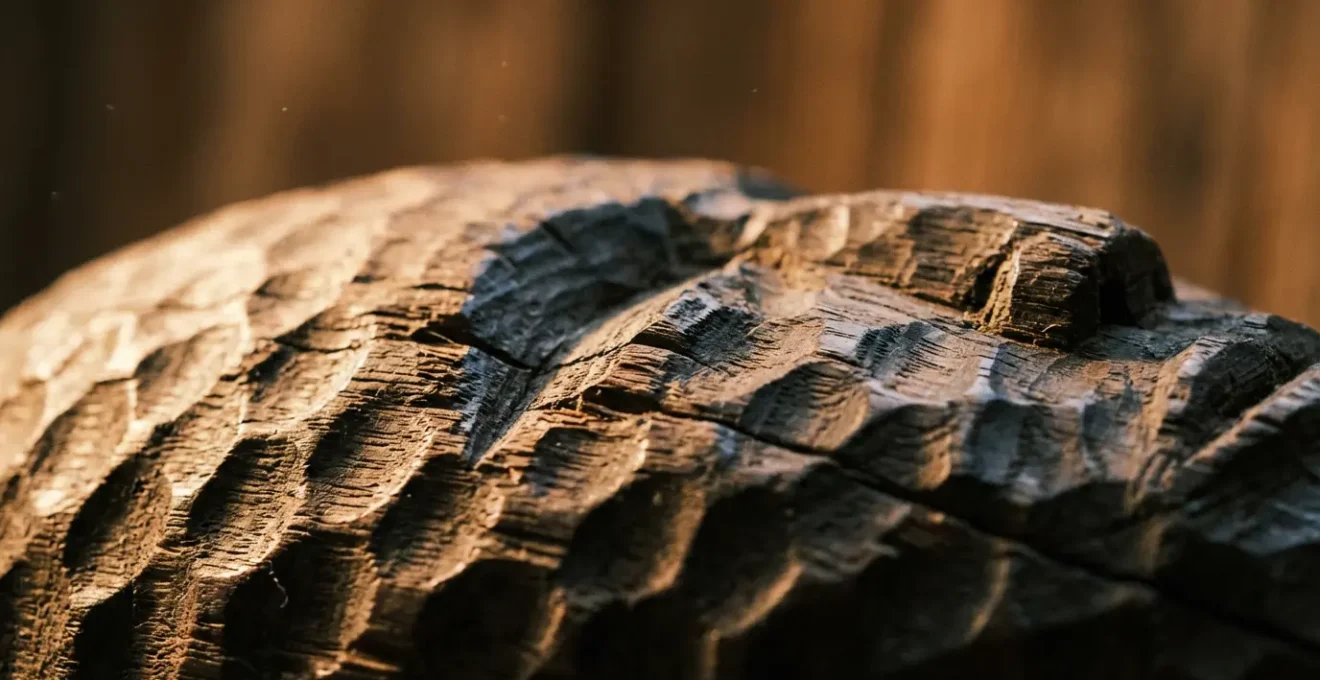
After examining the inside, your investigation moves to the surface texture. The tools used to create a mask leave an unmistakable signature. Traditional carvers, particularly in West and Central Africa, primarily used an adze. This tool, swung in a rhythmic motion, removes small chips of wood, creating a surface composed of many small, concave facets. This is the foundation of “tool mark cartography”—mapping the artist’s hand.
These adze marks are not a flaw; they are a hallmark of masterful, traditional craftsmanship. The surface is not perfectly smooth but has a dynamic, almost shimmering quality as light catches the different angles of the facets. This texture tells the story of the carver’s rhythm and skill. In contrast, “airport art” is often produced quickly using modern tools. The tell-tale sign of a modern reproduction is the use of sandpaper or electric sanders, which create a perfectly smooth, uniform surface that erases all evidence of the carving process. This lack of texture is a major red flag.
This macro photograph highlights the authentic texture created by an adze. Notice the rhythmic, faceted surface that no modern sandpapering can replicate.
Furthermore, the choice of wood itself is a clue. As experts from Gallery Preira African Art point out, there is a logic to the material. A mask intended to be danced for hours will be carved from a lightweight wood for comfort. In contrast, a sculpture meant to stand outdoors in a village setting would be made from a heavy, dense, weather-resistant wood. A heavy mask presented as a dance mask should raise suspicion. The materials and tools used create specific characteristics, and according to authentication experts at Gallery Preira, those from the early 1900s have aging patterns that cannot belong to any other period, making tool mark analysis crucial.
Collected in situ vs. Bought from a runner: Which provenance is legally safer?
Once you’ve analyzed the physical object, the next step is investigating its history, or provenance. This is not just a matter of authenticity but also of legal and ethical safety. Not all provenance is created equal. A collector must understand the “provenance hierarchy” to assess risk. The gold standard is an object published in a museum or academic catalog, or one bearing an old, painted collection inventory number from before 1970. This provides the highest level of legal security.
Below this are certificates from established, reputable dealers. However, the market is also populated by “runners”—traders who acquire pieces directly from villages or regional markets to sell in major cities. While buying from a runner can be a source of authentic material, it carries more risk. An experienced runner with verifiable references and a specialization can be reliable. A phenomenon known as “runner waves” can even be an indicator of authenticity; for instance, a sudden influx of Songye masks on the Nairobi market may correspond to changing conflict zones in the DRC, suggesting the pieces are recently field-collected rather than warehoused fakes. However, a runner with no history is a gamble.
The following table, based on analysis from specialists like Rand African Art, breaks down the hierarchy of provenance and its associated risks. It is a critical tool for any collector navigating the market.
| Provenance Type | Legal Safety Level | Verification Method | Red Flags |
|---|---|---|---|
| Museum/Academic Publication | Highest | Published catalog with provenance | Recent publication of previously unknown piece |
| Old Collection Inventory Number | High | Painted/carved collection marks pre-1970 | Fresh paint or recent carving marks |
| Established Dealer Certificate | Medium-High | Dealer reputation, business history verification | New dealer, no physical gallery |
| Runner with References | Medium | Multiple collector references, specialization proof | No verifiable sales history |
| Direct Village Purchase | Low-Risk | Community permission documentation | No written authorization from elders |
| Handwritten Field Note | Low | Date verification, collector research | Modern paper, inconsistent dates |
Ultimately, a direct village purchase with documented permission from community elders can be very safe, but a simple claim of being “collected in situ” without proof is one of the weakest forms of provenance. The burden is on the collector to verify claims and understand where a piece sits in this hierarchy of risk and authenticity.
The grave goods mistake: buying objects that are illegal to own or sell
One of the most serious errors a collector can make is to inadvertently acquire an illicitly excavated artifact. Many ancient terracotta and wooden figures, particularly from cultures like the Nok, Sao, or Ife, are known almost exclusively from archaeological contexts. These are not ritual masks that were used and passed down; they are often grave goods or buried shrine objects. Their sale and export are illegal under national and international law.
Distinguishing these objects requires a different kind of patina forensics. Instead of smoke and sweat, you must look for an encrusted burial patina. This consists of mineral deposits, soil adhesion, and often reddish or white clay packed into the crevices. Another key indicator is termite damage. Termites that attack wood underground leave a distinct pattern of holes beneath the surface, unlike the surface-level damage seen on objects stored above ground. Oxidization patterns in cracks are also telling: fresh, white wood indicates a recent break, while authentically aged cracks will be colored and filled with accumulated dust.
The legal framework for this is critical. A significant turning point was the 1970 UNESCO Convention on the Means of Prohibiting and Preventing the Illicit Import, Export and Transfer of Ownership of Cultural Property. After this, the legal importation of antique African masks stopped in the 1970s and 1980s for signatory countries. Any piece lacking clear provenance demonstrating it was outside its country of origin before 1970 (or the date of a country’s specific laws) is a major legal risk. A collector must be vigilant to avoid participating in the destruction of archaeological heritage.
Your Checklist for Identifying Potentially Illicit Objects
- Check for encrusted burial patina: Look for mineral deposits and soil adhesion in crevices, which differ from smoke patina.
- Look for termite damage patterns: Identify holes beneath the surface, indicating underground storage, rather than on top.
- Examine for grave soil remnants: Spot reddish or white clay in deep crevices that does not match the mask’s supposed origin region.
- Identify archaeological context styles: Be aware of Nok, Sao, or Ife terracotta styles known almost exclusively from excavations.
- Search oxidation patterns: Check if cracks show white fresh wood (recent) or oxidized coloring with dust accumulation (authentic aging).
When to consult a tribal elder: validating significance before purchase?
After all the physical and legal analysis, the ultimate authority on a mask’s significance is the culture from which it came. The most sensitive and informed collectors understand that there are limits to what can be learned from a distance. Consulting with a cultural expert or a tribal elder, when possible and appropriate, is the final and most profound step in validation. This isn’t just about authentication; it’s about understanding.
An elder can provide context that is impossible to glean from the object alone. They might identify the mask’s specific role in a ceremony, its symbolic meaning, or the identity of the carver’s workshop. This is particularly crucial because, as the specialists at Gallery Preira state, much of this knowledge is intentionally guarded. They note:
Any tribe’s ceremonies, meaning of pieces, what they are used for, are all part of the Secret Society of each tribe. Therefore, there are many secrets and meanings that are not known to outsiders, as they only share what they want.
– Gallery Preira, How Authentic is an African Tribal Mask
This “secret” knowledge means that without direct cultural input, a collector’s understanding will always be incomplete. Such consultation, however, must be done with the utmost respect. It is not an interrogation but a dialogue, often facilitated through museums, academics, or established cultural foundations. The goal is to honor the object by seeking to understand its true purpose from its creators’ descendants.
This image captures the ideal of respectful dialogue: a curator or collector humbly learning from a cultural expert, centering the indigenous knowledge in the process of understanding the artifact.

Engaging with elders is not always feasible, but recognizing its importance marks the transition from a mere owner of objects to a true custodian of culture. It acknowledges that the value of the mask is not just in its wood and patina, but in the stories, beliefs, and human experience it represents.
Why some cultures believe a mask must be fed or covered when not in use?
Acquiring an authentic mask is only the beginning of the journey. A truly sensitive collector must understand its “spiritual ecology”—the system of beliefs that governs its existence. In many African cultures, a mask is not an inanimate object. It is a vessel, a temporary home for a spirit or an ancestor. Once consecrated, it is considered a living entity with needs and agency. This belief is the reason behind practices that may seem strange to an outsider, such as “feeding” or covering a mask.
Feeding a mask can involve anointing it with sacrificial materials like palm oil, millet porridge, or animal blood. This is not for preservation but to nourish the spirit residing within, to keep it powerful and benevolent. Similarly, the practice of covering a mask with a natural cloth when not in use is about containing its spiritual energy. It is believed that an uncovered mask might wander, cause mischief, or lose its power. These are not superstitions; they are integral parts of a complex cosmological system where the boundary between the physical and spiritual worlds is permeable.
For example, among the Bobo, Bwa, and Mossi peoples of Burkina Faso, plank masks like the Nwantantay appear at funerals and agricultural festivals. Between these appearances, specific storage protocols are required to manage their spiritual force. Animal masks, in particular, are often seen as mediums that allow the wearer to communicate with the spirit of that animal, embodying its virtues and power. Treating such an object as a mere wall decoration ignores its fundamental purpose and identity. While a collector is not expected to replicate these rituals, understanding them is essential for respectful ownership.
The cataloging mistake that misrepresents indigenous artifacts for decades
A collector’s responsibility extends beyond acquisition and display to documentation. The way an object is cataloged—its story, provenance, and attribution—can either honor its origins or perpetuate historical mistakes. For decades, Western collectors and institutions have labeled objects based on aesthetic judgments or incomplete information, often stripping them of their true function and meaning. This can lead to a Dogon mask being mislabeled as Bambara, or a ritual object being described simply as a “fertility figure,” a generic and often inaccurate trope.
This “cult of authenticity,” as Nigerian artist and curator Zina Saro-Wiwa calls it, can be a “peculiar preoccupation amongst European connoisseurs.” In her critique, she highlights how the Western focus on a narrow, often primitivist, idea of authenticity can ignore the contemporary reality and evolving traditions of African artists. A collector’s catalog should be a living document, not a final verdict. It’s a place to record not just what is known, but what is *unknown*.
The cult of authenticity regarding African art objects is a peculiar preoccupation amongst European connoisseurs.
– Zina Saro-Wiwa, Worrying the Mask: The Politics of Authenticity and Contemporaneity in the Worlds of African Art
Proper documentation is an act of preservation. It counters the entropy of memory and the misinterpretations of history. A thorough record should include:
- A complete provenance chain: Dates, sellers, and previous owners.
- Physical characteristics: Dimensions, weight, wood type, and observed tool marks.
- Oral history: Any stories or information from the seller, recorded immediately.
- Comparative research: Notes on similar examples in museum collections.
- High-resolution photographs: Documenting the object from all angles, with close-ups of wear patterns.
By creating a detailed and honest record, the collector acts as a responsible steward, ensuring the object’s true story is not lost or distorted for future generations. This diligent cataloging is the final step in honoring the artifact’s journey.
Key takeaways
- True authenticity is found in forensic details, not superficial “wear and tear.”
- Provenance is a hierarchy of risk; documentation from before 1970 is the legal benchmark.
- Respectful ownership involves understanding the mask’s spiritual context and handling it accordingly.
How to Display Sacred Masks Respectfully Without Violating Taboos?
The final consideration for a collector is how to live with these powerful objects. Displaying a sacred mask is not a neutral act; it is a statement of values. The choice of presentation can either honor the object’s cultural origins or reduce it to a piece of interior design. Museums worldwide are grappling with this challenge, moving away from sterile, purely aesthetic presentations that strip masks of their function and meaning.
The “gallery style” of display—isolating a mask on a white wall under a dramatic spotlight—emphasizes its formal qualities as sculpture. While it highlights craftsmanship, it severs the object’s connection to the costume, music, and community that gave it life. A more culturally sensitive approach is a contextual display. This might involve grouping the mask with related objects, using more subdued lighting, and providing explanatory materials that discuss its original purpose. This method prioritizes the cultural narrative over purely formal appreciation.
For highly sacred objects, the most respectful approach may be not to display them at all, but to keep them wrapped or in private, quiet storage. This aligns with many indigenous practices of containing spiritual power. The decision depends on the specific mask and the information gathered during the research process. The following table outlines the different approaches and their implications, helping a collector make a conscious and respectful choice.
| Display Approach | Characteristics | Advantages | Cultural Considerations |
|---|---|---|---|
| Aesthetic/Gallery Style | Clean white walls, isolated presentation, dramatic lighting | Emphasizes formal qualities and craftsmanship | May strip cultural context and meaning |
| Contextual Display | Grouped with related objects, subdued lighting, explanatory materials | Preserves cultural narrative and function | Respects original purpose and spiritual significance |
| Hybrid Approach | Clean presentation with select contextual elements | Balances aesthetic appreciation with cultural respect | Requires careful curation to avoid appropriation |
| Respectful Non-Display | Kept wrapped or in private storage | Maintains spiritual integrity | Most appropriate for highly sacred objects |
Ultimately, a respectful display is one that is informed by knowledge and guided by a sense of stewardship. It reflects the collector’s understanding that they are not merely an owner, but a temporary custodian of an object with a rich and ongoing spiritual life.
By applying this multi-layered, investigative approach, you move beyond the simple act of buying and selling. You become a participant in the preservation of cultural heritage, ensuring that these powerful objects are understood, respected, and honored for generations to come. Start applying this forensic mindset to every piece you consider.