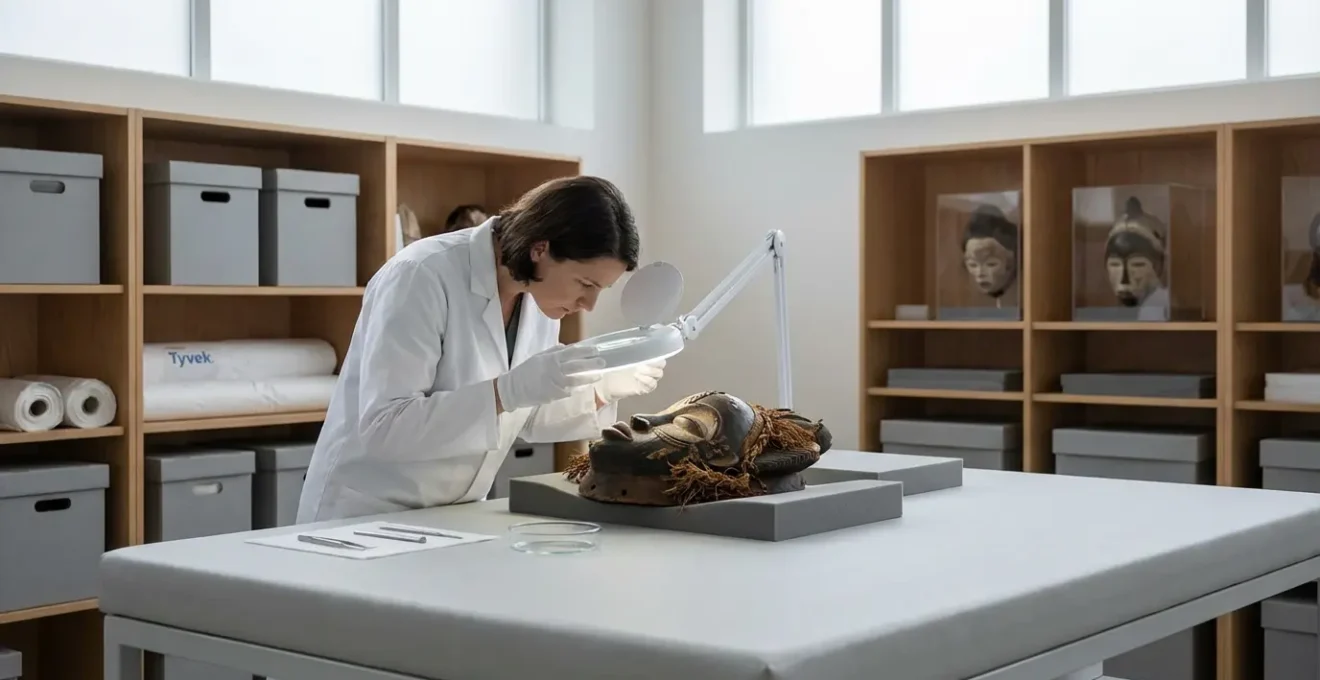
Ethical stewardship of a sacred mask requires treating it not as an inert object, but as a living entity with its own set of cultural and spiritual rules.
- Display decisions must go beyond aesthetics to honor the mask’s original function, whether through active “feeding” or restricted access.
- Proper handling involves non-invasive mounting techniques and diligent provenance research to respect the maker’s lineage.
Recommendation: Shift your perspective from owner to custodian, engaging with source communities to understand and uphold the “metaphysical laws” that give the object its true meaning.
For a museum curator or a private collector, acquiring a sacred mask is often the culmination of a long search. The immediate instinct is to display it, to share its aesthetic power and historical significance. However, this impulse often overlooks a profound reality: many of these masks are not considered mere objects. They are living entities, conduits for spirits, or integral parts of sacred ceremonies. Placing them behind glass without understanding their inherent rules can inadvertently strip them of their power and violate deeply held cultural beliefs.
The common approach focuses on physical preservation—climate control, pest management, and secure mounting. While crucial, this is only half the story. The real challenge lies in what can be called “ethical stewardship,” a practice that honors the object’s intangible heritage. It involves a shift in mindset from owner to custodian, from displaying a static artifact to caring for a dynamic, culturally significant being. This means understanding why a mask might need to be “fed” with tobacco smoke or covered when at rest, and why labeling it “Unknown Artist” is an act of erasure, not of academic caution.
This guide moves beyond the technicalities of display to explore the ethical framework required to handle these powerful objects. It is about learning to listen to the silence of the mask and the voices of its source community. The true art of displaying a sacred object is not in how it is seen, but in how it is respected. We will explore how to balance the need for visibility with the demands of cultural sanctity, ensuring the mask’s narrative integrity remains intact, even far from its original home.
This article provides a structured approach to navigating these complex ethical and practical considerations. The following sections will guide you through the key principles of respectful stewardship for sacred objects.
Contents: How to Ethically Steward Sacred Masks
- Why some cultures believe a mask must be fed or covered when not in use?
- How to build an armature that supports a heavy mask without drilling into the wood?
- Visible display vs. Restricted access: Which honors the object’s original function?
- The “Unknown Artist” mistake that erases the specific cultural lineage of the maker
- When to return the mask: recognizing when an object can no longer be ethically held?
- Why oil and smoke deposits inside a mask prove it was danced?
- Why marble needs internal pinning for outstretched arms but bronze doesn’t?
- How to Reorganize a Museum Storage Facility to Gain 30% More Space?
Why some cultures believe a mask must be fed or covered when not in use?
In many indigenous and traditional belief systems, a sacred mask is not a decorative item but a vessel or embodiment of a spirit, ancestor, or powerful natural force. To remove it from its ceremonial context is to place this entity in a dormant state, but its energy and needs persist. The practices of “feeding” or covering a mask are therefore not superstitions, but essential acts of cultural maintenance and respect. They are methods for sustaining the object’s spiritual energy and honoring the protocols that govern its existence. Forgetting these duties is seen as disrespectful and can render the mask inert or even anger the spirit within.
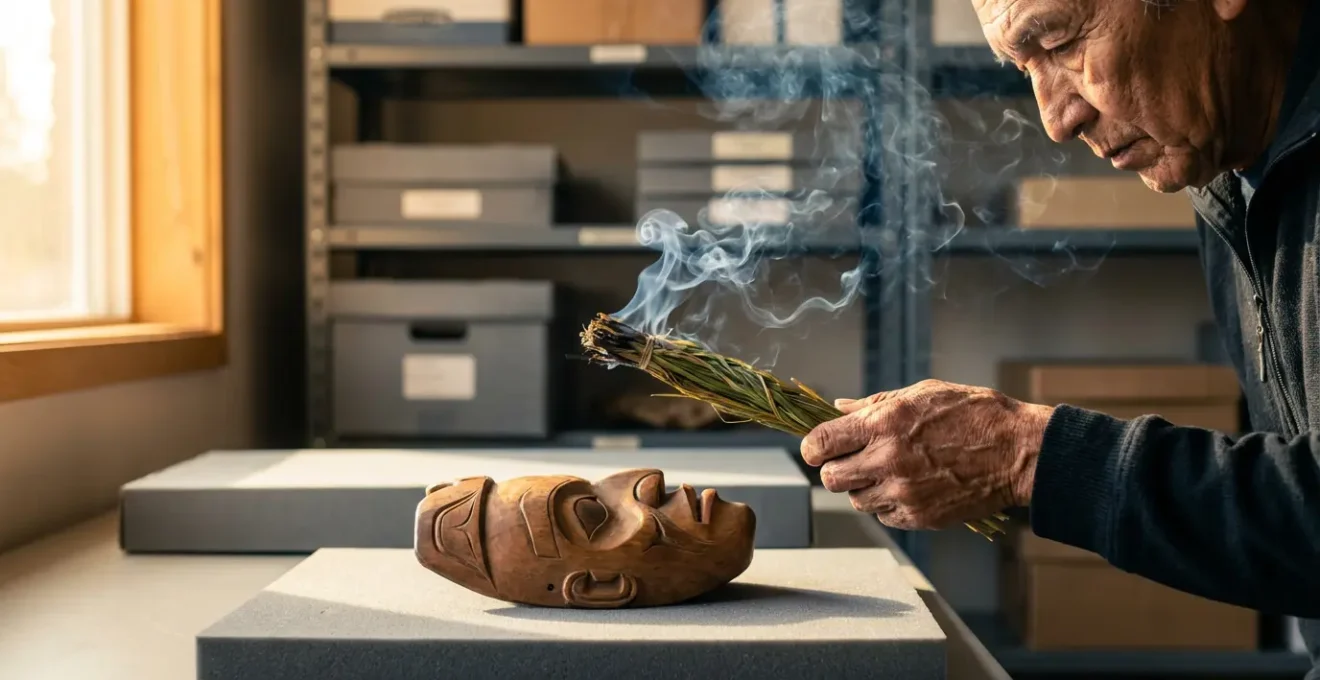
These rituals are highly specific and symbolic. For example, offering palm wine libations to a Yoruba mask sustains its connection to ancestral power, while blowing tobacco smoke over an Amazonian shamanic mask maintains its link to the spirit world. Covering a mask with a white cloth or placing it in a dark cedar box serves to protect its sacred power, shield it from profane gazes, or allow it to “rest” between uses. As a custodian, understanding and, where possible, facilitating these practices in consultation with source communities is the highest form of respect. It acknowledges the mask as a living object rather than a static piece of art.
The following table, based on guidelines for caring for sacred objects, illustrates how these protocols differ across cultures, each with a profound symbolic meaning that must be understood to provide ethical care. As an analysis from the Canadian Conservation Institute shows, these actions are integral to preservation.
| Culture | Feeding Protocol | Covering/Resting Method | Symbolic Meaning |
|---|---|---|---|
| Yoruba (West Africa) | Palm wine libations | White cloth covering | Sustaining ancestral energy |
| Amazonian Shamanic | Tobacco smoke blown over mask | Dark storage away from light | Maintaining spirit connection |
| Southwest Pueblo | Cornmeal offerings | Wrapped in specific textiles | Preserving inherent sacred power |
| Northwest Coast | Cedar smoke cleansing | Storage in cedar boxes | Protecting rights and privileges |
How to build an armature that supports a heavy mask without drilling into the wood?
The primary rule for mounting a sacred mask is an ethical one: do no harm. Drilling into the wood or affixing permanent hardware is an irreversible violation of the object’s integrity. The goal is to create a custom internal support, or armature, that cradles the mask securely without any invasive measures. This method respects the physical object and acknowledges that it may one day be returned to its community for active use. The process relies on using conservation-grade materials like Ethafoam (plastazote) and careful shaping to create a perfect, pressure-free fit.
The construction begins by taking precise measurements of the mask’s interior cavity. Blocks of Ethafoam are then cut and pinned together to create a rough internal form. This form is repeatedly tested against the mask’s contours and gradually refined with a craft knife. The key is to achieve a shape that provides broad support, distributing the mask’s weight evenly without creating pressure points on fragile areas. This patient process of fitting and shaping is paramount. While a study notes that due to time constraints, museum professionals typically allocate only 15 minutes per object, a sacred mask often requires significantly more time and care.
Once the shape is perfected, the entire foam mount is covered with a smooth, inert material like Relic Wrap (a PTFE film). This final layer prevents the foam from snagging on delicate internal elements, such as plant fibers or remnants of costume attachments. The finished armature should allow the mask to rest securely in its correct orientation, preventing stress on weak points like thin rims or extended features. This non-invasive method ensures the mask is both safely displayed and preserved in a state that respects its potential for future ritual life.
Action Plan: Building a Conservation-Grade Mask Mount
- Assessment: Take detailed measurements, note the mask’s materials, and perform a thorough condition assessment to identify fragile areas.
- Block Creation: Cut conservation-grade Ethafoam into blocks using a craft knife to create a rough approximation of the mask’s internal space.
- Structure Assembly: Pin the foam blocks together to build the internal support structure that will cradle the object.
- Refinement: Repeatedly test the fit, carefully carving and adjusting the foam’s shape to match the mask’s internal contours without applying pressure.
- Surface Finishing: Cover the completed mount with an inert material like Relic Wrap (PTFE film) to create a smooth surface that won’t snag or abrade the mask’s interior.
Visible display vs. Restricted access: Which honors the object’s original function?
The tension between public display and restricted access is a central ethical dilemma in the stewardship of sacred masks. For many museums, the mission is to educate and exhibit. Yet, for certain objects, their original function was precisely the opposite: they were meant to be seen only by initiated individuals during specific ceremonies. As the Museum Masks Research Team notes, “When such a mask is removed from its intended, sacred setting and placed in a secular museum environment, behind glass, it can violate profound cultural taboos.” In these cases, permanent public display can be an act of profound disrespect.
Honoring the object’s original function requires a shift from a curator-centric to a community-centric model. The decision should not be made unilaterally. Instead, it must involve active consultation with elders, spiritual leaders, and descendants from the source community. They are the ultimate authorities on the mask’s purpose and the proper protocols for its care. Sometimes, the community may grant permission for display, perhaps with specific conditions, such as the mask facing a certain direction or being covered at night.
In other instances, the most respectful action is to place the object in restricted storage. This does not mean it is forgotten; rather, it is housed in a culturally appropriate manner that honors its sacred status. This could involve storing it in a dedicated, quiet space, wrapped in specific textiles, or positioned according to ritual requirements. This approach acknowledges that the museum’s role is not one of ownership but of custodianship, safeguarding the object according to the living traditions from which it came. This practice respects the fundamental right of communities to determine the appropriate treatment for their own sacred heritage.
Case Study: Evolving Museum Practices
Museums are increasingly becoming more attuned to cultural sensitivities, often working directly with source communities. Based on community requests, many institutions now opt for the repatriation of sacred items or agree to keep them in restricted, culturally appropriate storage rather than displaying them publicly. This collaborative practice respects living traditions and upholds the right of communities to determine the appropriate treatment of their sacred heritage, transforming the museum from a simple exhibitor into a true ethical partner.
The “Unknown Artist” mistake that erases the specific cultural lineage of the maker
Labeling a sacred mask as the work of an “Unknown Artist” is a common practice in collections, but it is often a critical error rooted in colonial-era collecting habits. This generic attribution perpetuates the myth of the anonymous tribal craftsman, erasing the identity, skill, and specific cultural lineage of an individual maker. In many cultures, mask makers were and are renowned artists with distinct styles, workshop traditions, and spiritual authority. To ignore this is to strip the object of a significant layer of its history and meaning, reducing a masterwork to an ethnographic specimen.
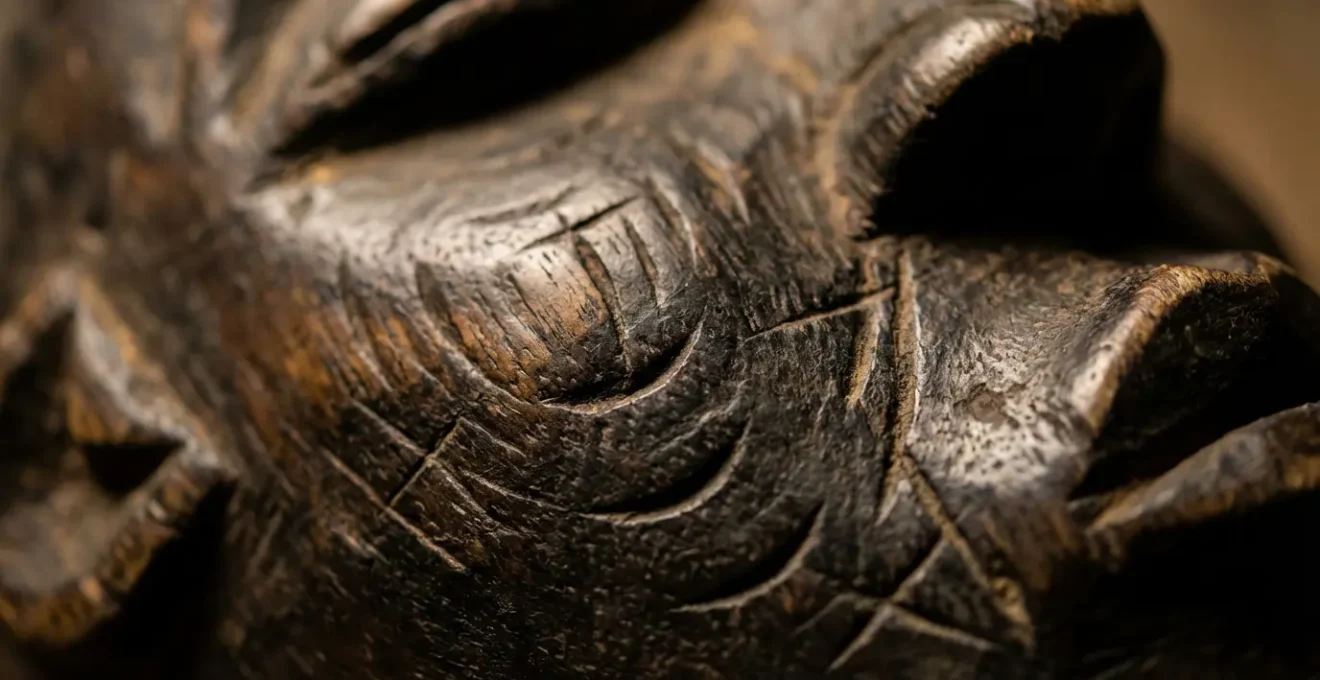
Correcting this mistake requires a proactive, forensic approach to attribution. This involves meticulous analysis of the object itself: studying the tool marks and carving techniques to link them to specific regional workshops, documenting the choice of wood and pigments, and comparing stylistic signatures with ethnographic databases. However, physical analysis alone is insufficient. The most crucial step is engaging in genuine collaboration with the source community. Elders, local historians, and contemporary artists often hold the oral histories and traditional knowledge necessary to identify a maker or, at the very least, a specific workshop or family lineage.
This collaborative process transforms the curatorial role. As stated in cultural partnership guidelines, this means active involvement from the community in every step. This commitment to narrative integrity not only enriches the museum’s own records but also serves as an act of respect and recognition for the communities and individuals who created these powerful objects. Compensating community experts for their knowledge is an essential part of this ethical exchange, acknowledging their expertise as equal to that of academic researchers.
Museums are increasingly working alongside community members, elders, and artists as true co-curators. This means active involvement in the selection of masks for display, the crafting of interpretive texts, the design of exhibition spaces, and even the determination of what information should or should not be shared publicly due to sacred protocols. This ensures authenticity, cultural sensitivity, and narrative accuracy from an insider perspective.
– Museum Collaboration Guidelines, Wonderful Museums – Cultural Partnership Protocols
When to return the mask: recognizing when an object can no longer be ethically held?
The question of repatriation is one of the most complex and important issues facing collectors and museums today. Holding a sacred object is not a permanent right; it is a temporary stewardship that carries immense responsibility. Recognizing when a mask can no longer be ethically held is a critical aspect of this duty. The decision is rarely simple and is often prompted by a combination of legal, ethical, and relational factors. A formal request for return from a recognized source community is the most direct trigger, and it must always be treated with the utmost seriousness and respect.
Beyond a direct request, other signs may indicate that continued custody is no longer appropriate. The emergence of new provenance information suggesting the object was acquired through looting, coercion, or illegal trade immediately calls ownership into question. Similarly, a museum or collector may find they are no longer able to provide the required physical conservation or, more importantly, the culturally appropriate storage conditions requested by the community. A breakdown in the relationship with the source community can also be a sign that the trust required for ethical stewardship has been lost.
Legal frameworks, such as the Native American Graves Protection and Repatriation Act (NAGPRA) in the United States, provide formal processes for repatriation. However, ethical stewardship often requires going beyond legal obligations. It means engaging in proactive dialogue and being willing to return an object even in the absence of a legal mandate if it is the right thing to do. The ultimate goal is not to possess the object, but to honor its heritage and the rights of the people from whom it came. This often means acknowledging that the mask’s true home is with its community, where its spiritual life can be fully restored.
Checklist: Annual Stewardship Ethics Self-Assessment
- Community Request: Has the source community formally requested the mask’s return?
- Provenance: Has new information emerged suggesting looting or illegal acquisition during the object’s history?
- Physical Care: Are you still able to provide the required physical conservation care to prevent deterioration?
- Cultural Care: Can you maintain the culturally appropriate storage conditions and protocols requested by the source community?
- Descendant Concerns: Have descendants of the maker or its original owners expressed concerns about its current custody?
Why oil and smoke deposits inside a mask prove it was danced?
The authenticity of a sacred mask is often determined by evidence of its use in ritual. While a mask made for the tourist trade or for direct sale to a museum may be aesthetically perfect, it lacks a soul. In contrast, a mask that has been “danced” carries the physical and spiritual residue of its ceremonial life. Oil and smoke deposits found on the interior surface are among the most definitive proofs of authentic use. These are not random dirt; they are the patina of ritual, a layered history of the mask’s interaction with its wearer and its sacred environment.
During a ceremony, a dancer perspires, and the oils and sweat from their face are absorbed by the inner surface of the wooden mask. Over many uses, these deposits build up, creating a distinct, often glossy patina, particularly around the forehead, nose, and chin areas. Likewise, many ceremonies involve fire, torches, or the burning of sacred substances like cedar or tobacco. The smoke from these sources permeates the mask, leaving a dark, sooty residue and a characteristic scent that can linger for decades. These internal deposits are nearly impossible to fake convincingly.
Conservation analysis distinguishes this authentic wear from artificial aging. As analysis of wear patterns shows, authentic patina includes concentrated wear at contact points, sweat deposits, and even bite marks on internal mouth bars used by the dancer to stabilize the mask. Artificial aging, by contrast, tends to be uniform, with an even distribution of “dirt” and random scratches. By examining these subtle clues, a curator can confirm that a mask was not just a carving, but a living part of a cultural tradition.
Understanding the difference between genuine and artificial signs of use is crucial for authentication, as this comparative table shows.
| Authentic Use Patina | Artificial Aging | Analysis Method |
|---|---|---|
| Concentrated wear at contact points | Uniform surface treatment | UV light examination |
| Sweat/oil deposits inside only | Even distribution of ‘dirt’ | Chemical composition test |
| Bite marks on mouth bars | Random scratch patterns | Microscopic analysis |
| Costume friction patterns | Artificial distressing marks | Wear pattern mapping |
| Layered accumulation over time | Single application aging | Cross-section sampling |
Why marble needs internal pinning for outstretched arms but bronze doesn’t?
The difference in how sculptors handle marble and bronze reveals a fundamental principle that applies equally to the care of sacred objects: one must always respect the inherent properties of the material. Marble, for all its beauty and permanence, has very low tensile strength. This means it is strong under compression but weak when pulled or bent. An outstretched arm carved from a single block of marble would be extremely vulnerable to cracking and breaking under its own weight due to gravitational stress. To counteract this, sculptors must use internal pinning, drilling into the stone and inserting metal armatures (pins or rods) to provide the necessary structural support.
Bronze, on the other hand, is an alloy with exceptionally high tensile strength. This property allows it to be cast into complex, gravity-defying forms, such as figures with extended limbs or dynamic poses, without the need for internal supports. The material itself can bear the load. This contrast in material science dictates the artist’s approach from the very beginning, forcing the marble sculptor to think about internal structure while the bronze artist can focus more on external form.
This principle offers a powerful metaphor for the stewardship of sacred masks. Just as a sculptor must obey the physical laws of their chosen medium, a curator must respect the “metaphysical laws” of a sacred object. Forcing a mask into a display context that violates its cultural or spiritual rules—such as exposing a restricted object to public view or failing to perform required rituals—is akin to carving an unsupported marble arm. It ignores the object’s inherent nature and risks causing a form of ethical and spiritual breakage.
Just as a sculptor must respect the physical laws of marble, a collector must respect the ‘metaphysical laws’ of a sacred mask. Forcing an object into a context that violates its ‘rules’ will cause it to ‘break’ ethically and spiritually.
– Conservation Philosophy Manual, Museum Mount Design Principles
Key Takeaways
- Ethical stewardship requires treating sacred masks as living entities with specific cultural needs, not as inert artifacts.
- Non-invasive techniques, like custom-fit foam armatures, are essential for physically supporting masks without causing damage or violating their integrity.
- Collaboration with source communities is non-negotiable for making decisions about display, restriction, and potential repatriation.
How to Reorganize a Museum Storage Facility to Gain 30% More Space?
While gaining physical space in a storage facility is often framed as a logistical challenge of optimizing shelving and density, applying this mindset to a collection of sacred masks requires a profound shift. The goal is not merely “gaining space,” but creating “meaningful space.” A purely efficiency-driven approach can lead to cultural violations, such as storing masks from rival societies next to each other or organizing objects by size in a way that ignores their ritual relationships. A truly ethical reorganization prioritizes cultural protocols over raw spatial metrics.
The first step is to de-center the idea of size and material as the primary organizing principles. Instead, the collection should be assessed based on fragility, cultural relationships, and spiritual requirements. For instance, masks that are part of the same ceremonial cycle should be stored together, regardless of their dimensions. This respects their narrative connection and facilitates their study or potential use as a group. Furthermore, as demonstrated in historical collection management, understanding acquisition patterns can inform modern organization and reveal relationships between objects that might otherwise be missed.
An ethical density approach involves creating zones within the storage facility. This might include climate-controlled areas for particularly fragile materials, but more importantly, it means creating culturally-defined spaces. This could involve physically separating objects from communities with historical rivalries or reserving premium, easily accessible, and spiritually “quiet” locations for the most sacred and powerful items. Documenting these locations with a digital mapping system ensures objects are findable, but the logic of the map is based on cultural respect, not just coordinates. This method may not always yield the absolute maximum spatial gain, but it creates a storage environment that is both efficient and ethically sound, transforming the facility from a warehouse into a true repository of living heritage.
Ultimately, the respectful stewardship of sacred masks is a journey of continuous learning and deep empathy. By shifting your role from owner to custodian and actively collaborating with source communities, you ensure that these powerful objects are honored not just for their beauty, but for the living traditions they represent. To begin applying these principles, the next logical step is to conduct a comprehensive ethical audit of your current collection and handling practices.