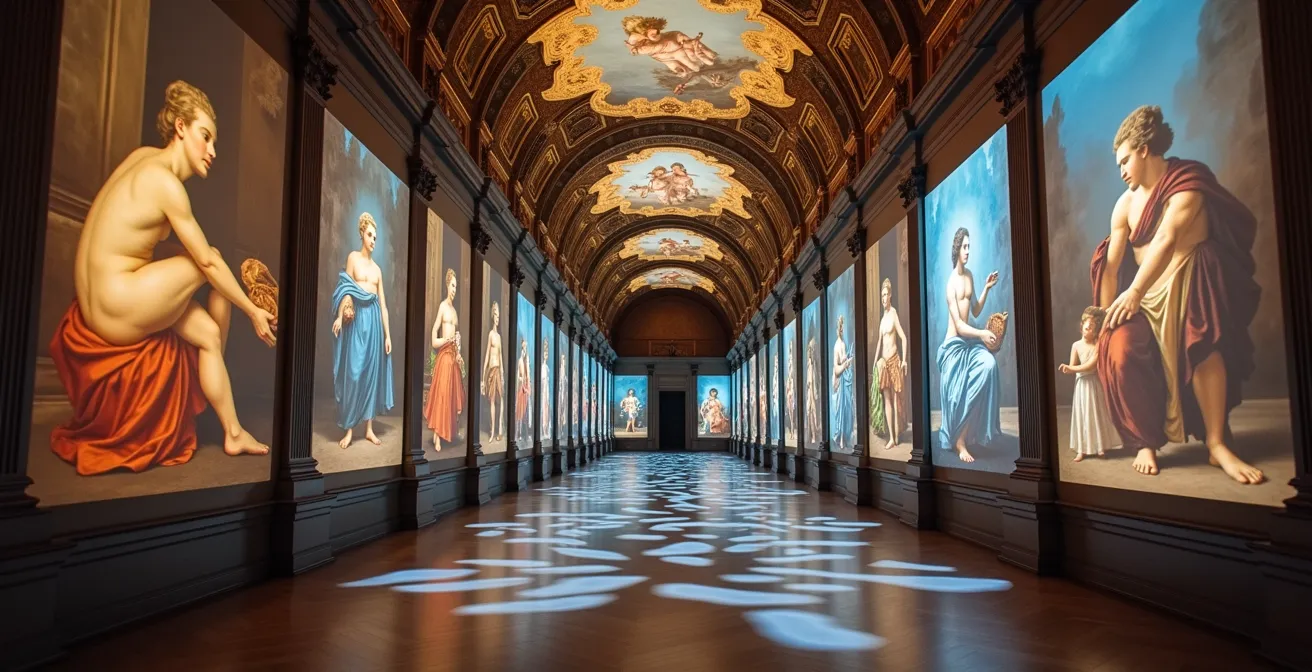
Creating a dialogue between old and new art is no longer just a curatorial choice; it’s a core strategy for institutional relevance and growth.
- Successful juxtaposition relies on conceptual “Narrative Resonance,” not just superficial aesthetic harmony.
- Engaging Gen Z requires moving beyond static labels to interactive, co-created experiences that foster audience activation.
Recommendation: Focus on “Audience Activation” by transforming visitors from passive viewers into active participants in the curatorial dialogue you create.
For curators and gallery owners, the vast collections of historical art represent both a priceless cultural heritage and a formidable challenge. How do you make a centuries-old masterpiece resonate with an audience fluent in the language of TikTok and augmented reality? The conventional approach often involves simple juxtaposition—placing a contemporary piece next to an old one and hoping the contrast sparks some interest. This method sees technology as a novelty to attract younger crowds or relies on basic thematic links.
But this view is critically limited. It overlooks the profound potential for what can only be described as curatorial alchemy. The true opportunity lies not in merely showing old and new art together, but in orchestrating a deliberate dialogue that fundamentally changes the meaning of both. The key isn’t simply about leveraging technology for engagement; it’s about a strategic act of meaning-making that can redefine your institution’s narrative and, by extension, its market position.
This isn’t about chasing trends. It’s about transforming your collection from a static archive into a living, breathing entity that generates new stories, challenges perceptions, and fosters a deeper connection with a more diverse audience. By shifting from aesthetic matching to conceptual resonance, you can unlock a powerful new relevance for your institution. This guide provides a strategic framework for orchestrating these dialogues, moving beyond simple contrast to create exhibitions that are both intellectually profound and culturally resonant.
This article explores the strategic and practical dimensions of this curatorial challenge, offering a roadmap to transform your exhibitions. The following sections provide concrete answers to the key questions curators face when bridging the gap between historical and contemporary art.
Summary: How to Curate a Dialogue Between Renaissance Art and Modern Digital Installations?
- Why placing a Jeff Koons next to a Baroque bronze changes the meaning of both?
- How to light a mixed-era exhibition without favoring one medium over another?
- Thematic vs. Chronological labels: Which engages the Gen Z visitor more?
- The curatorial trap of matching colors instead of concepts in mixed shows
- How to use a contemporary artist’s brand to sell tickets for an Old Master show?
- How to design a gallery workshop that appeals to teenagers who hate museums?
- How to map a video onto a 3D sculpture without expensive software?
- How to Increase Visitor Diversity in Public Galleries with Zero Budget?
Why placing a Jeff Koons next to a Baroque bronze changes the meaning of both?
The act of placing two artworks from different eras side-by-side is not a neutral act of presentation; it is an act of curatorial alchemy. This juxtaposition fundamentally alters the context and, therefore, the meaning of each piece. A Baroque bronze, on its own, speaks of classical tradition, religious devotion, or aristocratic power. A Jeff Koons sculpture speaks of consumer culture, celebrity, and the mechanics of the modern art market. When placed together, they cease to be isolated statements. Instead, they enter into a dialogue, forcing the viewer to forge new connections and ask new questions.
This is the essence of meaning-making. The contemporary work can demystify the historical piece, stripping away layers of academic reverence and exposing a universal human theme—like desire, loss, or status—that transcends time. Conversely, the Old Master lends a sense of gravitas and historical lineage to the contemporary work, suggesting its place within a longer artistic conversation. The dialogue reframes both, creating a third, emergent meaning that exists only in their shared space.
Case Study: KAWS ‘THE MESSAGE’ at Palazzo Strozzi
The installation of KAWS’ work in the Renaissance courtyard of Palazzo Strozzi exemplifies this principle. The exhibition created a direct confrontation between KAWS’ pop culture figures and the legacy of artists like Beato Angelico. As one analysis notes, the dialogue wasn’t just aesthetic; it was a conceptual reinterpretation of spirituality for an age of digital hyperconnectivity. By placing his contemporary figures in this historic space, KAWS’s work forces a reflection on what we hold sacred today, transforming the courtyard into a space for new questions rather than quiet reverence. The meaning of both the Renaissance architecture and the pop art sculpture was irrevocably changed by the encounter.
The goal for the curator is to engineer this new meaning deliberately. It requires moving beyond visual similarities to identify a deeper narrative resonance. What shared tension, question, or emotion connects these two disparate objects? When you find that link, the exhibition becomes more than a collection; it becomes an argument, an experience, and a revelation for the visitor.
How to light a mixed-era exhibition without favoring one medium over another?
Lighting a mixed-era exhibition is a delicate balancing act between conservation and presentation. The robust materials of a bronze sculpture can withstand light levels that would irrevocably damage a fragile Renaissance drawing on paper. At the same time, the subtle luminosity of a projected digital work can be completely washed out by the spotlights needed to illuminate an oil painting. Favoring one medium over another through lighting not only compromises the art but also sabotages the conceptual dialogue you’ve worked so hard to build.
The solution lies in a layered, technically precise approach that treats light as an integral part of the curatorial strategy, not an afterthought. This requires a deep understanding of material sensitivity and the strategic use of modern lighting technology. The goal is to create a visually cohesive environment where each artwork, regardless of its medium or age, is presented with integrity. This means establishing strict parameters for light exposure while using dynamic systems to create moments of focus and ambiance.
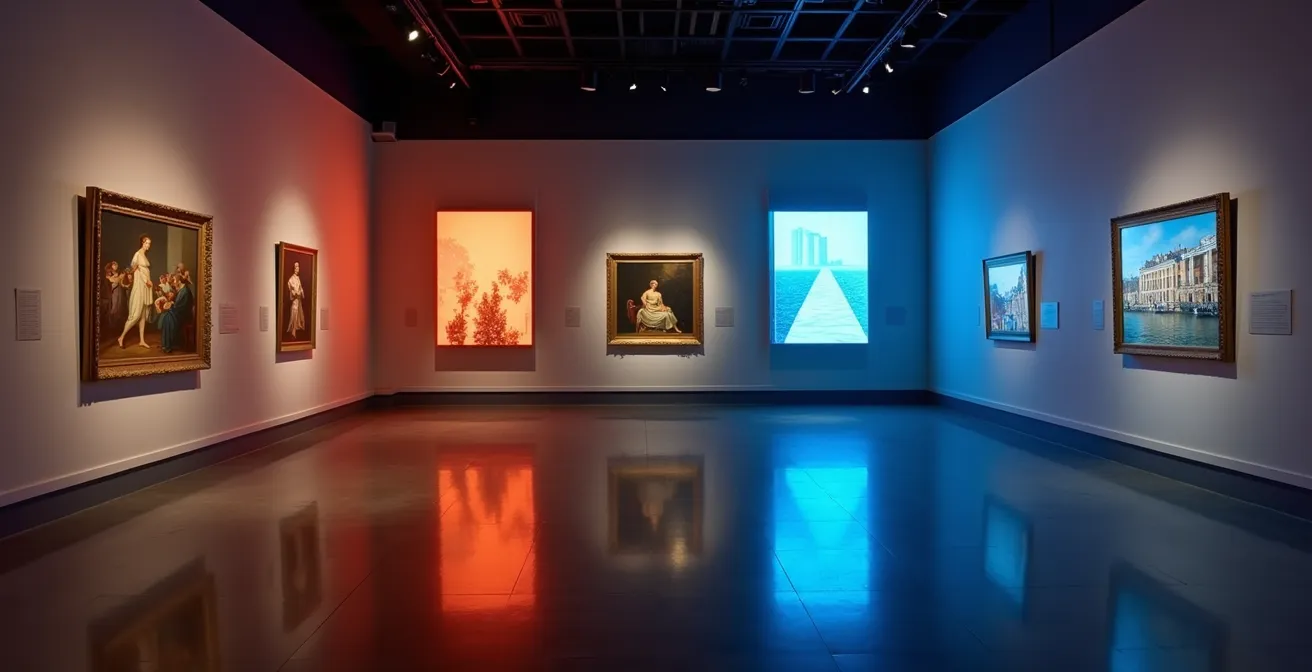
As the image suggests, a successful lighting scheme uses a combination of temperatures and technologies. Warm, focused spotlights can bring out the texture and depth of historical objects, while cool, diffuse backlighting can provide a clean canvas for digital displays. The key is calibration. Modern systems allow for ‘cumulative lux analysis’, a method where every beam of light is mapped to ensure that even reflected or ambient light does not exceed conservation standards. For extremely sensitive materials like textiles or works on paper, the maximum exposure must be drastically lower, often around 5 footcandles (or 54 lux), while less sensitive objects like stone or metal can tolerate up to 20 footcandles (200 lux). Furthermore, eliminating UV radiation is a non-negotiable goal for all light sources.
Ultimately, technology like Bluetooth-enabled sensors can automate this balance, adjusting light levels in real-time based on ambient conditions and visitor traffic. This ensures that conservation standards are met without sacrificing the visual impact of the exhibition. By mastering light, the curator ensures that the dialogue between past and present is one of mutual respect, not of dominance and submission.
Thematic vs. Chronological labels: Which engages the Gen Z visitor more?
For generations, the chronological label has been the museum’s default mode of communication: artist, title, date, medium. While factually sound, this approach often fails to connect with a Gen Z audience accustomed to non-linear, user-driven narratives. This generation doesn’t just consume content; they discover, remix, and participate in it. For them, context is not a fixed set of historical facts but a fluid network of connections. The question is no longer just “What is this?” but “Why should I care?” and “What does this have to do with anything else?”
This shift in information consumption is profound. Research reveals that over 60% of Gen Z now use TikTok as a search engine, bypassing traditional sources entirely. This signals a preference for content that is visual, bite-sized, and thematically linked by users, not by institutions. Consequently, thematic labels that pose provocative questions or draw unexpected parallels are far more effective at sparking curiosity than a dry chronological list. A label that asks, “Does this 16th-century portrait show the same obsession with status as a modern-day Instagram post?” immediately invites a personal connection and a deeper level of engagement.
However, the most strategic approach is not to choose between thematic and chronological but to offer multiple pathways. This is where audience activation begins. By using QR codes or simple AR overlays, you can empower visitors to choose their own journey. One tap might reveal historical facts, another might show a video of a contemporary artist responding to the work, and a third might link to a playlist that captures the mood of the piece. This multi-path approach transforms the static label into an interactive discovery tool.
Institutions are already being measured on this. The AAM Gen Z Engagement Scorecard, for instance, assesses museums on tactical measures like using “jargon-free program titles” and fostering youth collaboration. It’s a clear indicator that success is no longer just about attendance figures but about the depth and quality of connection. By reframing labels as prompts for dialogue rather than dispensers of fact, curators can turn passive viewing into an active, engaging experience that resonates with a younger, digitally native audience.
The curatorial trap of matching colors instead of concepts in mixed shows
One of the most common and tempting pitfalls in curating a mixed-era exhibition is the “aesthetic trap”: pairing a contemporary work with a historical one simply because they share a similar color palette or formal quality. A blue abstract painting next to a blue-robed Madonna, for instance. While visually pleasing on a superficial level, this approach is a missed opportunity. It reduces both works to their decorative properties and sidesteps the potential for a much richer, more challenging dialogue. The result is an exhibition that is pretty but intellectually silent.
A truly powerful exhibition is built on conceptual resonance, not visual harmony. The curator’s role is to unearth the deep, often complex, thematic currents that connect works across centuries. This requires looking beyond the surface to the ideas, tensions, and human experiences embedded within the art. Are both works grappling with the nature of power, the fragility of the body, or the performance of identity? These are the connections that spark genuine intellectual and emotional engagement in a visitor.
Case Study: Chinese Contemporary Art and Renaissance Drawings
A landmark exhibition juxtaposing Renaissance drawings from the British Museum with Chinese contemporary art deliberately avoided superficial pairings. Instead, the curators sought to explore the profound connections between the Western Renaissance and Chinese modernization. The dialogue was not about shared lines or colors, but about shared inquiries into humanism, scientific discovery, and the representation of the individual. By placing these works in conversation, the exhibition created a cross-cultural perspective that re-examined the very definition of the Renaissance, revealing its global echoes and challenging a purely Eurocentric view.
Spatial juxtapositions, therefore, as well as the contemporary works themselves, show the power of art to challenge the injustices of both the past and present.
– Image Journal, Audacious Borrowing: Contemporary Art Revisits the Renaissance
Building an exhibition around conceptual links requires more rigorous intellectual work, but the payoff is immense. It transforms the gallery from a showroom into a forum for ideas. The visitor is no longer a passive admirer of beautiful objects but an active participant in a conversation about history, culture, and the enduring questions of human existence.
How to use a contemporary artist’s brand to sell tickets for an Old Master show?
The idea of leveraging a famous contemporary artist’s brand to boost attendance for an Old Master exhibition is compelling. The “starchitect” effect is real; a household name can generate media buzz and attract audiences who might otherwise overlook a historical show. However, this is not a simple plug-and-play strategy. An artist’s brand is not a magic wand, and its value can be volatile. For example, a recent market analysis shows that Jeff Koons’s sales fell to just $27.8 million in 2023, a dramatic drop from a peak over $170 million. This demonstrates that brand power requires strategic activation, not just passive reliance.
The key to successful market-making is to frame the contemporary artist not as a headliner who overshadows the historical work, but as an expert interpreter and guide. The marketing narrative should position the artist as someone who is in dialogue with the Old Masters, offering a unique and personal lens through which to re-experience them. This transforms the exhibition from “A Show by [Famous Artist] with some Old Paintings” to “See the Old Masters Through the Eyes of [Famous Artist].”
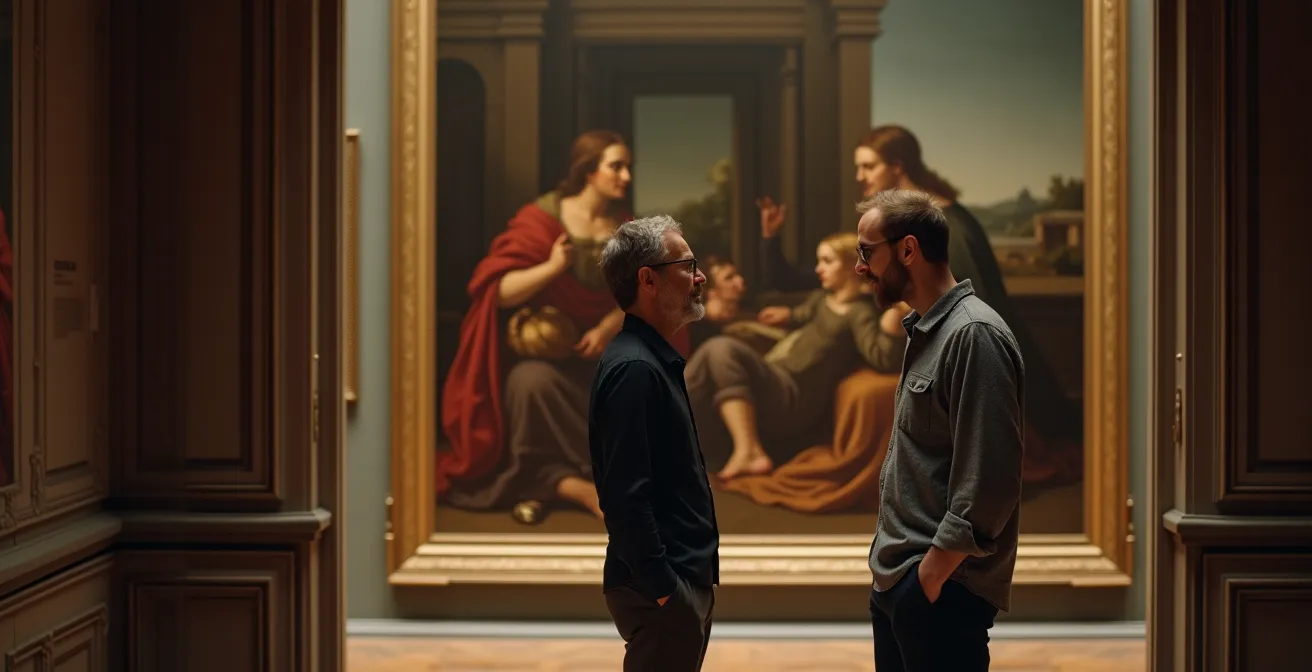
This strategy is executed through several channels. Social media campaigns should be led with content featuring the contemporary artist—interviews, studio visits, and videos where they discuss their fascination with a particular Renaissance piece. This creates an authentic “hook” for their followers, who are then introduced to the historical art through a trusted voice. As some museums discovered, using viral formats like TikTok videos with curators using Gen Z slang can lead to millions of views and translate into higher visitation by being authentic and transparent.
Beyond digital marketing, this approach opens up new revenue streams. Co-branded merchandise, limited edition prints co-signed by the artist, and high-value patronage events built around the artist’s network can generate income that extends far beyond ticket sales. By positioning the contemporary artist as a bridge to the past, the institution can leverage their brand to not only sell tickets but also to cultivate a new generation of supporters for its entire collection.
How to design a gallery workshop that appeals to teenagers who hate museums?
The perception of museums among many teenagers is one of dusty, silent halls where they are expected to be quiet and reverent—an environment fundamentally at odds with their digitally-driven, participatory culture. To bridge this gap, a workshop cannot be a passive lecture or a simple “art-making” session. It must be an act of audience activation, designed to tap into the creative behaviors they already practice online.
The strategic insight is simple but powerful: stop trying to make them love museums on your terms and start engaging them on theirs. Data shows that approximately 58% of Gen Z individuals create and share their own videos online. They are not passive consumers; they are active creators, commentators, and remixers. A successful workshop must therefore provide the tools and the permission to interact with art in the same way they interact with all other content: by making it their own.
This means shifting the focus from art appreciation to content creation. Instead of explaining the symbolism in a Renaissance painting, challenge them to “meme-ify” it by creating their own reaction GIFs. Instead of a lecture on sculpture, teach them basic projection mapping techniques so they can project images from their own phones onto 3D replicas. The workshop becomes a laboratory for them to apply their digital skills in a new context, using the museum’s collection as their raw material.
The goal is to foster a sense of ownership and community. By encouraging user-generated content through hashtags and challenges, the museum’s reach is amplified authentically. When a teenager shares a TikTok video they made during a workshop, it serves as a powerful peer-to-peer endorsement. The workshop’s success is measured not by how quietly the participants listened, but by how much content they created and shared. It repositions the museum from a place of passive consumption to a platform for active creation.
Your Action Plan: Designing a Teen-Centric Workshop
- Identify Target Behaviors: List the primary online activities of your target teen audience (e.g., creating memes, short-form video, playlists, online debates).
- Gather Raw Materials: Inventory the artworks in your collection that can be easily re-contextualized or are emotionally provocative, providing good material for remixing.
- Ensure Conceptual Coherence: Align the workshop activity with the core curatorial themes of the exhibition. The activity should be fun but also deepen understanding of the art.
- Test for Emotional Impact: Run a quick pilot. Does the activity spark laughter, debate, or surprise? If it feels like a school assignment, it’s too generic.
- Map the Sharing Pathway: Define a clear and simple plan for participants to share their creations (e.g., a unique hashtag, a contest, a feature on the museum’s social channels).
How to map a video onto a 3D sculpture without expensive software?
Projection mapping—the art of projecting video onto three-dimensional surfaces—is a powerful tool for creating a dialogue between digital and physical art. It can bring a static sculpture to life, overlaying it with motion, color, and narrative. However, the perceived cost and technical complexity of professional mapping software and high-end projectors can be a major barrier for institutions with limited budgets. The good news is that impactful projection mapping can be achieved with low-cost, creative, and accessible techniques.
The core principle is to think like a stage designer rather than a software engineer. It’s about controlling light, not just generating pixels. One of the most effective budget-friendly methods is to use multiple “pico” projectors—small, affordable projectors—controlled by open-source software like VPT (VideoProjectionTool). Instead of one expensive, high-lumen projector trying to cover a complex object, several smaller projectors can be aimed at specific facets of the sculpture, creating a more precise and manageable effect.
Another powerful low-tech technique involves creating physical cardboard “masks” or gobos. By cutting shapes out of cardboard and placing them in front of the projector lens, you can precisely block light spill and control the boundaries of the projection. This old-school method gives you an incredible amount of control without touching a line of code. For static patterns, you can even repurpose old slide projectors with custom-cut stencils. This DIY approach encourages experimentation and can produce surprisingly sophisticated results.
For alignment, a DSLR camera’s live view feed connected to a laptop can be an invaluable tool. It allows you to manually and precisely align the corners of your video with the edges of the sculpture. Even a smartphone flashlight combined with a stencil can be used for small-scale, detailed mapping effects. As the trend of incorporating interactive elements like AR and VR grows, these low-cost experiments are vital. They allow curators to explore the potential of digital art integration and develop a proof-of-concept before investing in more expensive technology, making the dialogue between eras accessible to any institution.
Key takeaways
- Conceptual Resonance Over Aesthetics: The most powerful exhibitions are built on deep thematic connections, not superficial visual similarities.
- Technology as a Tool for Dialogue: Use digital tools like AR and projection mapping to facilitate new interpretations and audience participation, not as mere novelties.
- Engagement Through Co-Creation: True audience activation, especially with younger demographics, comes from empowering visitors to become creators and share their own perspectives on the art.
How to Increase Visitor Diversity in Public Galleries with Zero Budget?
For many public galleries, the mission to increase visitor diversity often seems at odds with the reality of zero-budget constraints. Traditional outreach—advertising, paid events, and large-scale programming—is simply not an option. However, this limitation can force a strategic shift from “marketing to” communities to “partnering with” them. The most powerful assets a museum has are not financial; they are its space, its collection, and its expertise. These can be leveraged to build authentic, reciprocal relationships that naturally lead to a more diverse audience.
The core strategy is to move from a model of consumption to one of participatory engagement. This involves inviting community groups to become active collaborators in the museum’s work. Instead of just asking them to attend, ask them to co-curate a small section of an exhibition or to write “alternative” labels for artworks that reflect their own cultural perspectives and life experiences. This approach, as highlighted in studies on youth engagement in museums, fosters a profound sense of ownership and belonging. A Latvian study on participatory engagement with Gen Z found that young people are eager for meaningful involvement that goes beyond passive consumption.
Another zero-budget strategy is to establish skill-swap agreements. The museum can offer its assets—such as the use of a hall for a community meeting, a free lecture from a curator for a local group, or access to its archives for a student project—in exchange for promotion within that community’s networks. This builds goodwill and turns community leaders into the museum’s most effective ambassadors. Outreach can be further amplified by leveraging free platforms like public radio shows, community newsletters, and local library bulletin boards, which are often eager for quality cultural content.
Finally, transparency is a powerful and free tool for building trust, especially with younger, savvier audiences who value authenticity. Simply listing staff and their contact information on your website, as noted by the AAM, signals an openness to dialogue. By dismantling the institutional barriers and repositioning the gallery as a shared community resource, you can cultivate a more diverse and engaged visitor base without spending a single dollar.
Start by identifying one piece in your collection and ask: what contemporary dialogue could unlock its hidden value and invite a new community to the conversation?