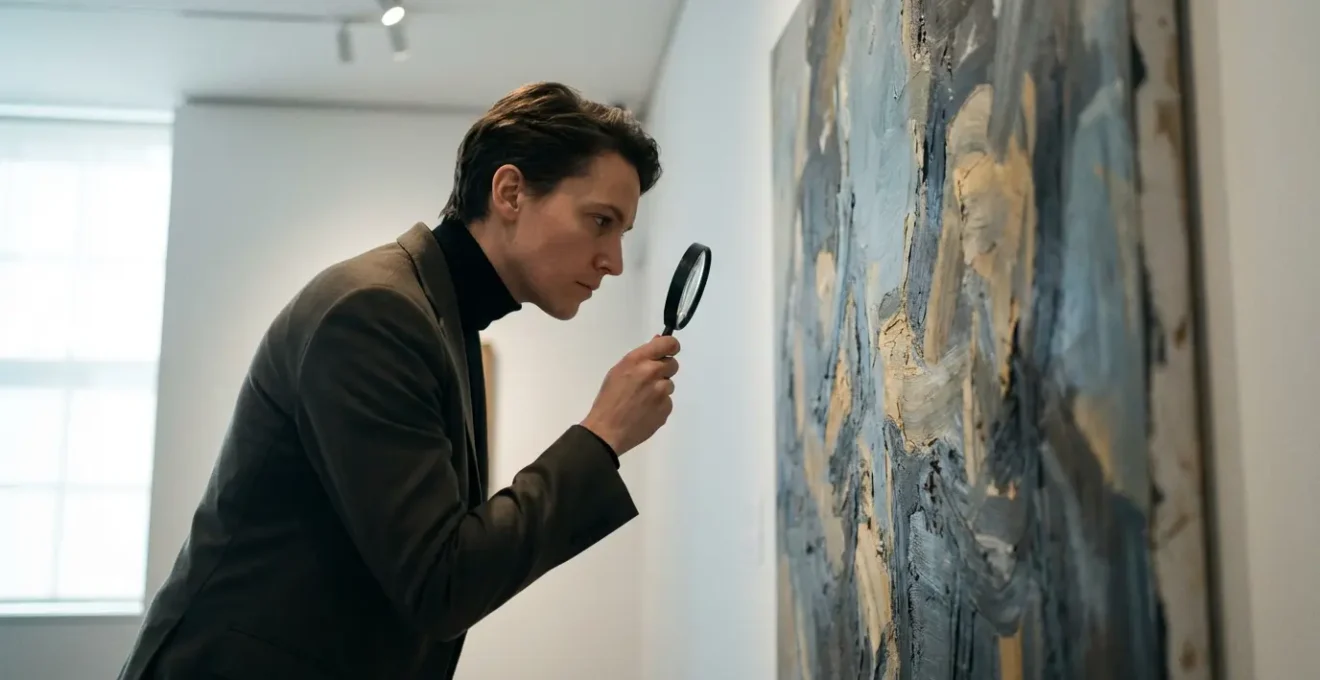
Valuing art with no sales data is a forensic process, not a guessing game; value is constructed from evidence, not found on a database.
- Compare the work to documented peers of similar quality and period, not to famous masters, to establish a realistic market proxy.
- Reconstruct the artist’s career using archival research to prove a primary market history, which is a critical asset.
Recommendation: Treat every appraisal of an unknown artist as a case to be built, where the provenance narrative and intrinsic quality indicators are your key exhibits.
For an appraiser or estate executor, encountering a competent, compelling painting by an artist with no auction record is a common yet complex challenge. The usual tools of market analysis—auction results, artist indices, sales databases—are absent. The immediate temptation is to either dismiss the work as having nominal value or, swayed by its quality, to hazard a wild guess based on a famous name it vaguely resembles. Both approaches are flawed and unprofessional. The standard advice to “get a professional appraisal” is obvious, but it fails to illuminate the rigorous methodology an expert must employ when standard data is unavailable.
The truth is that valuing a work “in the dark” is less about finding a price tag and more about becoming an investigator. It requires a shift in mindset from data retrieval to evidence construction. Instead of searching for a direct comparable, the goal is to build a logical, defensible case for value based on a matrix of indirect factors. This process involves a deep dive into art history, a forensic examination of the object itself, and a strategic understanding of market mechanics. It is a structured investigation into the artwork’s intrinsic quality, its historical footprint, and its potential place within the larger art ecosystem.
This guide abandons the futile search for non-existent data. Instead, it provides the forensic framework required to build a valuation from the ground up. We will explore how to establish value through peer comparison, unearth historical evidence, differentiate between valuation types, and navigate the psychological and strategic challenges inherent in bringing an unknown work to market. This is the professional’s methodology for transforming an unknown quantity into a quantifiable asset.
This article details the investigative steps necessary to build a credible valuation for an artwork by an artist without a public sales history. The following sections break down this forensic process, from initial quality assessment to final sales strategy.
Summary: A Forensic Guide to Appraising Unlisted Art
- Why you must compare an unknown artist to their documented peers, not the masters
- How to find old gallery catalogs to prove an artist had a primary market career
- Insurance Value vs. Resale Value: Why the numbers are different for the same painting
- The emotional error that inflates the price and prevents the art from selling
- When to sell at auction vs. private treaty: choosing the right venue for obscurity
- Carbon dating vs. Pigment analysis: Which method is foolproof for 20th-century art
- Roman glass vs. Egyptian faience: Which holds value better in a volatile market
- How to Build a Career as an Independent Art Historian Outside Academia
Why You Must Compare an Unknown Artist to Their Documented Peers, Not the Masters
The most common mistake in valuing an unknown artist is aspirational comparison. An appraiser might note that a regional landscape painter from the 1970s has a style “similar to” a well-known Impressionist and incorrectly anchor the valuation to the master’s multi-million dollar market. This creates an indefensible and unrealistic price point. The correct approach is a form of comparative forensics, where the goal is to identify a “market proxy”—a documented artist of a similar period, region, quality level, and school who has a modest but established auction record. This peer group, not the masters, provides the realistic benchmark for valuation.
The objective is not to find an identical match but to establish a tier of quality and market recognition. Is your unknown artist a competent follower of a regional school? Then their peers are other competent followers of that school, not the school’s founder. This requires connoisseurship: a deep, objective analysis of the work’s intrinsic qualities. Judging these qualities provides the evidence needed to place the work within a specific peer group. A systematic approach is essential to move beyond subjective “I like it” statements toward a defensible quality assessment.
Action Plan: Auditing Intrinsic Quality
- Assess foundational skill: Examine the line work and form. Is the draftsmanship confident and decisive, or is it hesitant and amateurish? Professional artists exhibit control and intention.
- Analyze composition and space: How does the artist use positive and negative space? Is the composition balanced, dynamic, and complex, or is it simple and static?
- Evaluate technical execution: Look at the texture and application of the medium (e.g., paint). Are the brushstrokes varied and used to create form and depth, or are they flat and uniform?
- Check the color palette: Assess the sophistication of the color theory. Does the artist use a nuanced palette to create mood and light, or are the colors primary and unmixed?
- Formulate a quality hypothesis: Based on these points, place the artist’s skill on a spectrum from amateur to accomplished regional professional. This justifies the selection of their market-proxy peers.
By focusing on these intrinsic value indicators, an appraiser can build a logical argument. For example: “While the artist is unknown, the decisive line work and complex use of negative space are comparable to Artist X and Artist Y, who have an established secondary market in the $5,000-$8,000 range.” This methodology grounds the appraisal in observable evidence rather than hopeful association, forming the first and most critical plank in your valuation hypothesis.
How to Find Old Gallery Catalogs to Prove an Artist Had a Primary Market Career
An auction record is a measure of secondary market activity, but its absence does not mean the artist had no career. The next investigative step is to prove the existence of a primary market career: evidence that the artist was professionally active, exhibited, and sold work through galleries during their lifetime. Old gallery catalogs, exhibition announcements, and art reviews are gold-standard evidence for building a provenance narrative. Finding these documents transforms an artist from a total unknown into a “historically documented” figure, significantly impacting their value.
The search begins in digital archives and specialized art research libraries. Institutions have been digitizing vast amounts of ephemera that were once buried in physical archives. The key is to search strategically, using the artist’s name in conjunction with dates and geographic locations associated with their life and work. This digital sleuthing can unearth a solo show announcement from a 1960s regional gallery or a mention in a group exhibition review, each piece adding a layer to the artist’s professional history. For example, resources like the Getty Research Portal aggregate global access to over 40,000 digitized art history texts, providing a powerful starting point for this research.
This research serves two purposes. First, it confirms the artist’s professional standing. Second, it can provide crucial information, such as original prices listed in a catalog. While a price from 50 years ago is not a direct valuation, it is a powerful piece of evidence proving the work had commercial value from its inception. An appraiser can then adjust this historical price for inflation and market changes to help build a contemporary valuation model. The discovery of a primary market history is often the turning point in an appraisal, providing the first concrete external validation of the artist’s significance.
Insurance Value vs. Resale Value: Why the Numbers Are Different for the Same Painting
Once you begin to formulate a price, it’s critical to define what kind of value you are assessing. For an appraiser or executor, the two most common types are Insurance Value and Fair Market Value (or Resale Value). They are not interchangeable, and confusing them can lead to significant errors. Insurance Value, or Replacement Value, is typically the highest figure. It represents the cost to replace the artwork with one of like-kind and quality in a retail setting (i.e., from a gallery). This value anticipates a longer search time and a higher “retail” price, as one cannot simply buy a replacement at auction tomorrow.
Fair Market Value (FMV), in contrast, is the price at which a property would change hands between a willing buyer and a willing seller, neither being under any compulsion to buy or sell and both having reasonable knowledge of relevant facts. This is effectively the “resale value” and is what you could realistically expect to achieve at auction or in a private sale in the current market. FMV is almost always lower than Insurance Value. For an unknown artist, the FMV must account for the challenges of marketing and the smaller pool of potential buyers. While public auctions are highly visible, it’s important to note that a significant portion of the art market operates privately. An appraisal for FMV must consider that only a fraction of the market is public, with recent analysis suggesting 66% of sales happen privately, away from auction spotlights.
This distinction is crucial in practice. An executor might see a high insurance value on a policy and mistakenly believe it’s the artwork’s achievable sale price, leading to unrealistic expectations and failed sales. Conversely, insuring a piece at its lower FMV could leave an owner underinsured in case of loss. The appraiser’s job is to clearly articulate which value is being determined and for what purpose. For an unknown artist, the Insurance Value might be based on the retail prices of their market proxy peers, while the FMV would be based on those same peers’ more modest auction results.
The Emotional Error That Inflates the Price and Prevents the Art from Selling
Perhaps the greatest obstacle to objectively valuing an inherited or long-held artwork is emotional attachment. The fact that a painting hung in a family home for generations or was a gift from a beloved relative imbues it with significant personal history and sentimental worth. This is the “emotional value,” a powerful but non-marketable component of an artwork’s perceived worth. An owner’s conviction that a piece is a “masterpiece” because of its personal significance is a common psychological bias that leads to inflated price expectations and ultimately prevents a successful sale.
As an appraiser, addressing this emotional component with empathy and objectivity is paramount. It is not about dismissing the owner’s feelings but about gently separating them from the market reality. As Dr. Abigail Adeyemi notes in the MoMAA Art Valuation Guide:
Inherited works or gifted pieces often carry legacy and memory, which, while not marketable, still impact your perception of the piece’s worth.
– Dr. Abigail Adeyemi, MoMAA Art Valuation Guide
The appraiser’s report serves as an objective, third-party tool to recalibrate these expectations. It grounds the conversation in facts: the artist’s lack of an auction record, the quality assessment relative to peers, and the realities of the secondary market for unlisted artists. Presenting a well-researched valuation hypothesis provides the owner with a clear, logical framework that stands in contrast to their emotional attachment, helping them understand the difference between what the art *means* to them and what it is *worth* to the market.
Case Study: The Family Heirloom Reality Check
A family in possession of a Ghanaian heirloom believed it to be highly valuable due to its long history within their family. An objective appraisal determined its market value was under €100. While initially disappointing, the professional report provided two crucial benefits. First, it helped the family focus on preserving the object for its historical and sentimental significance rather than for financial gain. Second, this documented, realistic valuation prevented them from being scammed by a fraudulent “buyer” who had offered an inflated price as part of an advance-fee fraud scheme.
By acknowledging the sentimental value while clearly and professionally delineating the fair market value, the appraiser protects the client from both disappointment and potential fraud, guiding them toward a realistic and successful outcome.
When to Sell at Auction vs. Private Treaty: Choosing the Right Venue for Obscurity
With a defensible Fair Market Value established, the final strategic question is choosing the right sales venue. The two primary channels are public auction and private sale (also known as a private treaty). Each has distinct advantages and is suited to different types of artwork. For a newly researched artist without name recognition, this choice is particularly critical and can mean the difference between a successful sale and a “burned” artwork that fails to find a buyer.
Public auction offers transparency and the potential for competitive bidding to drive up the price. However, it is a high-risk venue for an unknown artist. Auctions thrive on recognizable names and trends. An unknown work may be overlooked or “bought-in” (fail to sell), which attaches a public stigma of failure to the piece, making it much harder to sell later. Private treaty, on the other hand, is a discreet sale negotiated between a seller’s agent (a gallery or dealer) and a potential buyer. This allows for storytelling. The agent has time to present the research, build the provenance narrative, and explain the artist’s significance to a curated list of collectors who specialize in that period or style. This method is often more suitable for works whose value is based on connoisseurship and historical context rather than brand recognition.
Recent market trends underscore this distinction. While high-profile auctions capture headlines, the private market is a formidable force, particularly for nuanced sales. The following table provides a clear comparison of the two channels’ recent performance and best use cases.
| Sale Method | Best For | 2024 Performance | Success Rate |
|---|---|---|---|
| Public Auction | Known artists, trendy styles | Overall volumes fell | An 82% sell-through rate in day sales |
| Private Treaty | Story-driven pieces, unknown artists | Increased by 14% to $4.4 billion | Not disclosed |
For an unknown but high-quality artist, a private treaty sale through a specialized dealer is often the superior strategy. It minimizes risk and maximizes the opportunity to “make the case” for the artist’s value to the right audience, leveraging the very research and valuation work you have just completed.
Carbon Dating vs. Pigment Analysis: Which Method Is Foolproof for 20th-Century Art?
The short answer is that no scientific method is entirely foolproof, but for 20th-century art, pigment analysis is vastly more useful and precise than carbon dating. While connoisseurship and provenance research form the core of a valuation, scientific analysis can provide critical, objective data to support or refute an attribution or dating, especially when questions of authenticity arise. Understanding which test to use, and what it can realistically tell you, is key.
Carbon-14 dating is most effective for organic materials (like canvas, wood panels, or paper) and is used to determine an approximate age. However, its margin of error can be several decades or more, making it too imprecise for dating a work to a specific decade within the 20th century. Furthermore, it can be contaminated by later restorations or varnishes. Its primary use is to unmask blatant forgeries, for example, by proving a canvas supposedly from 1920 was actually made from cotton grown in the 1980s. It cannot, however, distinguish a genuine 1950 painting from a fake made in 1960 on old canvas.
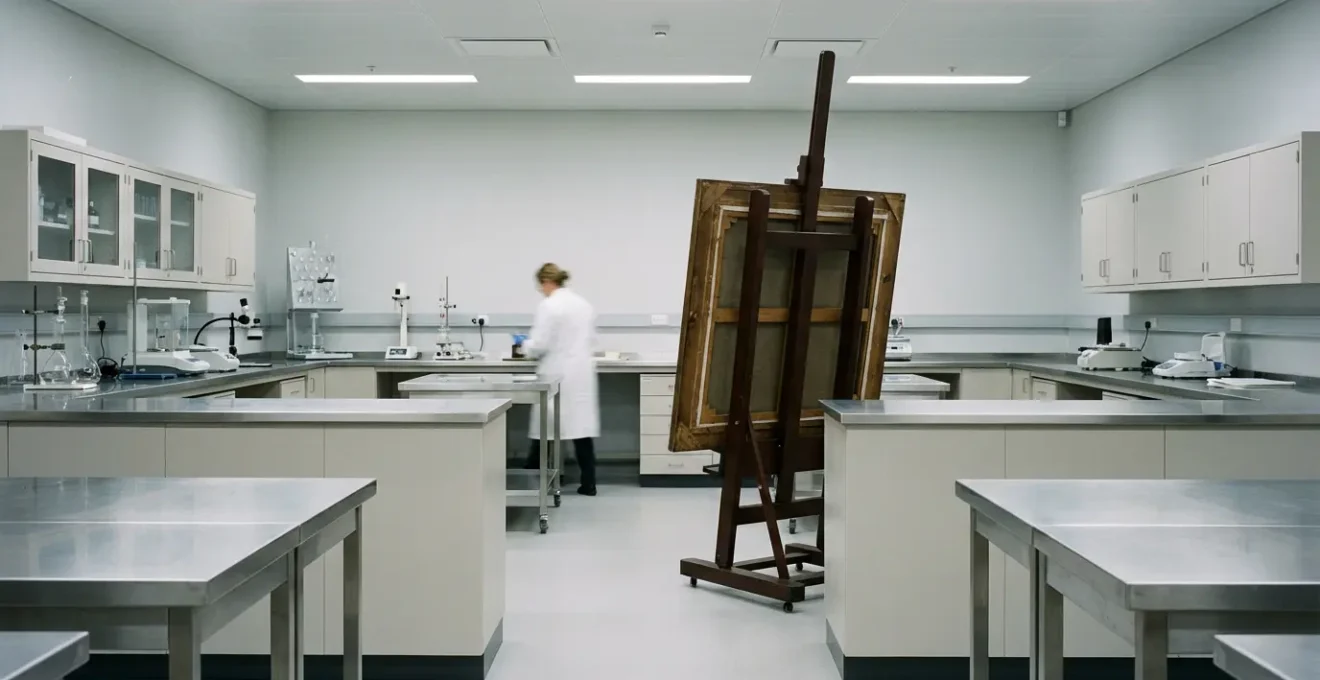
Pigment analysis, on the other hand, is a cornerstone of modern authentication. Techniques like Raman spectroscopy or X-ray fluorescence (XRF) can identify the precise chemical composition of the pigments used. Since the invention and commercial availability of specific pigments are meticulously documented, finding a pigment that was not available at the supposed time of creation is definitive proof of a fake. For instance, if a painting attributed to the 1930s contains Titanium White PW6 pigment that was only commercially perfected in the late 1940s, the dating is incorrect. This provides a hard, scientific terminus post quem (the earliest possible date) for the work, offering much more granular and actionable information than carbon dating for 20th-century objects.
Roman Glass vs. Egyptian Faience: Which Holds Value Better in a Volatile Market?
While seemingly unrelated, the market dynamics of antiquities like Roman glass and Egyptian faience offer a powerful analogy for valuing a 20th-century painting by an unknown artist. This comparison teaches a crucial lesson about how rarity, condition, and a dedicated collector base determine value stability in any market segment, especially volatile ones. The question is not just “is it old?” but “who cares about it and why?” The same principle applies to your unlisted painting: its value is tied to its ability to find a niche collector base.
Roman glass is relatively common; it was produced in vast quantities. Its value is therefore highly dependent on exceptional condition, color, or form. A standard piece may have modest value, while a perfect example can be highly sought after. Egyptian faience, a non-clay ceramic, is generally rarer, and pieces associated with specific dynasties or pharaohs carry a heavy premium driven by historical significance. This illustrates a key principle: value is a function of scarcity and desirability within a specific category. A work’s value is not absolute but is relative to its specific collecting field. The overall art market can be in flux, as shown by the AMR All Art Index standing at 87,486 in early 2024, but niche markets can behave differently.
This concept is directly applicable to an unknown 20th-century artist. Your goal is to position the painting not as a “generic painting” but as an excellent example of a specific, niche category (e.g., “mid-century West Coast abstraction,” “post-war figurative realism from the Ohio region”). By identifying and targeting the small but dedicated group of collectors who focus on that niche, you are essentially creating a “faience market” for your painting, where it can be appreciated for its specific historical and artistic context. This is far more effective than competing in the broad, “Roman glass” market of general decorative pictures. This reinforces a lesson from the contemporary market: a print by a well-known artist is often worth more than an original painting by an unknown one, demonstrating that market recognition within a category is a powerful driver of value.
Key Takeaways
- Valuation without auction data is an evidence-building process, not a search for a matching price.
- Compare the work to documented, regional peers of similar quality—not famous masters—to establish a realistic “market proxy.”
- Proving a primary market history through archival research transforms an artist from an unknown into a documented figure, adding significant value.
How to Build a Career as an Independent Art Historian Outside Academia
The rigorous process of appraising a painting by an unknown artist—involving connoisseurship, archival research, market analysis, and scientific literacy—is, in essence, the work of an independent art historian. For an appraiser or executor who develops a passion and skill for this work, it can be the foundation of a rewarding career outside the traditional confines of academia. This path leverages investigative skills to serve the art market, private collectors, foundations, and legal firms.
A career as an independent art historian or appraisal consultant is built on a reputation for diligence and objectivity. It requires mastering a specific set of research tools and methodologies. These professionals are not just giving opinions; they are providing certified, defensible reports that can have significant financial and legal weight. This involves becoming proficient with specialized databases, such as Benezit Dictionary of Artists for biographies, and auction record databases like askART for comparative analysis. It also means knowing how to access and interpret primary source documents, like the historical sales catalogues available through the Wildenstein Plattner Institute.
This career path is exemplified by professionals like Elizabeth Stewart, PhD, AAA, a certified member of the Appraisers Association of America. Her title itself demonstrates the combination of academic training (PhD) and professional certification (AAA) that builds authority. Building such a career involves continuous learning, networking with dealers and auction house specialists, and developing a specialization in a particular period or region. The demand for experts who can navigate the space between academic knowledge and market reality is constant. The ability to produce a meticulously researched report on an unknown artist is not just a one-off task; it is a highly valuable, marketable skill.
By following this structured, forensic approach, you transform a challenging task into a professional service. The next logical step is to formalize this process by obtaining certifications and building a network within the art appraisal community, turning specialized knowledge into a sustainable career.