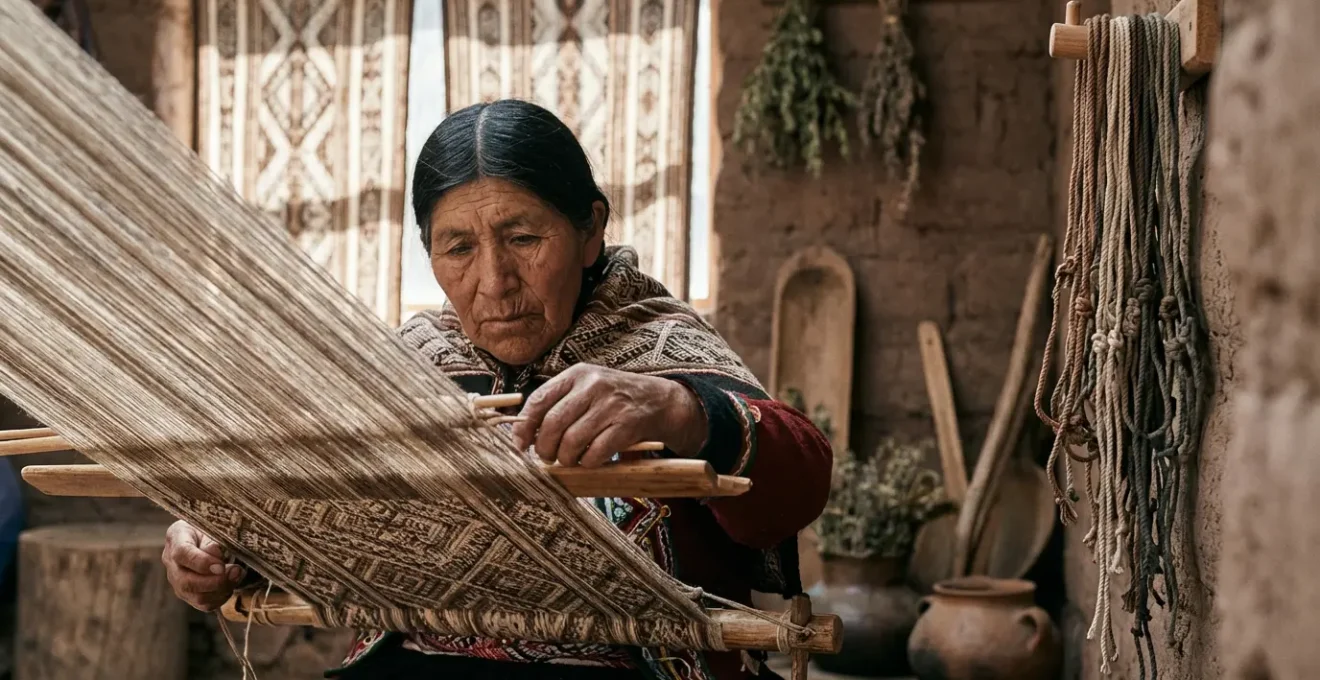
The physical structure of ancient Andean textiles was not merely a canvas for information, but a sophisticated data architecture in itself.
- High thread counts and specific weaving techniques created a high-density medium for complex data, far surpassing contemporary technologies.
- The integrity of this data was directly linked to the textile’s physical preservation, making conservation a form of data recovery.
Recommendation: To understand these artifacts, one must analyze them as engineered data storage devices, where material, structure, and symbol are inextricably linked.
Long before silicon chips and binary code, the Inca and their predecessors in the Andean highlands of South America developed a profound method of information management. They recorded everything from census data to historical narratives not with ink on paper, but with knots and colors in thread. These devices, known as khipus (or quipus), are often described as a form of three-dimensional writing or an abacus-like calculation tool. While this is true, it only scratches the surface of a much deeper technological brilliance.
Most discussions of khipus focus on the symbolism of the knots and the meaning of the colors. These are, of course, critical components of the code. However, this common perspective often overlooks the foundational genius of the system: the textile itself as a piece of data architecture. The very fibers, the tension of the weave, and the density of the threads were not passive elements but active participants in the storage, complexity, and durability of the information. This was a system where the physical medium was inseparable from the message.
To truly decipher these ancient computers, we must look beyond the knots and delve into the material informatics of their construction. This perspective reveals that the choices made by the weaver—from fiber selection to loom technique—were as crucial as the mathematical code they were recording. The textile was not just a container for data; it was an integral part of its operating system. This article explores how the physical and structural properties of these textiles were the key to their function as one of history’s most unique and sophisticated data systems.
In this exploration, we will unravel the intricate relationship between the physical form of Andean textiles and their function as data carriers. The following sections break down how material choices, weaving techniques, and preservation methods are fundamental to understanding this ancient technology.
Summary: How Ancient Andean Weavers Coded Data into Textiles Before Computers?
- Why the thread count in historical textiles determines the complexity of the narrative?
- How to display cochineal-dyed wool without it turning grey in UV light?
- Body-tension weaving vs. Machine weaving: Which produces tighter, more durable cloth?
- The moth infestation error that eats holes in your tapestry collection
- How to roll a textile to prevent permanent creasing and fiber breakage?
- How to date a painting solely by the construction of its stretcher bars?
- Hanging racks vs. Flat drawers: Which is better for framed works on paper?
- Why UV filtering glass is not enough to stop all light damage?
Why the thread count in historical textiles determines the complexity of the narrative?
In digital terms, thread count is the resolution of the textile “screen.” A higher thread count—more warp and weft threads per square inch—creates a denser, more stable fabric. For Andean weavers, this was not just an aesthetic choice; it was a direct expansion of their data storage capacity. A denser weave allowed for more intricate patterns, finer distinctions in color, and a greater number of knots to be placed in close proximity. This physical density directly translated to informational density, enabling the recording of more complex datasets and nuanced narratives.
The mastery of the Incas in this domain was unparalleled. While European textiles of the same period were considered high-quality, the finest Inca cloth, or qompi, was in a league of its own. It is documented that the finest Inca cloth achieved a remarkable thread count exceeding 600 threads per inch, a feat of technical skill that was not surpassed globally until the Industrial Revolution. This exceptionally high resolution provided a rich substrate for the khipu’s layered coding system, where every millimeter could hold significance. It allowed for a level of detail that a looser, lower-resolution weave simply could not support.
Modern research continues to uncover how these structural elements encoded information beyond simple numbers. The physical architecture of the khipu held layers of metadata, a concept brilliantly illustrated by a recent discovery.
Harvard’s breakthrough in khipu data decoding
In a groundbreaking discovery, Harvard student Manny Medrano and Professor Gary Urton decoded six khipus by matching them to a colonial-era Spanish census document. They discovered that the way pendant cords were attached to the main cord—a purely structural feature—indicated the social group affiliation of the individuals being counted. This was the first time a non-numerical, narrative element was definitively proven to be encoded in the khipu’s physical construction, showing that the textile’s architecture was as meaningful as its knots.
Thus, thread count is not a passive quality but the very foundation of the textile’s narrative power. It defines the bandwidth of the medium, determining whether the weaver could create a simple ledger or a complex, multi-layered document.
How to display cochineal-dyed wool without it turning grey in UV light?
The vibrant crimson and scarlet hues of Andean textiles are one of their most defining features, often derived from the cochineal insect. This dye was a precious commodity, creating colors that signified status, region, and meaning within the khipu’s code. However, this brilliant color is also exceptionally fragile. Cochineal is highly sensitive to light, particularly the ultraviolet (UV) spectrum. Prolonged exposure causes a chemical reaction that irrevocably fades the rich red to a dull, washed-out grey, effectively erasing a layer of encoded information.
Protecting these colors is a primary concern in textile conservation. The process is far more complex than simply placing the textile in a dim room. Museums employ a multi-faceted strategy of light management. This includes using specialized, low-UV LED lighting, installing UV filters on all light sources and display cases, and, most importantly, strictly limiting the total amount of light exposure over time. The cumulative effect of light is measured in lux-hours, and each textile has a lifetime “budget” of light it can be exposed to before unacceptable damage occurs.
The sensitivity is so profound that even in controlled research settings, light is used with extreme caution. To create reference samples for studying age and degradation, museum studies show that cochineal-dyed textiles require approximately 80 hours of controlled light exposure to simulate natural aging. This highlights how even a few days of improper display can cause centuries’ worth of damage.
This image demonstrates the highly controlled environment required for the preservation of these delicate artifacts, where light itself is treated as a potential contaminant.
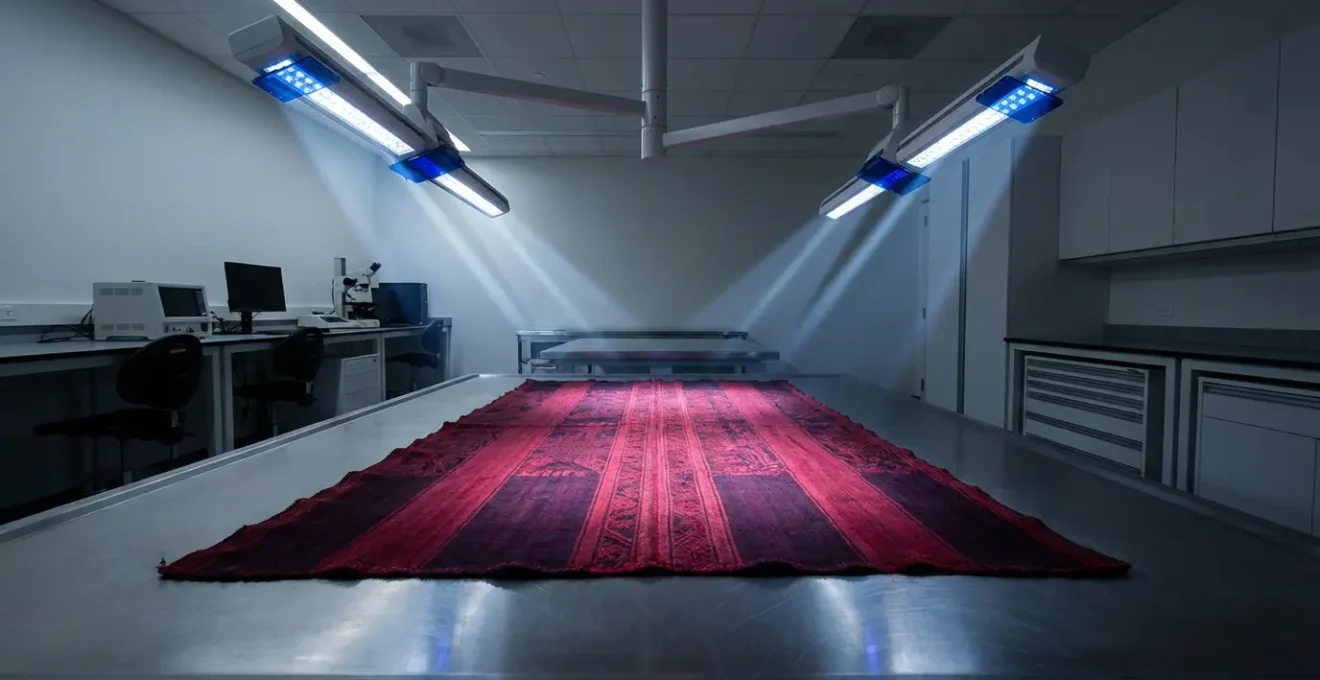
As you can see, the preservation of color is an active, scientific process. For a collector, this means any display must be in a location with no direct sunlight and preferably with UV-filtering glass or acrylic in the frame. Even then, rotation and periods of rest in complete darkness are essential to preserve the integrity of the color data.
Body-tension weaving vs. Machine weaving: Which produces tighter, more durable cloth?
The exceptional durability and tightness of ancient Andean textiles can be attributed to the primary tool used in their creation: the body-tensioned loom, also known as a backstrap loom. In this deceptively simple setup, one end of the loom is tied to a post or tree, while the other is attached to a strap around the weaver’s back. The weaver creates tension by leaning forward or backward, allowing for incredibly precise, hands-on control over the tightness of every single thread. This haptic feedback loop between the weaver’s body and the textile is something a machine loom, with its standardized, mechanical tension, cannot replicate.
This method allows the weaver to pack the weft threads down with immense force, creating a warp-faced fabric that is extraordinarily dense and hard-wearing. The result is a tighter, more robust cloth than most machine-woven fabrics. The deep connection to the process meant that a modern Andean weaver creating a complex pattern might only accomplish about one inch of weaving per day. This slow, deliberate pace enabled a level of precision and density that prioritized durability and data integrity over speed.
When compared to European loom technologies of the same era, the superiority of the Andean body-tension method for creating fine tapestries becomes even more apparent. It wasn’t just a different technique; it produced a structurally different and often superior product.
Structural superiority of Andean weaving
Analysis of ancient textiles reveals key differences between Andean and European weaving. Techniques like the scaffold weave were unique to the Andes. Furthermore, Andean tapestries were woven with finer yarns and packed much more tightly than their European counterparts. Crucially, they were often perfectly finished on both sides, making them reversible “documents.” This demonstrates a level of craftsmanship and structural integrity, achieved through body-tension methods, that was focused on creating a durable, high-quality information object.
Therefore, while machine weaving offers unparalleled speed and uniformity, body-tension weaving excels in producing a cloth of superior density and durability. The weaver’s direct physical control over tension creates a fabric that is not just woven, but engineered for longevity—a critical feature for a device intended to store valuable data for generations.
The moth infestation error that eats holes in your tapestry collection
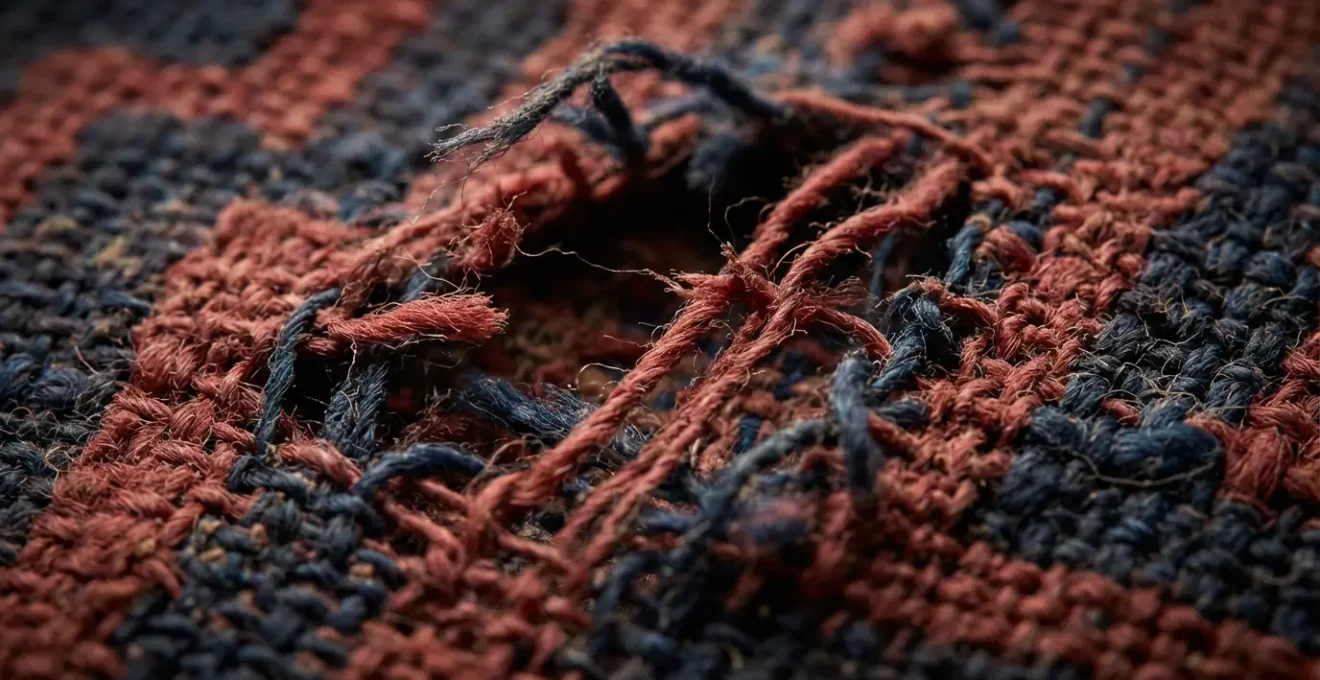
For any collection of wool or cotton artifacts, the most insidious threat is not time, but biology. The larvae of the common clothes moth (Tineola bisselliella) and carpet beetle see historical textiles not as priceless cultural heritage, but as a protein-rich meal. An infestation can begin with a single, unnoticed moth laying eggs. Weeks later, the larvae hatch and begin to consume the fibers, creating holes and severing threads. In the context of an Andean textile, this is not mere physical damage; it is catastrophic data corruption. Each broken thread can represent a lost number, a severed link in a genealogical record, or a gap in a celestial map.
The vast majority of khipus and other ancient textiles have been lost over the centuries. While many were deliberately destroyed during the Spanish conquest, countless others succumbed to environmental decay and pests in non-ideal climates. Researchers estimate that only about 1,600 khipus survive today in collections around the world, a tiny fraction of the thousands that once existed. This makes the prevention of further loss a critical mission for museums and collectors alike.
The visual evidence of this data loss is stark. What appears as a simple hole is, in fact, a void in the historical record, as seen in this macroscopic view of damaged fibers.
Preventing this “error” requires a proactive strategy known as Integrated Pest Management (IPM). This involves meticulous cleanliness in storage areas, regular inspection of artifacts for any signs of larval cases or frass (insect droppings), and maintaining a cool, dry environment, as moths thrive in warmth and humidity. Any new acquisition should be quarantined and inspected before being introduced to a collection. In museums, newly acquired or infested textiles are often placed in purpose-built freezers, as a controlled deep freeze cycle kills eggs, larvae, and adult insects without harming the textile fibers.
How to roll a textile to prevent permanent creasing and fiber breakage?
Storing a large textile presents a physical dilemma. Folding it creates sharp, permanent creases that will eventually break the aged and fragile fibers along the fold lines. For a khipu, a fold can distort the precise spatial relationships between cords, corrupting the encoded data. The standard museum practice to avoid this is rolling the textile around a wide-diameter, acid-free tube. This method supports the textile evenly and prevents the formation of hard creases, distributing the stress across a gentle curve.
The process must be done with care. First, the textile is laid flat, and any debris is gently removed. It is then interleaved with acid-free tissue paper, which cushions the fibers and prevents layers from rubbing against each other. The textile is then carefully and evenly rolled onto the tube, ensuring the tension is firm but not tight. The roll should never be loose or sloppy, as this can cause sagging and distortion. Finally, the rolled textile is wrapped in a breathable material like unbleached muslin to protect it from dust while allowing for air circulation.
However, for the most complex textile documents like khipus, even rolling is now considered a compromise. The ideal is to store them completely flat, preserving their three-dimensional structure exactly as it was intended. This philosophy treats the object not as a tapestry to be rolled, but as a document to be filed.
Museums like Dumbarton Oaks often opt for custom flat storage where khipus are laid out with their cords carefully arranged, treating the khipu not as a textile to be hung, but as a complex document to be preserved in its ‘native’ spatial format.
– Juan Antonio Murro, Dumbarton Oaks Museum – Written in Knots Exhibition
For collectors and institutions, this presents a clear hierarchy of storage methods. While flat storage is the gold standard for preserving data integrity, rolling is a far superior alternative to the destructive act of folding. The key is to minimize stress on the fibers at all costs.
Action plan: Key principles for textile preservation
- Assess and Document: Before storage, thoroughly document the textile’s condition, size, and material. Photograph any existing damage or unique features.
- Prepare the Environment: Choose a storage location that is cool, dry, and dark. Ensure the area is clean and part of an Integrated Pest Management program.
- Select Proper Materials: Use only acid-free, archival-quality materials. This includes acid-free rolling tubes, tissue paper for interleaving, and unbleached muslin for an outer dust cover.
- Execute the Roll: Lay the textile flat and interleave with tissue. Roll evenly and firmly, but not tightly, onto a wide-diameter tube. Ensure there are no wrinkles or sagging.
- Plan for Long-Term Care: Label the stored textile clearly. Plan to unroll and inspect it periodically (e.g., annually) to check for any signs of stress or pest activity, and to allow the fibers to relax.
How to date a painting solely by the construction of its stretcher bars?
In art conservation, the physical structure supporting a canvas—its stretcher bars—can be a key clue to its age and origin. The type of wood, the style of the corner joints, and the method of expansion all changed over time, providing a form of “structural metadata.” This same principle of dating an object by its physical architecture is even more critical when analyzing ancient Andean textiles, which lack written dates or signatures. Here, the “stretcher bars” are the very threads, knots, and weaving techniques themselves.
Textile historians and archaeologists can establish a chronology by identifying shifts in material and structure. For instance, the transition from Z-twist (clockwise) to S-twist (counter-clockwise) yarns, or a change in the dominant fiber from cotton to alpaca wool, can signify a specific time period or cultural influence. This is especially vital for the earliest textile artifacts, such as those from the Wari civilization, which predated the Inca. With fewer than a dozen complete Wari khipu existing in collections worldwide, every structural detail becomes an invaluable piece of chronological evidence.
The most significant structural shifts are those that reflect changes in the information system itself. The Inca, for example, standardized and modified the khipu systems they inherited from earlier cultures, and these modifications serve as clear chronological markers.
Structural metadata in Andean textile dating
When the Inca empire expanded, they adapted the existing Wari and Tiwanaku khipu systems to their own administrative needs. A key modification was the shift from a color-based system of encoding primary information to one that relied more heavily on a standardized, knot-based decimal system. For example, a Wari khipu might use a red cord to represent “warriors,” while an Inca khipu would more likely use a specific knot structure on an un-dyed cord. This fundamental change in the “operating system” is a clear chronological marker that allows experts to distinguish an earlier Wari artifact from a later Inca one.
Therefore, just as an art historian examines stretcher bars, an expert in Andean textiles analyzes the underlying structure of the weave. The twist of a cord, the ply of a yarn, and the logic of the knot system are the fingerprints of a specific time and place, allowing us to date these silent documents.
Hanging racks vs. Flat drawers: Which is better for framed works on paper?
For framed works on paper, the debate between hanging storage and flat storage often comes down to space efficiency versus ideal preservation. While hanging racks are space-saving, they place all the object’s weight on the top edge of the frame. For the far more complex and fragile case of three-dimensional Andean textiles like khipus, this question is not one of convenience, but of data integrity. The wrong choice can physically distort the artifact and corrupt the information it holds.
Hanging a khipu, as one might a tapestry, is extremely damaging. The sheer weight of the pendant cords, especially on a large khipu which can span meters and contain hundreds of cords, puts immense strain on the main horizontal cord. Over time, this force will stretch the primary cord, altering the precise spacing and hierarchy of the pendant cords. Since we now know that position and attachment methods are part of the code, this stretching is a form of data corruption. Hanging a khipu is akin to stretching a hard drive until the sectors no longer align.
For this reason, the undisputed best practice for long-term preservation is flat storage. Khipus are laid out in large, shallow drawers or on custom-made archival boards. This method provides even support, places no stress on the primary cord, and, most importantly, preserves the original three-dimensional spatial arrangement of all the cords. This allows researchers to study the artifact in its native format, without the distortion caused by gravity. The following table, based on museum conservation principles, summarizes the impact of each method.
| Storage Method | Impact on Data Structure | Best For | Risk Level |
|---|---|---|---|
| Hanging Display | Can stretch primary cord and alter spatial relationships of pendant cords | Short-term exhibition only | High – data corruption risk |
| Flat Storage | Preserves 3D structure and cord hierarchy intact | Long-term preservation | Low – maintains data integrity |
| Custom Supports | Cords arranged in native spatial format | Research and documentation | Very Low – optimal preservation |
Ultimately, while both methods have their place, the choice depends on the goal. For temporary public display, a specially designed support might allow for a form of hanging. But for the crucial task of long-term preservation and research, flat storage is the only method that respects the khipu as a complex, three-dimensional document and ensures the integrity of its data for future generations.
Key Takeaways
- The physical properties of a textile—thread density, weave tension, and structure—are an integral part of the Andean data-encoding system, not just a passive medium.
- Preserving a textile’s physical integrity through proper handling, storage, and protection from light and pests is equivalent to preserving data integrity.
- Advanced weaving techniques like the body-tension loom were a form of engineering, designed to create a high-density, durable “storage device.”
Why UV filtering glass is not enough to stop all light damage?
For decades, the primary culprit in light-induced damage to art and textiles was identified as ultraviolet (UV) radiation. This led to the widespread adoption of UV-filtering glass and films in museums and galleries, a crucial step that significantly slowed the rate of fading and degradation. However, it created a common misconception that if UV light is blocked, the object is safe. This is dangerously untrue. UV light is only one part of the electromagnetic spectrum, and the visible light that allows us to see the textile is also causing slow but certain damage.
Light is energy, and when photons from any part of the spectrum strike the molecules of a dye, they can trigger a chemical reaction. While high-energy UV photons are the most aggressive, lower-energy photons from the visible spectrum (blue, green, yellow, etc.) also contribute to the cumulative damage. Blue light, in particular, is now recognized as a significant factor in the fading of many organic dyes. This is why a comprehensive lighting policy in a museum goes far beyond a simple UV filter. It involves controlling the intensity of the light (measured in lux), the duration of exposure, and the spectral composition of the light itself.
Recent scientific analysis using advanced imaging techniques has made it possible to see how different dyes react to specific wavelengths of light. Studies on cochineal show that it responds in complex ways across the spectrum, proving that a holistic approach is necessary. Research has shown that multiband imaging reveals that cochineal-dyed textiles luminesce under ultraviolet light but respond differently to visible-induced luminescence, demonstrating that multiple light wavelengths beyond UV contribute to the chemical processes of fading.
The Metropolitan Museum’s holistic lighting strategy
The Met’s Department of Textile Conservation has a collection of 36,000 items and implements a comprehensive light damage prevention strategy. This goes far beyond simple UV filters. They utilize specialized LED lighting systems that have minimal UV and infrared output, carefully control the intensity of the light in galleries, and strictly enforce “light budgets” for each artifact, rotating them out of display and into dark storage to “rest.” This systematic approach acknowledges that all light is a potential source of damage and must be managed as a whole.
Therefore, while UV-filtering glass is an essential first line of defense, it is not a complete solution. It is a filter, not a force field. True preservation requires a holistic understanding that every photon of light contributes to the irreversible loss of color, and by extension, the loss of the historical and cultural data encoded within these irreplaceable textiles.