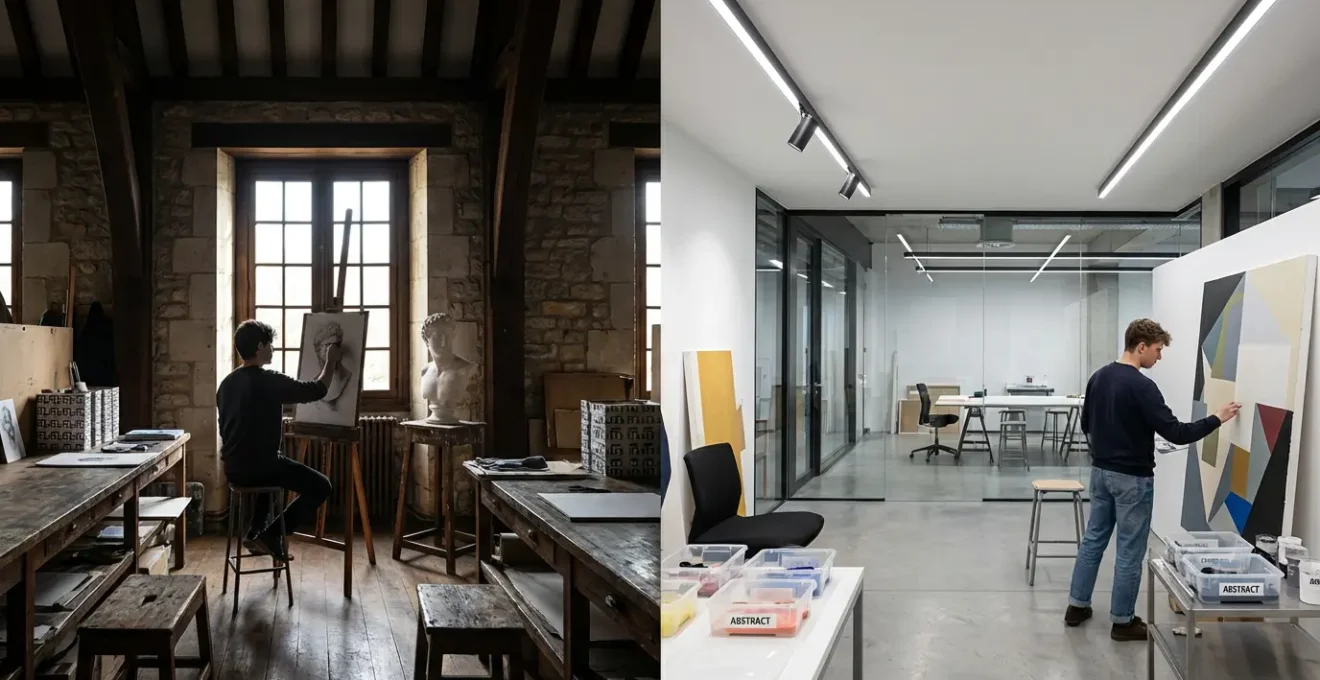
The most successful realist painters don’t choose between an atelier and a university; they strategically acquire the essential tools from both systems.
- Ateliers provide unparalleled technical fluency, teaching the ‘how’ of painting through systematic, disciplined practice.
- Universities foster the conceptual framework, teaching the ‘why’ through critical thinking, art history, and interdisciplinary exposure.
Recommendation: Instead of asking “which path to take?”, ask “how can I build my personal educational toolkit?” by combining the strengths of each model, either sequentially or concurrently.
The art world is witnessing a powerful resurgence of classical realism. Aspiring painters, hungry for foundational skills, are increasingly looking beyond the standard university Bachelor of Fine Arts (BFA) and toward the disciplined, traditional world of the classical atelier. The debate often gets simplified into a stark binary: technical skill (atelier) versus conceptual thinking (university). This conversation is more relevant than ever, as recent workshops show that approximately 30 percent of art teachers now know about atelier training, a massive jump from just a few years ago. But this framing misses the crucial point.
The most pressing question isn’t which institution is “better,” but how a student can strategically build a complete educational toolkit for a sustainable career. The idea that one must choose between being a skilled technician and a thoughtful artist is a false dichotomy. A successful career in realist painting demands both technical fluency and a robust conceptual framework. This guide reframes the debate. Instead of pitting two systems against each other, we will dissect the specific tools each one offers, showing you how to assemble a personalized education that leverages the best of both worlds to build not just a portfolio, but a lasting artistic identity.
For those who prefer a condensed, visual format, the following video offers a primer on color theory, a fundamental skill at the heart of any painter’s training, whether in an atelier or a university setting.
To help you navigate this decision, we will break down the core competencies and philosophies that define each educational path. This article examines specific, practical skills—from achieving accurate proportions to mixing lifelike skin tones—and places them within the larger context of building a unique artistic vision and a viable career. The following sections will guide you through the essential tools you’ll need to collect for your personal artistic toolkit.
Summary: Classical Atelier vs. University Degree: Which Path Creates Better Realist Painters?
- Why standing back from your easel is crucial for accurate proportions?
- How to turn a flat circle into a sphere using the “bedbug line” (terminator)?
- Technical perfection vs. Storytelling: Why skill alone doesn’t make a masterpiece?
- The photo-reference trap that makes realist paintings look dead and plastic
- How to mix 100 skin tones from a limited Zorn palette (4 colors)?
- Grisaille vs. Verdaccio: Which underpainting creates more lifelike skin tones?
- How to build a value scale from 1 to 10 using only one H pencil?
- How to Find Your Unique Artistic Vision When Everyone Has a Camera?
Why standing back from your easel is crucial for accurate proportions?
The first tool in any realist painter’s toolkit is the ability to see accurately. Ateliers ingrain this through methods like Sight-Size, which requires the artist to stand back at a specific distance where their eye can see both the subject and the artwork as the same visual size. This constant physical movement—stepping back from the easel—is not just a quaint tradition; it is a fundamental mechanism for bypassing the brain’s tendency to distort and “correct” what it sees up close. It forces an objective comparison, allowing the artist to judge shapes, angles, and proportions with startling accuracy.
Up close, you see details. From a distance, you see the whole composition and its foundational relationships. Failing to step back is the number one reason beginners struggle with proportions. Their drawing of a nose might be beautifully rendered, but it’s the wrong size or in the wrong place relative to the eyes. Standing back regularly builds a powerful visual memory and an intuitive sense of the “big picture.”
This disciplined observation is the bedrock of the atelier method. As artist Adrian Gottlieb notes, while measuring devices are necessary during training, the goal is for the method to become internalized. This is how technical fluency begins. As he explains in his discussion on atelier methods:
While professional painters pursuing a full-time career will develop an ‘eye’ that precludes the need for measuring devices and plumb lines (tools necessary during the training period), the observation method itself is not abandoned – instead it becomes second nature. Sight-size can be taught and applied in conjunction with a particular sensitivity to gesture to create life-like imagery.
– Adrian Gottlieb, Wikipedia – Atelier Training Methods
Ultimately, this practice is about training the eye to be a reliable instrument. It’s less about a rigid formula and more about developing a profound sensitivity to the visual world, a skill that serves the artist long after the formal training period ends.
How to turn a flat circle into a sphere using the “bedbug line” (terminator)?
Once you can see proportions accurately, the next tool is understanding how to represent three-dimensional form on a two-dimensional surface. This is where the physics of light comes into play. A key concept taught in ateliers is the terminator, sometimes grimly called the “bedbug line” because it’s the dark line where light can no longer reach around a curved form. It is the core of the shadow, the dividing line between light and dark, and it is the secret to making a flat circle look like a solid sphere.
Many beginners make the mistake of placing the darkest part of the shadow at the very edge of the object. This is incorrect. The edge of an object often picks up reflected light from its surroundings, making it slightly lighter than the terminator. The terminator itself is the zone that receives neither direct light nor significant reflected light. Mastering its placement and softness is non-negotiable for creating convincing volume.
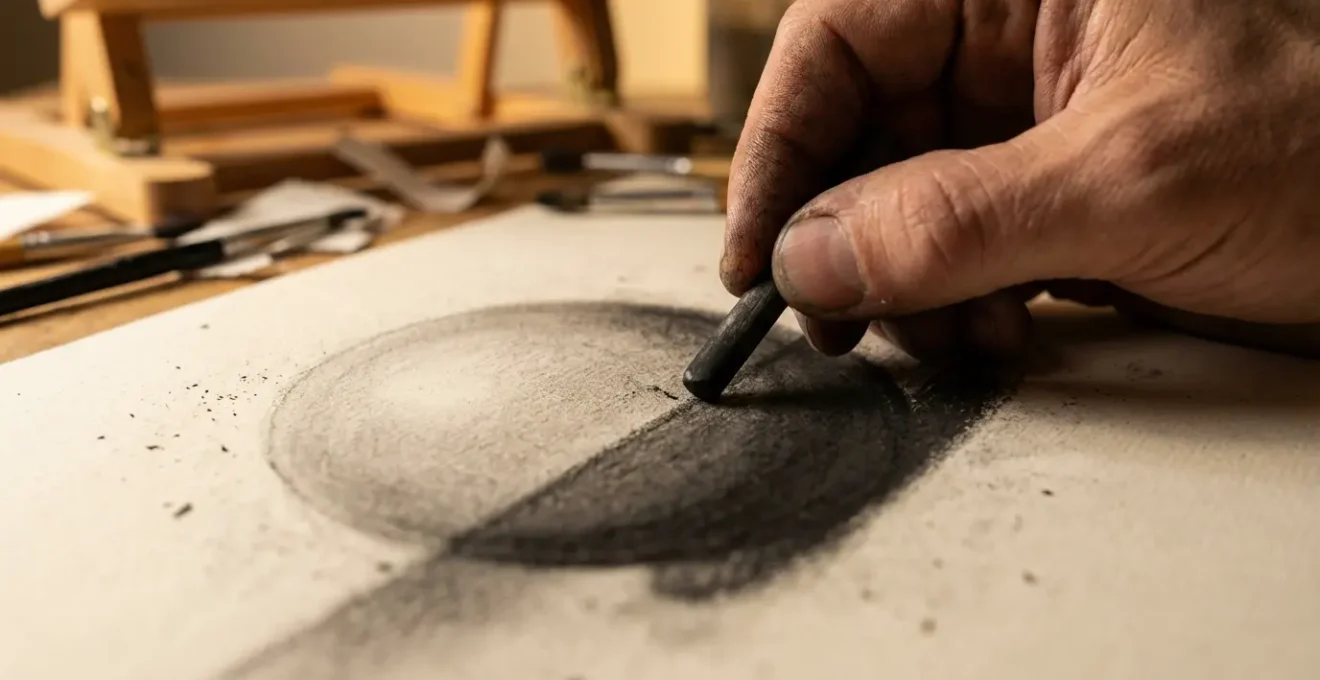
As the illustration above demonstrates, the terminator is not a harsh, single line but a transitional zone. In the atelier system, students spend hundreds of hours mastering this concept, often through a highly structured, progressive system. This systematic approach ensures that fundamental principles are not just understood, but embodied.
Your Action Plan: Adopting the Atelier’s Systematic Approach
- Master Casts First: Begin by drawing plaster casts of simple shapes, then progress to anatomical features like faces and hands. This removes the complexity of color and movement.
- Isolate the Variable: Use a single medium, like charcoal, to focus exclusively on value and form without the distraction of color mixing.
- Systematic Progression: Do not move to the next task (e.g., painting) until you have demonstrated mastery of the current one (e.g., drawing) to a high standard.
- Focus on the Process: The goal of each task is not just a finished drawing, but a deep understanding of the underlying principles of light and form.
- Seek Objective Feedback: Complete each stage to an instructor’s satisfaction or against a clear, objective standard before advancing. This builds discipline and prevents the reinforcement of bad habits.
Technical perfection vs. Storytelling: Why skill alone doesn’t make a masterpiece?
Possessing the ability to render a perfect sphere or capture a flawless likeness is an incredible achievement. This is the promise of the atelier: technical fluency. However, skill alone is a language without a story. A masterpiece resonates because it uses this language to communicate something meaningful, emotional, or profound. This is where the university’s emphasis on a conceptual framework becomes an invaluable part of the artist’s toolkit. Art history, critical theory, and peer critiques push students to ask “Why am I painting this?” not just “How do I paint this?”
Without a compelling idea or a personal vision, technical perfection can feel sterile and soulless. The danger of some atelier environments is that they can inadvertently stifle individuality by over-emphasizing the instructor’s personal style. As one artist noted in a forum discussion, the best instructors teach a method, not a style.
Ateliers are a wonderful experience. Again, some are better than others. There are many ateliers that are great at producing artists that all paint very much like the instructor. Subject matter and all, fulfilling the ego of the instructor. That is what separates the bad ones from the good.
– WetCanvas Forum Discussion, University, Art school, Atelier?
The ideal artist is a synthesizer, someone who can merge the “how” from the atelier with the “why” from a broader, more critical education. They build a personal vision on a foundation of unshakeable skill. Modern masters of the form often demonstrate this synthesis in their careers.
Case Study: Juliette Aristides – Bridging Tradition and Modernity
Juliette Aristides is a pivotal figure in the modern atelier revival movement. After receiving a traditional training, she founded her own successful atelier in Seattle. However, she didn’t stop there. Recognizing the need to make this training more accessible, she partnered with an online portal to create the Aristides Atelier Online. This move demonstrates a key insight: classical skills are not relics of the past but a powerful living tradition that can be adapted to modern platforms and reach a global audience. Aristides’ career shows how an artist can be both a master of old-world techniques and a savvy contemporary educator and entrepreneur, effectively blending deep skill with a forward-thinking vision.
The photo-reference trap that makes realist paintings look dead and plastic
In an age of infinite digital images, it’s tempting for artists to rely on a single photograph as their source material. This is “the photo-reference trap.” A camera is not a human eye. It flattens space, distorts perspective, exaggerates contrasts, and captures a single, frozen moment in time. Paintings based slavishly on a single photo often look lifeless, with a waxy, plastic quality to the skin and a lack of atmospheric depth. The camera sees information; an artist sees relationships.
The antidote to this trap is to treat references as a library, not a blueprint. This involves working from life whenever possible, a practice central to both atelier and university training. When working from photos, a skilled artist triangulates information from multiple sources: life sketches, color studies done from observation, anatomical knowledge, and even small sculptures (maquettes) to understand how form turns in space. This creates a composite image in the artist’s mind that is far richer and more believable than any single photograph could ever be.
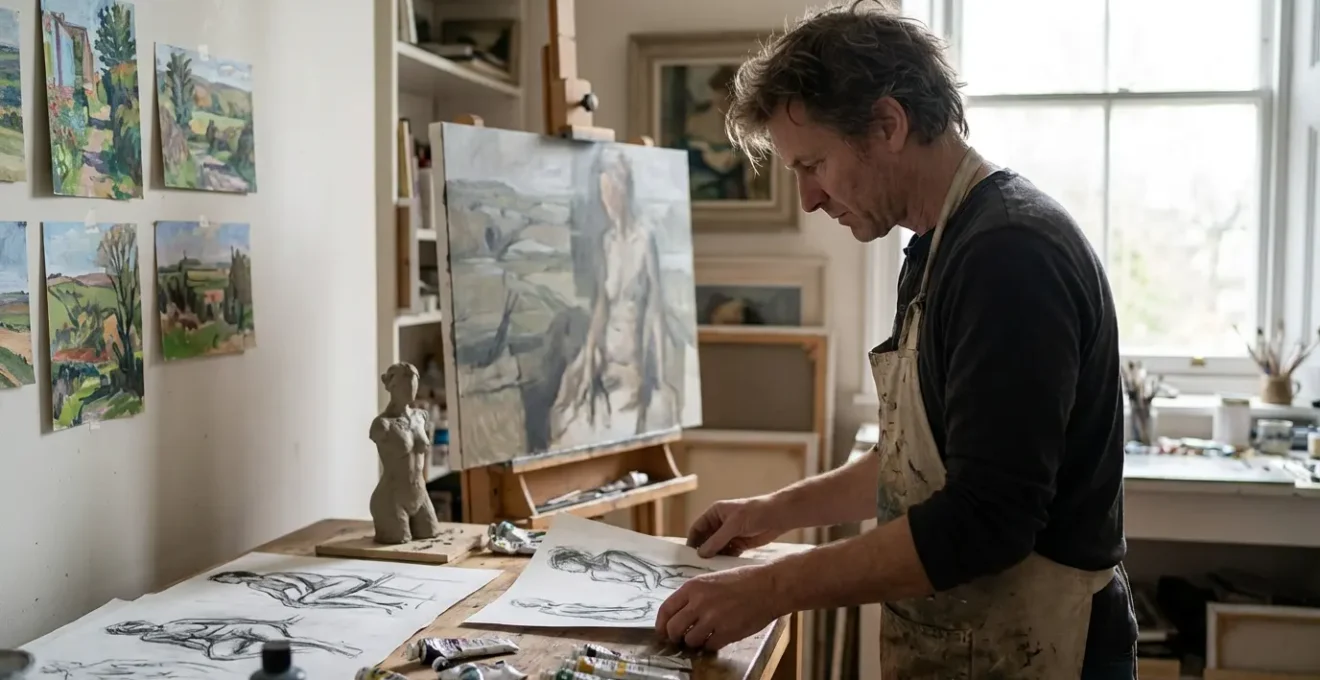
This ability to synthesize information is a critical thinking skill that a broad education, like that from a university, is designed to foster. While the “starving artist” is a persistent myth, the reality is that an arts education provides flexible, problem-solving skills applicable across many fields. In fact, data shows that a fine arts education is far from a dead end, as 93 percent of fine artists are employed, with many pursuing graduate studies and earning above-average wages. This suggests the cognitive flexibility learned in a BFA program has significant career value beyond the studio.
How to mix 100 skin tones from a limited Zorn palette (4 colors)?
A common misconception is that a wider range of paints on the palette leads to better paintings. Ateliers often teach the opposite principle: mastery through limitation. A perfect example is the Zorn palette, named after the Swedish painter Anders Zorn, which typically consists of only four colors: Ivory Black, White, Yellow Ochre, and Cadmium Red. From this incredibly restricted selection, a skilled artist can mix a breathtaking range of harmonious colors, including hundreds of subtle and convincing skin tones.
Working with a limited palette forces the artist to understand color relationships on a profound level. Instead of reaching for a pre-mixed tube of “flesh tone,” they must learn to see color as a function of value, temperature, and saturation. This builds an intuitive color sense that is far more powerful than simply owning every color available. It ensures color harmony because all mixtures are derived from the same parent colors, creating a unified and cohesive world within the painting. This approach offers a distinct professional advantage in speed and consistency.
The following table breaks down the philosophical differences between the limited palette approach common in ateliers and the more exploratory approach often found in university programs.
| Aspect | Atelier Limited Palette | University Approach |
|---|---|---|
| Number of Colors | 4-6 colors maximum | Unlimited color access |
| Learning Focus | Color mixing mastery | Color theory exploration |
| Time to Proficiency | 1-2 years intensive practice | Varies by individual exploration |
| Professional Advantage | Faster painting, consistent harmony | Broader experimental range |
| Material Cost | Minimal ongoing expense | Higher material investment |
The atelier path often starts with even greater limitation. A first-year student will rarely touch a paintbrush, instead spending a year on figure drawing with only charcoal. This forces a complete mastery of form and value before the complexity of color is even introduced. By the time painting begins in the second year, the student has a rock-solid foundation to build upon.
Grisaille vs. Verdaccio: Which underpainting creates more lifelike skin tones?
As an artist adds more advanced tools to their toolkit, they encounter historical techniques like underpainting. An underpainting is a monochromatic or limited-color initial layer of paint that establishes the value structure and form of the final piece. Two of the most famous methods are Grisaille (a grayscale underpainting, usually in neutral grays) and Verdaccio (a grayish-green underpainting). The choice between them has a dramatic impact on the final appearance of skin tones.
Verdaccio, with its greenish tint, is particularly effective for rendering lifelike flesh. When thin layers of pink and red glazes are applied over the green underpainting, the complementary colors interact optically. The green neutralizes the reds just enough to prevent them from looking too raw or saturated, creating the subtle, complex, and translucent quality of real skin. Grisaille provides a strong value foundation but can sometimes lead to cooler, more statuesque skin tones if not handled carefully.
Mastering these techniques requires historical knowledge and technical precision—hallmarks of the atelier. Yet, the decision of which to use, and why, is a conceptual one. This highlights the synergy between the two educational systems. The ultimate career path may not be a single choice but a carefully constructed hybrid. In fact, this is exactly what academic research suggests.
Research points towards a conclusion that a prospective classical artist should pursue a carefully crafted individual academic roadmap. This roadmap may include a college and university degree program, however incorporating atelier training is equally important. Conversely, a student may choose a full-time atelier program and augment their education with college and university studies.
– Utah State University Research, The Impact of University and Atelier Instruction on Classical Realism Art in America
This idea of a “crafted roadmap” is the core of building a successful career. It’s about recognizing that both traditions offer indispensable tools. Charles H. Cecil Studios, for instance, perpetuates a direct lineage of atelier training that traces back through figures like R. H. Ives Gammell all the way to the 19th-century École des Beaux-Arts and John Singer Sargent, proving the enduring power of this knowledge.
How to build a value scale from 1 to 10 using only one H pencil?
Value—the range from pure black to pure white—is more important than color for creating convincing realism. An artwork with correct values but wrong colors will still look believable, while one with perfect colors but incorrect values will look flat and confusing. Ateliers dedicate an enormous amount of time to mastering value, often through exercises like creating a full 10-step value scale using only a single, relatively hard pencil (like an H or 2H).
This exercise is not about having the right tools; it’s about developing control. By using a single hard pencil, the student cannot rely on softer, darker graphite to achieve blacks. They are forced to learn pressure control, building up dark values through patient, successive layering rather than by switching to a 6B pencil. This builds incredible muscle memory and sensitivity in the artist’s hand. It teaches them to see the world not in lines, but in shapes of value.
This focus on fundamentals is a core tenet of the atelier. It’s a belief that freedom in art comes from discipline, not from a lack of rules. This disciplined approach to education has benefits that extend far beyond the art studio. For instance, extensive data shows a strong correlation between arts education and general academic achievement, noting that students with four years of arts education have a graduation rate of 90.2%, significantly higher than the 72.9% for students without it. This suggests the problem-solving and disciplined thinking taught in the arts are highly transferable skills, a key argument for the university model’s holistic approach.
Key Takeaways
- False Dichotomy: The “skill vs. concept” debate is outdated. A modern career requires a synthesis of both atelier technique and university-level critical thinking.
- Build a Toolkit: The best approach is to view education as building a personal “toolkit,” strategically acquiring specific skills and knowledge from both systems.
- Career Viability: A hybrid education—combining technical fluency, a conceptual framework, and business acumen—is the most effective way to build a resilient and successful career as a realist painter.
How to Find Your Unique Artistic Vision When Everyone Has a Camera?
In a world saturated with images, what makes a painting relevant? With a camera in every pocket, a perfect copy of reality is no longer a novel achievement. The role of the realist painter has shifted from pure documentation to interpretation. This is the final and most important challenge: synthesizing all the technical tools from the atelier with a conceptual framework to develop a unique artistic vision. Your voice is what makes your work yours, and it’s what collectors and galleries will ultimately be drawn to.
This vision is found at the intersection of your skills, your interests, and your perspective on the world. It’s about choosing what to paint, how to compose it, and what story you want to tell. Do you use classical techniques to depict contemporary life? Do you explore personal themes through traditional genres? Answering these questions is a journey of self-discovery that neither an atelier nor a university can complete for you, but they can provide the essential tools to navigate it.
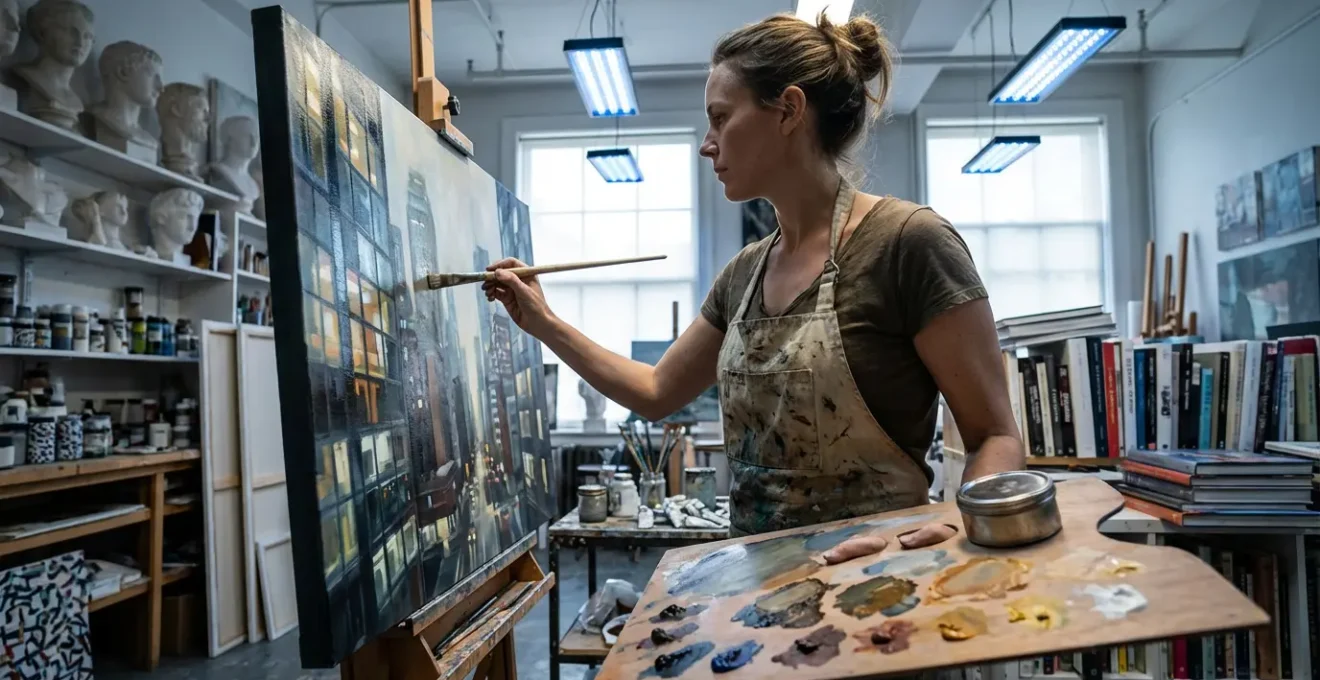
Some artists feel passionately that the atelier is the only path. Artist Kevin McEvoy argues forcefully for their superiority, stating, “art schools are as essential as tonsils. Ateliers, however, are radically different, as they are art studios that actually teach you something about the craft of drawing, painting, and sculpting.” While this highlights the deep value of craft, a successful career today also involves another crucial skill: business acumen. As artist Mandy Theis points out, part of the job is educating the public on the value of collecting original art. This entrepreneurial skill, often overlooked in both systems, is a vital component of the modern artist’s “skill stack.”
The choice is not between two mutually exclusive paths. It’s about understanding that your education is your first major artistic project. Your task is to be a discerning curator, selecting the best tools from each tradition to build a foundation strong enough to support your own unique vision for a lifetime of work. Start today by outlining your personal educational roadmap, identifying the skills you need and where you can best acquire them.